Loading...

Table of contents

    21 August 2025, Volume 34 Issue 9 Previous issue    Next issue
    TOPICAL REVIEW — Exciton physics: Fundamentals, materials and devices
    First-principles design of excitonic insulators: A review
    Hongwei Qu(曲宏伟), Haitao Liu(刘海涛), and Yuanchang Li(李元昌)
    Chin. Phys. B, 2025, 34 (9):  097101.  DOI: 10.1088/1674-1056/ade073
    Abstract ( 113 )   HTML ( 2 )   PDF (1397KB) ( 110 )  
    The excitonic insulator (EI) is a more than 60-year-old theoretical proposal that is still elusive. It is a purely quantum phenomenon involving the spontaneous generation of excitons in quantum mechanics and the spontaneous condensation of excitons in quantum statistics. At this point, the excitons represent the ground state rather than the conventional excited state. Thus, the scarcity of candidate materials is a key factor contributing to the lack of recognized EI to date. In this review, we begin with the birth of EI, presenting the current state of the field and the main challenges it faces. We then focus on recent advances in the discovery and design of EIs based on the first-principles Bethe-Salpeter scheme, in particular the dark-exciton rule guided screening of materials. It not only opens up new avenues for realizing excitonic instability in direct-gap and wide-gap semiconductors, but also leads to the discovery of novel quantum states of matter such as half-EIs and spin-triplet EIs. Finally, we will look ahead to possible research pathways leading to the first recognized EI, both theoretically and computationally.
    Unique high-energy excitons in two-dimensional transition metal dichalcogenides
    Yongsheng Gao(高永盛), Yuanzheng Li(李远征), Weizhen Liu(刘为振), Chuxin Yan(闫楚欣), Qingbin Wang(王庆彬), Wei Xin(辛巍), Haiyang Xu(徐海阳), and Yichun Liu(刘益春)
    Chin. Phys. B, 2025, 34 (9):  097102.  DOI: 10.1088/1674-1056/ade074
    Abstract ( 94 )   HTML ( 0 )   PDF (5665KB) ( 49 )  
    Two-dimensional (2D) transition metal dichalcogenides (TMDs), endowed with exceptional light-matter interaction strength, have become a pivotal platform in advanced optoelectronics, enabling atomically precise control of excitonic phenomena and offering transformative potential for engineering next-generation optoelectronic devices. In contrast to the narrowband absorption characteristics of conventional band-edge excitons, which are limited by the bandgap energy, high-energy excitons not only demonstrate broad momentum matching capability in the ultraviolet regime due to band nesting effects, but also exhibit distinct absorption peak signatures owing to robust excitonic stabilization under 2D confinement. These unique photophysical properties have established such systems as a prominent research frontier in contemporary exciton physics. This review primarily outlines the distinctive physical characteristics of high-energy excitons in TMDs from the perspectives of band structure, excitonic characteristics, and optical properties. Subsequently, we systematically delineate cutting-edge developments in TMD-based photonic devices exploiting high-energy excitonic band-nesting phenomena, with dedicated emphasis on the strategic engineering of nanoscale heterostructures for tailored optoelectronic functionality. Finally, the discussion concludes with an examination of the challenges associated with the design of high-energy exciton devices and their potential future applications.
    Exciton insulators in two-dimensional systems
    Huaiyuan Yang(杨怀远), Xi Dai(戴希), and Xin-Zheng Li(李新征)
    Chin. Phys. B, 2025, 34 (9):  097301.  DOI: 10.1088/1674-1056/ade3ae
    Abstract ( 103 )   HTML ( 0 )   PDF (1788KB) ( 59 )  
    Electron-hole interactions play a crucial role in determining the optoelectronic properties of materials, and in low-dimensional systems this is especially true due to the decrease of screening. In this review, we focus on one unique quantum phase induced by the electron-hole interaction in two-dimensional systems, known as "exciton insulators" (EIs). Although this phase of matter has been studied for more than half a century, suitable platforms for its stable realization remain scarce. We provide an overview of the strategies to realize EIs in accessible materials and structures, along with a discussion on some unique properties of EIs stemming from the band structures of these materials. Additionally, signatures in experiments to distinguish EIs are discussed.
    Regulation strategies of hot carrier cooling process in perovskite nanocrystals
    Zhenyao Tan(谭振耀), Kexin Xu(徐可欣), Yi Chen(陈逸), Can Ren(任璨), and Tingchao He(贺廷超)
    Chin. Phys. B, 2025, 34 (9):  097302.  DOI: 10.1088/1674-1056/ade24d
    Abstract ( 80 )   HTML ( 0 )   PDF (2530KB) ( 68 )  
    Recent breakthroughs in hot carrier (HC) cooling dynamics within halide perovskite nanocrystals (NCs) have positioned them as promising candidates for next-generation optoelectronic applications. Therefore, it is of great importance to systematically summarize advances in understanding and controlling HC relaxation mechanisms. Here, we offer an overview of advances in the understanding of the HC cooling process in perovskite NCs, with a focus on influences of excitation energy, excitation intensity, composition, size, dimensionality, doping, and core-shell structure on the HC cooling times. Finally, we propose suggestions for future investigations into the HC cooling process in perovskite NCs.
    SPECIAL TOPIC — Exciton physics: Fundamentals, materials and devices
    Exciton dynamics and random lasing in surface-passivated CdSe/CdSeS core/crown nanoplatelets
    Huan Liu(刘欢), Puning Wang(王谱宁), and Rui Chen(陈锐)
    Chin. Phys. B, 2025, 34 (9):  094201.  DOI: 10.1088/1674-1056/adcd46
    Abstract ( 87 )   HTML ( 2 )   PDF (3670KB) ( 34 )  
    CdSe nanoplatelets (NPLs) are promising candidates for on-chip light sources, yet their performance is hindered by surface defects and inefficient optical gain. Herein, we demonstrate that CdSeS crown passivation significantly enhances the photophysical property of CdSe NPLs. Laser spectroscopy techniques reveal suppressed electronic and hole trapping at lateral surfaces, leading to a 4.2-fold increase in photoluminescence quantum yield and a shortened emission lifetime from 13.5 to 4.8 ns. In addition, amplified spontaneous emission is achieved under nanosecond pulse pumping, with thresholds of 0.75 to 0.16 mJ/cm$^{2}$ for CdSe and CdSe/CdSeS NPLs, respectively. By integrating CdSe/CdSeS NPLs with high-refractive-index SiO$_{2}$ scatters, coherent random lasing is realized at a threshold of 0.21 mJ/cm$^{2}$. These findings highlight the critical role of lateral surface passivation in optimizing optical gain and pave the way for low-cost, multifunctional nanophotonic devices.
    Room-temperature exciton-polariton condensation in pressed perovskite microcavities
    Tianyin Zhu(朱天寅), Zelei Chen(陈泽磊), Xiaoyu Wang(王小宇), Zhongmin Huang(黄钟民), Haibin Zhao(赵海斌), and Jun Wang(王俊)
    Chin. Phys. B, 2025, 34 (9):  094202.  DOI: 10.1088/1674-1056/addce6
    Abstract ( 70 )   HTML ( 0 )   PDF (1073KB) ( 72 )  
    Microcavity exciton-polaritons, formed by strong light-matter coupling, are essential for realizing Bose-Einstein condensation and low-threshold lasing. Such polaritonic lasing and condensation have been demonstrated in III-V semiconductors at liquid helium temperatures. However, the complex fabrication of these microcavities and operating temperatures limit their room-temperature practical application. Here, we experimentally realize room-temperature exciton-polariton condensation and polaritonic lasing in a CsPbBr$_{3}$ perovskite planar microcavity fabricated by the pressing process. Angle-resolved photoluminescence spectra demonstrate the strong light-matter coupling and the formation of exciton-polaritons in such a pressed microcavity. Above the critical threshold, mass polaritons accumulating at the bottom of dispersion lead to a narrow emission linewidth and pronounced blueshift, further reinforcing the Bose-Einstein condensation and polaritonic lasing in this system. Our results offer a feasible and effective approach to investigate exciton-polariton condensation and polariton lasing at room temperature.
    Exciton and valley dynamics in WSe2/GaAs heterostructure
    Xin Wei(魏鑫), Yuanhe Li(李元和), Wenkai Zhu(朱文凯), Rongkun Han(韩荣坤), Jianhua Zhao(赵建华), Kaiyou Wang(王开友), and Xinhui Zhang(张新惠)
    Chin. Phys. B, 2025, 34 (9):  096701.  DOI: 10.1088/1674-1056/add504
    Abstract ( 94 )   HTML ( 1 )   PDF (1382KB) ( 71 )  
    Transition metal dichalcogenide (TMDC) monolayers provide an ideal platform for exciton and valley-spintronics exploration due to their unique properties. Integrating TMDC monolayers with conventional semiconductors allows for harnessing the unique properties of both materials. This strategy holds great promise for the development of advanced optoelectronics and spintronic devices. In this work, we investigated exciton and valley dynamics in WSe$_{2}$/GaAs heterostructure by employing the femtosecond pump-probe ultrafast spectroscopy. Facilitated by the charge transfer within the heterostructure, it was found that the exciton of WSe$_{2}$ exhibited much longer lifetime of nanosecond than that of the WSe$_{2}$ monolayer counterpart. Especially, a significantly long valley lifetime up to $\sim 2.7 $ ns was observed for trions of WSe$_{2}$ in the heterostructure even under the off-resonant excitation, which is found to be associated with the resident electrons accumulated at the interface resulting from the charge transfer and resultant interfacial electric field. Our results provide fundamental references for conventional semiconductor-integrated TMDC heterostructures that have great potential for designing novel optoelectronic and spintronic devices.
    Probing high-energy and band-edge exciton dynamics in monolayer WS2 using transient absorption spectroscopy under near-resonant and high-energy excitations
    Hang Ren(任航), Shuai Zhu(朱帅), Mingzhao Ouyang(欧阳名钊), Jiake Wang(王加科), Yuegang Fu(付跃刚), Chuxin Yan(闫楚欣), Qingbin Wang(王庆彬), and Yuanzheng Li(李远征)
    Chin. Phys. B, 2025, 34 (9):  097104.  DOI: 10.1088/1674-1056/adf61d
    Abstract ( 62 )   HTML ( 0 )   PDF (2996KB) ( 31 )  
    Insight into exciton dynamics of two-dimensional (2D) transition metal dichalcogenides (TMDs) is critical for the optimization of their performance in photonic and optoelectronic devices. Although current researches have primarily concentrated on the near-resonant excitation scenario in 2D TMDs, the case of excitation energies resonating with high-energy excitons or higher energies has yet to be fully elucidated. Here, a comparative analysis is conducted between high-energy excitation (360 nm) and near-resonant excitation (515 nm) utilizing transient absorption spectroscopy to achieve a comprehensive understanding of the exciton dynamics within monolayer WS$_{2}$. It is observed that the high-energy C-exciton can be generated via an up-conversion process under 515 nm excitation, even the energy of which is less than that of the C-exciton. Furthermore, the capacity to efficiently occupy band-edge A-exciton states leads to longer lifetimes for both the C-excitons and the A-excitons under conditions of near-resonant excitation, accompanied by an augmented rate of radiative recombination. This study provides a paradigm for optimizing the performance of 2D TMDs-based devices by offering valuable insights into their exciton dynamics.
    Anisotropic electronic and excitonic properties of monolayer SiP2 from the first-principles GW-BSE calculations
    Zichen Wang(王紫辰), Benshu Fan(范本澍), and Peizhe Tang(汤沛哲)
    Chin. Phys. B, 2025, 34 (9):  097801.  DOI: 10.1088/1674-1056/ade66a
    Abstract ( 80 )   HTML ( 0 )   PDF (2262KB) ( 73 )  
    We investigate electronic structures and excitonic properties of monolayer SiP$_2$ within the framework of first-principles GW plus Bethe-Salpeter equation (GW-BSE) calculations. Within the G$_0$W$_0$ approximation, monolayer SiP$_2$ is identified as a direct-gap semiconductor with an electronic gap of 3.14 eV, and the excitons exhibit a hybrid-dimensional character similar to that of the bulk counterpart. The optical absorption spectra reveal pronounced excitonic effects with strong anisotropy: the first bright exciton has a binding energy of 840 meV under x-polarized light, compared with 450 meV under y-polarized light. We further analyze the symmetry origins of the polarization-dependent optical selection rules through group theory. This binding energy difference arises from the intrinsic nature of the excitons: flat-band excitons under x-polarized light and conventional excitons localized at a single $\bm{k}$ point under y-polarized light. Our work enhances the understanding of excitonic behavior in monolayer SiP$_2$ and highlights its potential for polarization-sensitive and directionally tunable optoelectronic applications.
    Layer-dependent exciton dynamics in InSe/WS2 heterostructures
    Siyao Li(李思垚), Yufan Wang(王雨凡), Zhiqiang Ming(明志强), Yong Liu(刘勇), Lanyu Huang(黄岚雨), Siman Liu(刘思嫚), Jialong Li(李佳龙), Yulin Chen(成昱霖), Zhoujuan Xu(徐周娟), Zeyu Liu(刘泽宇), Danliang Zhang(张丹亮), and Xiao Wang(王笑)
    Chin. Phys. B, 2025, 34 (9):  097802.  DOI: 10.1088/1674-1056/adc6f7
    Abstract ( 66 )   HTML ( 1 )   PDF (2800KB) ( 32 )  
    Understanding interlayer charge transfer is crucial for elucidating interface interactions in heterostructures. As the layer number can significantly influence the interface coupling and band alignment, the charge transfer behaviors can be largely regulated. Here, we constructed two-dimensional (2D) heterostructures consisting of monolayer WS$_{2}$ and few-layer InSe to investigate the impact of InSe thickness on exciton dynamics. We performed photoluminescence (PL) spectroscopy and lifetime measurements on pristine few-layer InSe and the heterostructures with different InSe thicknesses. For pristine InSe layers, we found a non-monotonic layer dependence on PL lifetime, which can be attributed to the interplay between the indirect-to-direct bandgap transition and surface recombination effects. For heterostructures, we demonstrated that the type I band alignment of the heterostructure facilitates electron and hole transfer from monolayer WS$_2$ to InSe. As the InSe layer number increases, the reduction in conduction band minimum (CBM) enhances the driving force for charge transfer, thereby improving the transfer efficiency. Furthermore, we fabricated and characterized a WS$_{2}$/InSe optoelectronic device. By analyzing bias voltage dependent PL spectra, we further demonstrated that the trions in WS$_{2}$ within the heterostructure are positively charged ($X^+$), and their emission intensity can be efficiently modulated by applying different biases. This study not only reveals the layer-dependent characteristics of band alignment and interlayer charge transfer in heterostructures but also provides valuable insights for the applications of 2D semiconductors in optoelectronic devices.
    Electrically tuning exciton polaritons in a liquid crystal microcavity based on WS2 monolayer
    Chenxi Yang(杨晨曦), Lanyu Huang(黄岚雨), Yujie Li(李宇杰), Xiaokun Zhai(翟晓坤), Qiang Ai(艾强), Chunzi Xing(邢淳梓), Xinmiao Yang(杨新苗), Yazhou Gu(谷亚舟), Peigang Li(李培刚), Zhitong Li(李志曈), Haitao Dai(戴海涛), Liefeng Feng(冯列峰), Linsheng Liu(刘林生), Xiao Wang(王笑), and Tingge Gao(高廷阁)
    Chin. Phys. B, 2025, 34 (9):  097803.  DOI: 10.1088/1674-1056/ade668
    Abstract ( 70 )   HTML ( 0 )   PDF (3474KB) ( 75 )  
    Two-dimensional (2D) transition-metal dichalcogenide (TMD) monolayers based on become a promising platform to study photonics and optoelectronics. Electrically controlling the excitonic properties of TMD monolayers can be realized in different devices. In this work, we realize the strong coupling between the excitons of WS$_2$ monolayers and a photonic cavity mode in a liquid crystal microcavity. The formed exciton polaritons can be electrically tuned by applying voltage to the microcavity. Our work offers a way to study exciton-polariton manipulation based on TMD monolayers by electrical methods at room temperature.
    TOPICAL REVIEW — Heat conduction and its related interdisciplinary areas
    Phase change thermal interface materials: From principles to applications and beyond
    Chenggong Zhao(赵成功), Yifan Li(李一凡), Chen Jiang(蒋晨), Yuanzheng Tang(唐元政), Yan He(何燕), Wei Yu(于伟), and Bingyang Cao(曹炳阳)
    Chin. Phys. B, 2025, 34 (9):  096301.  DOI: 10.1088/1674-1056/ade59f
    Abstract ( 93 )   HTML ( 0 )   PDF (4838KB) ( 203 )  
    Phase change thermal interface materials (PC-TIMs) have emerged as a promising solution to address the increasing thermal management challenges in electronic devices. This is attributed to their dual mechanisms of latent heat absorption and phase change-induced interfacial wettability. This review explores the fundamental principles, material innovations, and diverse applications of PC-TIMs. The heat transfer enhancement mechanisms are first underlined with key factors such as thermal carrier mismatch at the microscale and contact geometry at the macroscale, emphasizing the importance of material selection and design for optimizing thermal performance. Section 2 focuses on corresponding experimental approaches provided, including intrinsic thermal conductivity improvements and interfacial heat transfer optimization. Section 3 discusses common methods such as physical adsorption via porous materials, chain-crosslinked network designs, and core-shell structures, and their effects on leakage prevention, heat transfer enhancement, and application flexibility. Furthermore, the extended applications of PC-TIMs in thermal energy storage are explored in Section 4, suggesting their potential in diverse technological fields. The current challenges in interfacial heat transfer research and the prospect of PC-TIMs are also discussed. The data-driven machine learning technologies will play an increasingly important role in addressing material development and performance prediction.
    SPECIAL TOPIC — Heat conduction and its related interdisciplinary areas
    Normal energy and stretch diffusion in a one-dimensional momentum conserving lattice with nonlinear bounded kinetic energy
    Hongbin Chen(陈宏斌), Qin-Yi Zhang(张钦奕), Jiahui Wang(王佳惠), Nianbei Li(李念北), and Jie Chen(陈杰)
    Chin. Phys. B, 2025, 34 (9):  094401.  DOI: 10.1088/1674-1056/addce5
    Abstract ( 69 )   HTML ( 0 )   PDF (647KB) ( 59 )  
    One-dimensional (1D) nonlinear lattices that conserve momentum exhibit anomalous heat conduction, except for the specific case of the 1D coupled rotator lattice. Unlike classical interacting 1D nonlinear lattices such as the Fermi-Pasta-Ulam $\beta$ (FPU-$\beta$) lattice, the 1D coupled rotator lattice has a bounded interaction potential energy. Recently, the 1D coupled rotator lattice with additional bounded kinetic energy has also been found to exhibit normal heat conduction. Here, we study energy diffusion in the 1D momentum-conserving lattice with bounded kinetic energy only. We find that this lattice exhibits normal energy diffusion as well as normal stretch diffusion. This work indicates that bounded energy, whether kinetic or potential, is crucial for normal energy diffusion and heat conduction in 1D momentum-conserving nonlinear lattices.
    Giant thermal rectification beyond structural asymmetry via current-induced nonreciprocity effects
    Jiayao Zhang(张佳瑶), Yu Hao(郝雨), Bowen Xiong(熊博文), Shanhe Su(苏山河), and Zhimin Yang(杨智敏)
    Chin. Phys. B, 2025, 34 (9):  094402.  DOI: 10.1088/1674-1056/add906
    Abstract ( 58 )   HTML ( 0 )   PDF (625KB) ( 20 )  
    Pursuing significant thermal rectification effect with minimal temperature differences is critical for thermal rectifiers. While asymmetric structures enable spectral matching, they inherently limit thermal rectification performance. To address this issue, we developed a thermal rectification structure comprising a current-biased graphene-coated silicon carbide (SiC) substrate paired with another graphene-coated SiC substrate separated by a nanoscale vacuum gap. A current-biased graphene sheet generates nonreciprocal effect that actively modulates radiative energy transfer. Our theoretical framework demonstrates that the current-biased graphene achieves a high thermal diode efficiency even under a modest temperature difference. Remarkably, the thermal diode efficiency exceeds 0.8 at a temperature difference of just 100 K (between 300 K and 400 K). These findings highlight the synergistic enhancement from graphene coatings and current biasing, providing a viable strategy for nanoscale thermal management applications.
    Dual-band switchable mid-infrared emitter based on In3SbTe2 for gas detection application
    Biyuan Wu(吴必园), Xiqiao Huang(黄希桥), and Xiaohu Wu(吴小虎)
    Chin. Phys. B, 2025, 34 (9):  094403.  DOI: 10.1088/1674-1056/ade59e
    Abstract ( 71 )   HTML ( 0 )   PDF (660KB) ( 38 )  
    As a highly energy-efficient and sensitive radiation source, narrowband thermal emitters provide an ideal solution for non-contact gas detection, enabling the widespread application of mid-infrared "molecular fingerprint" technology. However, most narrowband thermal emitters lack reconfigurability, limiting their adaptability in practical applications. In this study, we propose a novel dual-band switchable narrowband thermal emitter in the mid-infrared region. The emitter consists of an aperiodic Ge/SiO$_{2}$/Ge/SiO$_{2}$ (GSGS) structure and a phase change material In$_{3}$SbTe$_{2}$ (IST). When IST is in the crystalline state, the emitter achieves narrowband emission peaks at wavelengths of 3.79 μm and 6.12 μm, corresponding to the "on" state. However, when IST transitions to the amorphous state, the dual-band high emission disappears and it features angle- and polarization-independent behavior, representing the "off" state. Furthermore, we verify the physical mechanism behind the high emission through phase and amplitude calculations as well as electric field distribution analysis. Notably, the introduction of the IST provides an additional degree of freedom for tunability. Furthermore, by adjusting the thickness of the spacer layer, the emitter can be precisely tuned to match the characteristic absorption peaks of various mid-infrared gases, such as CH$_{4}$, CO$_{2}$, CO, and NO, enabling multi-gas detection in mixed gas environments. The proposed thermal emitter serves as an effective and low-cost alternative for dual-band narrowband mid-infrared light sources, contributing to the advancement of multi-gas detection strategies.
    Cattaneo-Christov heat transfer model for tangent hyperbolic fluid with Thompson-Torian slip and melting effects
    Anwar Saeed and Afrah Al-Bossly
    Chin. Phys. B, 2025, 34 (9):  094404.  DOI: 10.1088/1674-1056/add90a
    Abstract ( 64 )   HTML ( 0 )   PDF (934KB) ( 28 )  
    This work investigates thermal enhancement in fluid flow over a nonlinear stretching sheet. The thickness of the sheet is variable and the flow of the fluid is affected by solar radiation energy with Thompson and Troian slip effects. The flow is magnetized by applying a magnetic field in the normal direction to the flow system. Moreover, thermal transport is controlled by incorporating the Cattaneo-Christov heat fluid model into the flow problem. The governing equations, initially framed in their dimensional form, are meticulously transformed into a dimensionless framework to simplify the analysis. These dimensionless equations are then solved using the homotopy analysis method (HAM). It is observed in this study that upsurges in the stagnation parameter, critical shear rate and velocity slip factor augment the velocity distribution while reducing the thermal profiles. The velocity distribution deteriorates while the thermal profiles are amplified with expansions in the magnetic factor and power law index. The thermal distribution also increases with rising Prandtl number and radiation factor. Augmentation of the power-law index, velocity slip parameter, critical shear rate, magnetic factor and stagnation parameter leads to an increased Nusselt number. The modeled problem is validated by comparing the current results with established work for different values of nonlinear stretching factor $n$ in terms of the drag force and thermal flow rate at $\eta =0$, and a good agreement is observed between the current and established results.
    Thermal transport properties of 2D narrow bandgap semiconductor Ca3N2, Ba3P2, and Ba3As2: Machine learning potential study
    Wenlong Li(李文龙), Yu Liu(刘余), Zhendong Li(李振东), Pei Zhang(张培), Xinghua Li(李兴华), and Tao Ouyang(欧阳滔)
    Chin. Phys. B, 2025, 34 (9):  096302.  DOI: 10.1088/1674-1056/ade5a0
    Abstract ( 69 )   HTML ( 0 )   PDF (3286KB) ( 43 )  
    By combining neuroevolution potential (NEP) with phonon Boltzmann transport theory, we systematically investigate the thermal transport properties of three two-dimensional (2D) narrow bandgap semiconductors: Ca$_3$N$_2$, Ba$_3$P$_2$, and Ba$_3$As$_2$. The room-temperature lattice thermal conductivities ($\kappa_{\rm L}$) of Ca$_3$N$_2$, Ba$_3$P$_2$, and Ba$_3$As$_2$ considering only three-phonon scattering are 6.60 W/mK, 11.90 W/mK, and 8.88 W/mK, respectively. When taking into account the higher-order phonon (four-phonon) scattering processes, the $\kappa_{\rm L}$ of these three materials decrease to 6.12 W/mK, 9.73 W/mK and 6.77 W/mK, respectively. Among these systems, Ba$_3$As$_2$ undergoes the most pronounced suppression with a reduction of 23.8%. This is mainly due to the greater scattering phase space which enhances the four-phonon scattering. Meanwhile, it is revealed that unlike the traditional evaluation using the $P_{4}/P_{3}$ ratio as an indicator of the strength of four-phonon interactions, the thermal conductivity of Ba$_3$P$_2$ exhibits weaker four-phonon suppression behavior compared to Ba$_3$As$_2$, despite hosting a higher $P_{4}/P_{3}$ ratio. That is to say, the strength of four-phonon scattering cannot be evaluated solely by the ratio of $P_{4}/P_{3}$. These results presented in this work shed light on the thermal transport properties of such new 2D semiconductors with narrow bandgaps.
    Tunable thermal conductivity and mechanical properties of metastable silicon by phase engineering
    Guoshuai Du(杜国帅), Yubing Du(杜玉冰), Jiaxin Ming(明嘉欣), Zhixi Zhu(朱芷希), Jiaohui Yan(闫皎辉), Jiayin Li(李嘉荫), Tiansong Zhang(张天颂), Lina Yang(杨哩娜), Ke Jin(靳柯), and Yabin Chen(陈亚彬)
    Chin. Phys. B, 2025, 34 (9):  096401.  DOI: 10.1088/1674-1056/adcf8a
    Abstract ( 74 )   HTML ( 0 )   PDF (855KB) ( 24 )  
    The extensive applications of cubic silicon in flexible transistors and infrared detectors are greatly hindered by its intrinsic properties. Metastable silicon phases, such as Si-III, IV, and XII, prepared using extreme pressure methods, provide a unique "genetic bank" with diverse structures and exotic characteristics. However, exploration of their inherent physical properties remains underdeveloped. Herein, we demonstrate the phase engineering strategy to modulate the thermal conductivity and mechanical properties of metastable silicon. The thermal conductivity, obtained via the Raman optothermal approach, exhibits broad tunability across various Si-I, III, XII, and IV phases. The hardness and Young's modulus of Si-IV are significantly greater than those of the Si-III/XII mixture, as confirmed by the nanoindentation technique. Moreover, it was found that pressure-induced structural defects can substantially degrade the thermal and mechanical properties of silicon. This systematic investigation offers a feasible route for designing novel semiconductors and further advancing their desirable applications in advanced nanodevices and mechanical transducers.
    Charge doping induced thermal switches with a high switching ratio in monolayer MoS2
    Chen Gui(桂琛), Zhi-Fu Duan(段志福), Chang-Hao Ding(丁长浩), Hao Chen(陈浩), Yuan Yao(姚远), Nan-Nan Luo(罗南南), Jiang Zeng(曾犟), Li-Ming Tang(唐黎明), and Ke-Qiu Chen(陈克求)
    Chin. Phys. B, 2025, 34 (9):  097401.  DOI: 10.1088/1674-1056/add907
    Abstract ( 49 )   HTML ( 0 )   PDF (3522KB) ( 28 )  
    The thermal switch plays a crucial role in regulating system temperature, protecting devices from overheating, and improving energy efficiency. Achieving a high thermal switching ratio is essential for its practical application. In this study, by utilizing first-principles calculations and semi-classical Boltzmann transport theory, it is found that hole doping with an experimentally achievable concentration of $1.83 \times 10^{14}$ cm$^{-2}$ can reduce the lattice thermal conductivity of monolayer MoS$_2$ from 151.79 W$\cdot$m$^{-1}\cdot$K$^{-1}$ to 12.19 W$\cdot$m$^{-1}\cdot$K$^{-1}$, achieving a high thermal switching ratio of 12.5. The achieved switching ratio significantly surpasses previously reported values, including those achieved by extreme strain methods. This phenomenon mainly arises from the enhanced lattice anharmonicity, which is primarily contributed by the S atoms. These results indicate that hole doping is an effective method for tuning the lattice thermal conductivity of materials, and demonstrate that monolayer MoS$_2$ is a potential candidate material for thermal switches.
    SPECIAL TOPIC — Quantum communication and quantum network
    Multicast-oriented key provision in hybrid DV/CV multi-domain quantum networks
    Xinyu Chen(陈欣宇), Yuan Cao(曹原), Yuxiang Lu(陆宇翔), Yue Chen(陈越), Kunpeng Zheng(郑昆朋), Xiaosong Yu(郁小松), Yongli Zhao(赵永利), Jie Zhang(张杰), and Qin Wang(王琴)
    Chin. Phys. B, 2025, 34 (9):  090301.  DOI: 10.1088/1674-1056/adecf8
    Abstract ( 73 )   HTML ( 0 )   PDF (2866KB) ( 45 )  
    As the cornerstone of future information security, quantum key distribution (QKD) is evolving towards large-scale hybrid discrete-variable/continuous-variable (DV/CV) multi-domain quantum networks. Meanwhile, multicast-oriented multi-party key negotiation is attracting increasing attention in quantum networks. However, the efficient key provision for multicast services over hybrid DV/CV multi-domain quantum networks remains challenging, due to the limited probability of service success and the inefficient utilization of key resources. Targeting these challenges, this study proposes two key-resource-aware multicast-oriented key provision strategies, namely the link distance-resource balanced key provision strategy and the maximum shared link key provision strategy. The proposed strategies are applicable to hybrid DV/CV multi-domain quantum networks, which are typically implemented by GG02-based intra-domain connections and BB84-based inter-domain connections. Furthermore, the multicast-oriented key provision model is formulated, based on which two heuristic algorithms are designed, i.e., the shared link distance-resource (SLDR) dependent and the maximum shared link distance-resource (MSLDR) dependent multicast-oriented key provision algorithms. Simulation results verify the applicability of the designed algorithms across different multi-domain quantum networks, and demonstrate their superiority over the benchmark algorithms in terms of the success probability of multicast service requests, the number of shared links, and the key resource utilization.
    Effect of quantum measurement errors on witnessing network topology
    Shu-Yuan Yang(杨舒媛), Kan He(贺衎), and Ming-Xing Luo(罗明星)
    Chin. Phys. B, 2025, 34 (9):  090302.  DOI: 10.1088/1674-1056/ade3af
    Abstract ( 80 )   HTML ( 0 )   PDF (937KB) ( 35 )  
    The fragility and stochastic behavior of quantum sources make it crucial to witness the topology of quantum networks. Most previous theoretical methods are based on perfect assumptions of quantum measurements. In this work, we propose a method to witness network topology under imperfect assumptions of quantum measurements. We show that the discrimination between star and triangle networks depends on the specific error tolerances of local measurements. This extends recent results for witnessing the triangle network [Phys. Rev. Lett. 132 240801 (2024)].
    Protection path and security-metric-based resource allocation algorithm in quantum key distribution optical networks
    Li Liu(刘力), Shengtong Zhai(翟晟童), Yao Pu(蒲瑶), and Xu Zhang(张旭)
    Chin. Phys. B, 2025, 34 (9):  090306.  DOI: 10.1088/1674-1056/adefd6
    Abstract ( 65 )   HTML ( 0 )   PDF (637KB) ( 28 )  
    Quantum key distribution (QKD) optical networks can provide more secure communications. However, with the increase of the QKD path requests and key updates, network blocking problems will become severe. The blocking problems in the network can become more severe because each fiber link has limited resources (such as wavelengths and time slots). In addition, QKD optical networks are also affected by external disturbances such as data interception and eavesdropping, resulting in inefficient network communication. In this paper, we exploit the idea of protection path to enhance the anti-interference ability of QKD optical network. By introducing the concept of security metric, we propose a routing wavelength and time slot allocation algorithm (RWTA) based on protection path, which can lessen the blocking problem of QKD optical network. According to simulation analysis, the security-metric-based RWTA algorithm (SM-RWTA) proposed in this paper can substantially improve the success rate of security key (SK) update and significantly reduce the blocking rate of the network. It can also improve the utilization rate of resources such as wavelengths and time slots. Compared with the non-security-metric-based RWTA algorithm (NSM-RWTA), our algorithm is robust and can enhance the anti-interference ability and security of QKD optical networks.
    Mode-pairing quantum key distribution with multi-step advantage distillation
    Shizhuo Li(李世卓), Xin Liu(刘馨), Zhenrong Zhang(张振荣), and Kejin Wei(韦克金)
    Chin. Phys. B, 2025, 34 (9):  090307.  DOI: 10.1088/1674-1056/adf4a9
    Abstract ( 59 )   HTML ( 0 )   PDF (1250KB) ( 34 )  
    The advantage distillation (AD) technology has been proven to effectively improve the secret key rate and the communication distance of quantum key distribution (QKD). The mode-pairing quantum key distribution (MP-QKD) protocol can overcome a fundamental physical limit, known as the Pirandola-Laurenza-Ottaviani-Banchi bound, without requiring global phase-locking. In this work, we propose a method based on multi-step AD to further enhance the performance of MP-QKD. The simulation results show that, compared to one-step AD, multi-step AD achieves better performance in long-distance scenarios and can tolerate a higher quantum bit error rate. Specifically, when the difference between the communication distances from Alice and Bob to Charlie is 25 km, 50 km and 75 km, and the corresponding transmission distance exceeds 523 km, 512 km and 496 km, respectively, the secret key rate achieved by multi-step AD surpasses that of one-step AD. Our findings indicate that the proposed method can effectively promote the application of MP-QKD in scenarios with high loss and high error rate.
    SPECIAL TOPIC — Ultrafast physics in atomic, molecular and optical systems
    Lasing and fluorescence of air plasma in presence of an external electric field
    Kai-Lu Wang(王凯璐), Hai-Cheng Mei(梅海城), Liang Xu(许亮), and Yi Liu(刘一)
    Chin. Phys. B, 2025, 34 (9):  093101.  DOI: 10.1088/1674-1056/ade065
    Abstract ( 86 )   HTML ( 0 )   PDF (759KB) ( 33 )  
    Cavity-free lasing of nitrogen molecules pumped by intense femtosecond laser pulses holds the potential for remote sensing of electric fields. Here we compared the influence of an external direct current (DC) electric field on both the directional lasing radiation and omnidirectional fluorescence emission of neutral nitrogen molecules. It was found that the forward lasing radiation in both pure nitrogen gas and ambient air shows a sensitive dependence on the direction and strength of the DC field, while the fluorescence is not influenced. The effect of pump laser polarization was also investigated. The distinct behavior of the lasing and fluorescence in response to the DC field was attributed to their different dependences on the population distribution of excited nitrogen molecules. This study consolidates the method for standoff detection of electric field with an air lasing effect in the atmosphere.
    Semiclassical Coulomb-scattering model for strong-field tunneling ionization
    Qing Zhao(赵晴), Yigen Peng(彭易根), Jiayin Che(车佳殷), Chao Chen(陈超), Shang Wang(王赏), Guoguo Xin(辛国国), and Yanjun Chen(陈彦军)
    Chin. Phys. B, 2025, 34 (9):  093201.  DOI: 10.1088/1674-1056/ade06e
    Abstract ( 107 )   HTML ( 0 )   PDF (1156KB) ( 67 )  
    This study analytically examines the ionization of atoms in strong near-circular laser fields. The classic Keldysh-Rutherford (KR) Coulomb-scattering (CS) model [Phys. Rev. Lett. 121 123201 (2018)] successfully explained the attoclock experimental curve for the H atom at lower laser intensities. Here, we develop a semiclassical model that includes the initial conditions related to the quantum properties of tunneling in the KR model at the beginning of the scattering process. This model is able to explain recent attoclock experimental curves over a wider range of laser and atomic parameters. Our results show the importance of system symmetry and quantum effects in attoclock measurements, suggesting the complex role of the Coulomb potential in strong-field ionization.
    Machine learning approach to reconstruct dephasing time from solid HHG spectra
    Jiahao Liu(刘佳豪), Xi Zhao(赵曦), Jun Wang(王俊), and Songbin Zhang(张松斌)
    Chin. Phys. B, 2025, 34 (9):  097804.  DOI: 10.1088/1674-1056/ade064
    Abstract ( 81 )   HTML ( 0 )   PDF (999KB) ( 38 )  
    The dephasing time $ T_2 $ is a fundamental parameter that characterizes the coherence of electronic states and electron-phonon interactions in condensed matter physics. Accurate measurement of $ T_2 $ is essential for elucidating ultrafast electronic and phononic processes, which are crucial for the development of advanced electronic, optoelectronic, and quantum devices. However, due to the complexity of solid-state systems with their intricate band structures and strong many-body interactions, reconstructing $ T_2 $ remains a long-term challenge for both condensed matter physics and optical science. In this work, we introduce a machine learning (ML) approach to retrieve $ T_2 $ from the high-order harmonic generation (HHG) spectrum resulting from the interaction between a strong infrared (IR) laser pulse and solid-state material. The consistency between the experimental and reconstructed HHG spectra validates the efficiency of our scheme. Our ML method offers two key advantages: first, it does not require stringent experimental conditions, and second, the optimization process is fully automated and more reliable than empirical selection of dephasing time values. The ability of our method to reconstruct dephasing time from solid HHG spectra provides a powerful tool for probing the intrinsic properties of materials under extreme conditions. Besides, our method provides another significant advantage, which offers a direct approach to calculating the quantum tunneling time of carriers between different energy bands under light-induced excitation.
    Interaction enhanced inter-site hoppings for holons and interlayer exciton insulators in moiré correlated insulators
    Zijian Ma(马子健) and Hongyi Yu(俞弘毅)
    Chin. Phys. B, 2025, 34 (9):  097303.  DOI: 10.1088/1674-1056/adcb9b
    Abstract ( 70 )   HTML ( 0 )   PDF (4491KB) ( 28 )  
    In moiré-patterned van der Waals structures of transition metal dichalcogenides, correlated insulators can form under integer and fractional fillings, whose transport properties are governed by various quasiparticle excitations including holons, doublons and interlayer exciton insulators. Here we theoretically investigate the nearest-neighbor inter-site hoppings of holons and interlayer exciton insulators. Our analysis indicates that these hopping strengths are significantly enhanced compared to that of a single carrier. The underlying mechanism can be attributed to the strong Coulomb interaction between carriers at different sites. For the interlayer exciton insulator consisting of a holon and a carrier in different layers, we have also obtained its effective Bohr radius and energy splitting between the ground and the first-excited states.
    SPECIAL TOPIC — Moiré physics in two-dimensional materials
    Semiregular tessellation of electronic lattices in untwisted bilayer graphene under anisotropic strain gradients
    Zeyu Liu(刘泽宇), Xianghua Kong(孔祥华), Zhidan Li(李志聃), Zewen Wu(吴泽文), Linwei Zhou(周霖蔚), Cong Wang(王聪), and Wei Ji(季威)
    Chin. Phys. B, 2025, 34 (9):  097309.  DOI: 10.1088/1674-1056/adfb54
    Abstract ( 63 )   HTML ( 0 )   PDF (5031KB) ( 40 )  
    Two-dimensional (2D) moiré superlattices have emerged as a versatile platform for uncovering exotic quantum phases, many of which arise in bilayer systems exhibiting Archimedean tessellation patterns such as triangular, hexagonal, and kagome lattices. Here, we propose a strategy to engineer semiregular tessellation patterns in untwisted bilayer graphene by applying anisotropic epitaxial tensile strain (AETS) along crystallographic directions. Through force-field and first-principles calculations, we demonstrate that AETS can induce a rich variety of semiregular tessellation geometries, including truncated hextille, prismatic pentagon, and brick-phase arrangements. Characteristic electronic Dirac and flat bands of the lattice models associated with these semiregular tessellations are observed near the Fermi level, arising from interlayer interactions generated by the spatial rearrangement of AB, BA, and SP domains. Furthermore, the real-space observations of electronic kagome, distorted Lieb, brick-like, and one-dimensional stripe lattices demonstrate that AETS enables tunable semiregular tessellation lattices. Our study identifies AETS as a promising new degree of freedom in moiré engineering, offering a reproducible and scalable platform for exploring exotic electronic lattices in moiré systems.
    SPECIAL TOPIC — Structures and properties of materials under high pressure
    Anionic electron dimensionality and monolayer ferromagnetism in Y-Co electrides
    Lu Zheng(郑璐), Zimeng Lv(吕梓萌), Xiaochen Huang(黄小琛), Zhuangfei Zhang(张壮飞), Chao Fang(房超), Yuewen Zhang(张跃文), Qianqian Wang(王倩倩), Liangchao Chen(陈良超), Xiaopeng Jia(贾晓鹏), Biao Wan(万彪), and Huiyang Gou(缑慧阳)
    Chin. Phys. B, 2025, 34 (9):  097105.  DOI: 10.1088/1674-1056/adf82f
    Abstract ( 48 )   HTML ( 0 )   PDF (1870KB) ( 45 )  
    Electrides, characterized by spatially confined anionic electrons, have emerged as a promising class of materials for catalysis, magnetism, and superconductivity. However, transition-metal-based electrides with diverse electron dimensionalities remain largely unexplored. Here, we perform a comprehensive first-principles investigation of Y-Co electrides, focusing on Y$_{3}$Co, Y$_{3}$Co$_{2}$, and YCo. Our calculations reveal a striking dimensional evolution of anionic electrons: from two-dimensional (2D) confinement in YCo to one-dimensional (1D) in Y$_{3}$Co$_{2}$ and zero-dimensional (0D) in Y$_{3}$Co. Remarkably, the YCo monolayer exhibits intrinsic ferromagnetism, with a magnetic moment of 0.65 $\mu_{\rm B}$ per formula unit arising from spin-polarized anionic electrons mediating long-range coupling between Y and Co ions. The monolayer also shows a low exfoliation energy (1.66 J/m$^{2}$), indicating experimental feasibility. All three electrides exhibit low work functions (2.76 eV-3.11 eV) along with Co-centered anionic states. This work expands the family of transition-metal-based electrides and highlights dimensionality engineering as a powerful strategy for tuning electronic and magnetic properties.
    INVITED REVIEW
    Pressure in active matter
    Guo Yu(余果), Ruiyao Li(李蕤耀), Fukang Li(李富康), Jiayu Zhang(张佳玉), Xiyue Li(李西月), Zequ Chen(陈泽渠), Joscha Mecke, and Yongxiang Gao(高永祥)
    Chin. Phys. B, 2025, 34 (9):  094702.  DOI: 10.1088/1674-1056/ae030c
    Abstract ( 106 )   HTML ( 0 )   PDF (3625KB) ( 83 )  
    In the last decade, the study of pressure in active matter has attracted growing attention due to its fundamental relevance to nonequilibrium statistical physics. Active matter systems are composed of particles that consume energy to sustain persistent motion, which are inherently far from equilibrium. These particles can exhibit complex behaviors, including motility-induced phase separation, clustering, and anomalous stress distributions, motivating the introduction of active swim stress and swim pressure. Unlike in passive fluids, pressure in active systems emerges from momentum flux originating from swim force rather than equilibrium conservative interactions, offering a distinct perspective for understanding their mechanical response. Simple models of active Brownian particles (ABPs) have been employed in theoretical and simulation studies across both dilute and dense regimes, revealing that pressure is a state function and exhibits a nontrivial dependence on density. Together with nonequilibrium statistical concepts such as effective temperature and effective adhesion, pressure offers important insight for understanding behaviors in active matter such as sedimentation equilibrium and motility induced phase separation. Extensions of ABP models beyond their simplest form have underscored the fragility of the pressure-based equation of state, which can break down under factors such as density-dependent velocity, torque, complex boundary geometries and interactions. Building on these developments, this review provides a comprehensive survey of theoretical and experimental advances, with particular emphasis on the microscopic origins of active pressure and the mechanisms underlying the breakdown of the equation of state.
    INSTRUMENTATION AND MEASUREMENT
    A low-noise and high-stability DC source for superconducting quantum circuits
    Daxiong Sun(孙大雄), Jiawei Zhang(张家蔚), Peisheng Huang(黄培生), Yubin Zhang(张玉斌), Zechen Guo(郭泽臣), Tingjin Chen(陈庭槿), Rui Wang(王睿), Xuandong Sun(孙炫东), Jiajian Zhang(张家健), Wenhui Huang(黄文辉), Jiawei Qiu(邱嘉威), Ji Chu(储继), Ziyu Tao(陶子予), Weijie Guo(郭伟杰), Xiayu Linpeng(林彭夏雨), Ji Jiang(蒋骥), Jingjing Niu(牛晶晶), Youpeng Zhong(钟有鹏), and Dapeng Yu(俞大鹏)
    Chin. Phys. B, 2025, 34 (9):  090303.  DOI: 10.1088/1674-1056/ade1c5
    Abstract ( 121 )   HTML ( 0 )   PDF (2041KB) ( 77 )  
    With the rapid scaling of superconducting quantum processors, electronic control systems relying on commercial off-the-shelf instruments face critical bottlenecks in signal density, power consumption, and crosstalk mitigation. Here we present a custom dual-channel direct current (DC) source module (QPower) dedicated to large-scale superconducting quantum processors. The module delivers a voltage range of $\pm7$ V with 200 mA maximum current per channel, while achieving the following key performance benchmarks: noise spectral density of 20 nV/$\sqrt{\mathrm{Hz}}$ at 10 kHz, output ripple $<$500 μV$_{\mathrm{pp}}$ within 20 MHz bandwidth, and long-term voltage drift $<$5 μV$_{\mathrm{pp}}$ over 12 hours. Integrated into the control electronics of a 66-qubit quantum processor, QPower enables qubit coherence time of $T_1$ = 87.6 μs and Ramsey dephasing time of $T_2$ = 5.1 μs, with qubit resonance frequency drift constrained to $\pm40$ kHz during 12-hour operation. This modular design is compact in size and efficient in energy consumption, providing a scalable DC source solution for intermediate-scale quantum processors with stringent noise and stability requirements, with potential extensions to other quantum hardware platforms and precision measurement systems.
    Development of a ceramic gas-electron-multiplier neutron detector prototype with a large sensitive area
    Lin Zhu(朱林), Jianrong Zhou(周健荣), Xiaojuan Zhou(周晓娟), Lixin Zeng(曾莉欣), Liang Xiao(肖亮), Hong Xu(许虹), Fei Jia(贾飞), Chaoyue Zhang(张超月), Yezhao Yang(杨烨钊), Dingfu Li(黎定福), Hao Xiong(熊皓), Yuguang Xie(谢宇广), Yubin Zhao(赵豫斌), Yadong Wei(魏亚东), Zhijia Sun(孙志嘉), and Yuanbo Chen(陈元柏)
    Chin. Phys. B, 2025, 34 (9):  090701.  DOI: 10.1088/1674-1056/ade38a
    Abstract ( 74 )   HTML ( 0 )   PDF (3294KB) ( 56 )  
    The rapid growth of neutron flux has driven the development of $^{3}$He-free neutron detectors to satisfy the requirements of the neutron scattering instruments under construction or planned at the China Spallation Neutron Source (CSNS). Position-sensitive neutron detectors with a high counting rate and large area play an important role in the instruments performing neutron measurements in or close to the direct beam. The ceramic gas-electron-multiplier (GEM) detector serves as a promising solution, and considerable work has been done using the small-area GEM neutron detectors. In this article, we designed and constructed a detector prototype utilizing ceramic GEM foils with an effective area of about 307 mm$\times$307 mm. To evaluate and investigate their basic characteristics, the Monte Carlo (MC) tool FLUKA was employed and several neutron beam tests were conducted at CSNS. The simulated spatial resolution was basically in agreement with the measured value of 2.50$\pm$0.01 mm (FWHM). The wavelength spectra measurement was verified through comparisons with a commercial beam monitor. In addition, a detection efficiency of 4.7$\pm$0.1% was achieved for monoenergetic neutrons of 1.59 Å wavelength. This is consistent with the simulated result. The results indicate that the large-area ceramic GEM detector is a good candidate to implement neutron beam measurements. Its efficiency can be improved in a cascading manner to approach that reached by traditional $^{3}$He detectors.
    A new design and simulation of an aberration-corrected PEEM/ARPES/nano-ARPES instrument
    Yuqin Yang(杨玉琴), Zichun Miao(苗滋春), Shan Qiao(乔山), Wenxin Tang(唐文新), Ning Dai(戴宁), and Weishi Wan(万唯实)
    Chin. Phys. B, 2025, 34 (9):  094101.  DOI: 10.1088/1674-1056/adebed
    Abstract ( 54 )   HTML ( 0 )   PDF (4796KB) ( 37 )  
    Over the past few decades, angle-resolved photoemission spectroscopy (ARPES) has been one of the important tools to study electronic structure of crystals. In recent years, the spatial resolution of around 150 nm has been reached through tight focusing of the light spot (nano-ARPES). At present, the lower limit of the spot size of the light on the sample has been reached. Another way to further improve the spatial resolution is through using apertures to only let electrons from a small area of the sample pass. With both back-focal plane and image apertures, the size of the selected area can be as small as 20 nm. Yet, without aberration correction, the maximum opening angle at the sample for 20 nm spatial resolution is usually smaller than 3$^\circ$, making this method not suitable for nano-ARPES. As shown in this paper, a conventional aberration corrector, which corrects chromatic and third-order spherical aberrations, is not enough either. Only when the fifth-order spherical aberration is also corrected, the opening angle at the sample is large enough for nano-ARPES. In this paper, the design of a time-of-fight PEEM/ARPES/nano-ARPES instrument, which is currently under development at the Quantum Science Center of Guangdong-Hong Kong-Macao Greater Bay Area, is presented. The main point of innovation is a five-electrode electron mirror corrector, which is used to correct simultaneously chromatic, third-order and fifth-order spherical aberrations, resulting in 1 nm spatial resolution with $\sim 230$ mrad aperture angle in PEEM mode. This makes feasible the method of using apertures to improve the spatial resolution of the nano-ARPES mode. A new design of the magnetic prism array (MPA) is also presented, which preserves the rotational symmetry better than the existing designs.
    COMPUTATIONAL PROGRAMS FOR PHYSICS
    3D-GTDSE: A GPU-based code for solving 3D-TDSE in Cartesian coordinates
    Ke Peng(彭科), Aihua Liu(刘爱华), Jun Wang(王俊), and Xi Zhao(赵曦)
    Chin. Phys. B, 2025, 34 (9):  094203.  DOI: 10.1088/1674-1056/adee00
    Abstract ( 77 )   HTML ( 0 )   PDF (1332KB) ( 26 )  
    We present a graphics processing units (GPU) parallelization based three-dimensional time-dependent Schrödinger equation (3D-TDSE) code to simulate the interaction between single-active-electron atom/molecule and arbitrary types of laser pulses with either velocity gauge or length gauge in Cartesian coordinates. Split-operator method combined with fast Fourier transforms (FFT) is used to perform the time evolution. Sample applications in different scenarios, such as stationary state energies, photon ionization spectra, attosecond clocks, and high-order harmonic generation (HHG), are given for the hydrogen atom. Repeatable results can be obtained with the benchmark program PCTDSE, which is a 3D-TDSE Fortran solver parallelized using message passing interface (MPI) library. With the help of GPU acceleration and vectorization strategy, our code running on a single NVIDIA 3090 RTX GPU can achieve about 10 times faster computation speed than PCTDSE running on a 144 Intel Xeon CPU cores server with the same accuracy. In addition, 3D-GTDSE can also be modified slightly to simulate non-adiabatic dynamics involving the coupling of nuclear and electronic wave packets, as well as pure nuclear wave packet dynamics in the presence of strong laser fields within 3 dimensions. Additionally, we have also discussed the limitations and shortcomings of our code in utilizing GPU memory. The 3D-GTDSE code provides an alternative tool for studying the ultrafast nonlinear dynamics under strong laser fields.
    RAPID COMMUNICATION
    Bond-resolved silicene on Au(111) substrate
    Ye Chen(陈烨), Wenya Zhai(翟文雅), Haoyuan Zang(臧浩原), Zengfu Ou(欧增福), Donghui Guo(郭东辉), and Jingcheng Li(李竟成)
    Chin. Phys. B, 2025, 34 (9):  096801.  DOI: 10.1088/1674-1056/adee02
    Abstract ( 80 )   HTML ( 0 )   PDF (3006KB) ( 33 )  
    Silicene, a silicon analog of graphene, holds promise for next-generation electronics due to its tunable bandgap and larger spin-orbit coupling. Despite extensive efforts to synthesize and characterize silicene on metal substrates, bond-resolved imaging of its atomic structure has remained elusive. Here, we report the fabrication and bond-resolved characterization of silicene on Au(111) substrate. Three silicene phases tuned by surface reconstruction and annealing temperatures are achieved. Using CO-terminated scanning tunneling microscopy (STM) tips, we resolve these silicene phases with atomic precision, determining their bond lengths, local strain, and geometric configurations. Furthermore, we correlate these structural features with their electronic properties, revealing the effect of strain and substrate interactions on the electronic properties of silicene. This work establishes silicene's intrinsic bonding topology and resolves longstanding controversies in silicene research.
    Strain tuning of charge density wave and Mott-insulating states in monolayer VTe2
    Wenqian Tu(涂文倩), Run Lv(吕润), Dingfu Shao(邵定夫), Yuping Sun(孙玉平), and Wenjian Lu(鲁文建)
    Chin. Phys. B, 2025, 34 (9):  097103.  DOI: 10.1088/1674-1056/ade8e0
    Abstract ( 83 )   HTML ( 0 )   PDF (1649KB) ( 41 )  
    Monolayer vanadium ditelluride (VTe$_{2}$) exhibits a $2\sqrt{3}\times2\sqrt{3}$ charge-density-wave (CDW) order intertwined with a Mott-insulating state. However, the physical mechanisms driving the emergence of the CDW order and the Mott-insulating state are still not well understood. In this study, we systematically investigate the electronic band structure, phonon dispersion, and electron-phonon coupling (EPC) of monolayer VTe$_{2}$ under applied biaxial strain. Our results reveal that the $2\sqrt{3}\times2\sqrt{3}$ CDW phase is metastable in free-standing monolayer VTe$_{2}$ but becomes stabilized under compressive strain below $\varepsilon=-2\%$. The formation of the CDW order originates predominantly from strong EPC, rather than from Fermi-surface nesting. The narrowing of the bandwidth due to the CDW order, combined with correlation effects associated with the V 3d orbitals, collectively drive the system into a Mott-insulating state. Furthermore, we find that tensile strain suppresses the CDW order and induces a superconducting state above a critical strain threshold ($\varepsilon=2\%$). These findings enhance our understanding of correlation physics in monolayer VTe$_{2}$ and provide a pathway for strain-engineered manipulation of quantum phases in two-dimensional transition-metal dichalcogenides.
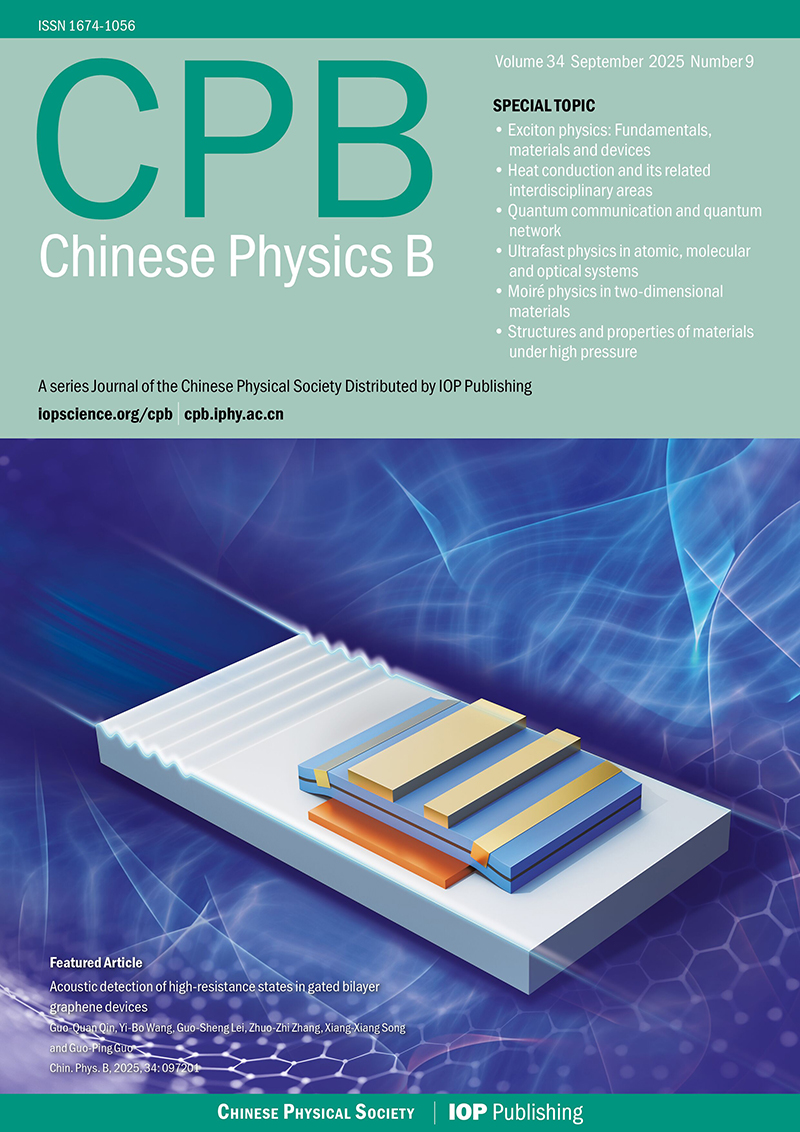
    Acoustic detection of high-resistance states in gated bilayer graphene devices Hot!
    Guo-Quan Qin(秦国铨), Yi-Bo Wang(王奕博), Guo-Sheng Lei(雷国盛), Zhuo-Zhi Zhang(张拙之), Xiang-Xiang Song(宋骧骧), and Guo-Ping Guo(郭国平)
    Chin. Phys. B, 2025, 34 (9):  097201.  DOI: 10.1088/1674-1056/ade1c6
    Abstract ( 240 )   HTML ( 4 )   PDF (935KB) ( 204 )  
    Applying a perpendicular electric field to bilayer graphene (BLG) induces an electrically tunable bandgap, so that insulating states with resistances exceeding $\sim {{10}}^{{8}} { \Omega }$ can be generated. These high-resistance states pinch off the conducting channel, thereby enabling high-quality gated devices for classical and quantum electronics. However, it is challenging to precisely quantify these states electrically due to their high resistances, especially when different areas of the device are operated in different high-resistance states. Here, taking advantage of the strong acoustoelectric effect, we demonstrate the detection of these high-resistance states in a multi-gated BLG device using surface acoustic waves. Under different gating configurations, the device is operated in different high-resistance states. Although these states have similar resistances of $\sim {{10}}^{{8}} { \Omega }$, we show their acoustoelectric responses exhibit pronounced differences, thereby allowing the acoustic detection. More interestingly, we demonstrate that when the conducting channel is pinched off by one top gate, we are still able to acoustically, but not electrically, detect the gating effect of another top gate. Our results reveal the powerful capability and the promising future of acoustically characterizing BLG and other two-dimensional materials, especially their electronic states with high resistances.
    Doping-induced magnetic and topological transitions in Mn2X2Te5 (X = Bi, Sb) bilayers
    Wei Chen(陈威), Chuhan Tang(唐楚涵), Chao-Fei Liu(刘超飞), and Mingxing Chen(陈明星)
    Chin. Phys. B, 2025, 34 (9):  097304.  DOI: 10.1088/1674-1056/ade4af
    Abstract ( 74 )   HTML ( 0 )   PDF (4590KB) ( 92 )  
    We investigate the magnetic and topological properties of Mn$_{2}X_{2}$Te$_{5}$ ($X = {\rm Bi}$, Sb) using first-principles calculations. We find that both Mn$_{2}$Bi$_{2}$Te$_{5}$ and Mn$_{2}$Sb$_{2}$Te$_{5}$ bilayers exhibit A-type antiferromagnetic order, which can be understood based on the Goodenough-Kanamori-Anderson rules. We further find that an appropriate hole doping can induce a transition from the A-type antiferromagnetic phase to the ferromagnetic phase in these systems, which also experience a transition from a normal insulator to a quantum anomalous Hall phase. Our study thus demonstrates that tunable magnetism and band topology can be achieved in Mn$_{2}X_{2}$Te$_{5}$, which may be utilized in the design of new functional electronic devices.
    Enhancing room-temperature thermoelectricity of SrTiO3 based superlattices via epitaxial strain
    Yi Zhu(朱怡), Hao Liu(刘昊), Huilin Lai(赖辉琳), Zhenghua An(安正华), Yinyan Zhu(朱银燕), Lifeng Yin(殷立峰), and Jian Shen(沈健)
    Chin. Phys. B, 2025, 34 (9):  097305.  DOI: 10.1088/1674-1056/ade24e
    Abstract ( 57 )   HTML ( 0 )   PDF (1071KB) ( 70 )  
    Epitaxial strain is an effective way to control thermoelectricity of a thin film system. In this work, we investigate strain-dependent thermoelectricity of [(SrTiO$_{3}$)$_{3}$/(SrTi$_{0.8}$Nb$_{0.2}$O$_{3}$)$_{3}$]$_{10 }$ superlattices grown on different substrates, including $-0.96$% on (LaAlO$_{3}$)$_{0.3}$(SrAl$_{0.5}$Ta$_{0.5}$O$_{3}$)$_{0.7}$(001) (LSAT), 0% on SrTiO$_{3}$(001) (STO), $+0.99$% on DyScO$_{3}$(110) (DSO) and $+1.64$% on GdScO$_{3}$(110) (GSO), respectively. Our results show that the highest room-temperature thermoelectricity is achieved when the STO-based superlattice is grown on the DSO substrate with $+0.99$% tensile strain. This is attributed to the high permittivity and low dielectric loss arising from the ferroelectric domain and electron-phonon coupling, which boost the power factor (PF) to 10.5 mW$\cdot$m$^{-1}\cdot$K$^{-2}$ at 300 K.
    Superconductivity and band topology of double-layer honeycomb structure M2N2 (M = Nb, Ta) Hot!
    Jin-Han Tan(谭锦函), Na Jiao(焦娜), Meng-Meng Zheng(郑萌萌), Ping Zhang(张平), and Hong-Yan Lu(路洪艳)
    Chin. Phys. B, 2025, 34 (9):  097402.  DOI: 10.1088/1674-1056/adee04
    Abstract ( 177 )   HTML ( 3 )   PDF (9434KB) ( 116 )  
    Two-dimensional double-layer honeycomb (DLHC) materials are known for their diverse physical properties, but superconductivity has been a notably absent characteristic in this structure. We address this gap by investigating $M_{2}$N$_{2}$ ($M = {\rm Nb}$, Ta) with DLHC structure using first-principles calculations. Our results show that $M_{2}$N$_{2}$ are stable and metallic, exhibiting superconducting behavior. Specifically, Nb$_{2}$N$_{2}$ and Ta$_{2}$N$_{2}$ display superconducting transition temperatures of 6.8 K and 8.8 K, respectively. Their electron-phonon coupling is predominantly driven by the coupling between metal d-orbitals and low-frequency metal-dominated vibration modes. Interestingly, two compounds also exhibit non-trivial band topology. Thus, $M_{2}$N$_{2}$ are promising platforms for studying the interplay between topology and superconductivity and fill the gap in superconductivity research for DLHC materials.
    Experimental demonstration and mechanism study of single-event gate leakage current in 4H-SiC power MOSFET with top oxide and double P-well structures
    Yin Luo(罗寅), Keyu Liu(刘科宇), Hao Yuan(袁昊), Zhiwen Zhang(张质文), Chao Han(韩超), Xiaoyan Tang(汤晓燕), Qingwen Song(宋庆文), and Yuming Zhang(张玉明)
    Chin. Phys. B, 2025, 34 (9):  097701.  DOI: 10.1088/1674-1056/adee8a
    Abstract ( 71 )   HTML ( 1 )   PDF (1458KB) ( 33 )  
    This work proposes and fabricates the 4H-SiC power MOSFET with top oxide and double P-well (TODP-MOSFET) to enhance the single-event radiation tolerance of the gate oxide. Simulation results suggest that the proposed TODP structure reduces the peak electric field within the oxide and minimizes the sensitive region by more than 70% compared to C-MOSFETs. Experimental results show that the gate degradation voltage of the TODP-MOSFET is higher than that of the C-MOSFET, and the gate leakage current is reduced by 95% compared to the C-MOSFET under heavy-ion irradiation with a linear energy transfer (LET) value exceeding 75 MeV$\cdot $cm$^{2}$/mg.
    Strain tuning of the transport gap and magnetic order in Dirac fermion systems Hot!
    Jingyao Meng(孟敬尧), Zenghui Fan(范增辉), Miao Ye(叶苗), and Tianxing Ma(马天星)
    Chin. Phys. B, 2025, 34 (9):  098101.  DOI: 10.1088/1674-1056/adea5e
    Abstract ( 347 )   HTML ( 13 )   PDF (2369KB) ( 327 )  
    Using the determinant quantum Monte Carlo method, we explore a rich phase diagram featuring strain-induced metal-insulator and magnetic phase transitions in an interacting two-dimensional Dirac fermion system. Asymmetric strain applied along the zigzag crystal direction drives the semimetallic regime into a band-insulating phase, or it breaks the antiferromagnetic order of the Mott insulator, inducing a nonmagnetic insulating phase under strong correlations. The critical strain required for band gap opening or for a transport phase transition is significantly reduced in the presence of Coulomb repulsion, while increasing interaction strength makes it more difficult for strain to induce a nonmagnetic phase transition. In addition, we measure in detail the band gap modulation by strain and identify a doping effect whereby doping inhibits band gap opening. Our results provide an effective way to tune the transport gap, which could help extend the applications of graphene, whose zero band gap currently limits its use.
    Interlayer exchange coupling effects on the spin-orbit torque in synthetic magnets
    Haodong Fan(樊浩东), Zhongshu Feng(冯重舒), Tingwei Chen(陈亭伟), Xiaofeng Han(韩晓峰), Xinyu Shu(舒新愉), Mingzhang Wei(卫鸣璋), Shiqi Liu(刘士琦), Mengxi Wang(王梦溪), Shengru Chen(陈盛如), Xuejian Tang(唐学健), Menghao Jin(金蒙豪), Yungui Ma(马云贵), Bo Liu(刘波), and Tiejun Zhou(周铁军)
    Chin. Phys. B, 2025, 34 (9):  098501.  DOI: 10.1088/1674-1056/ade42c
    Abstract ( 74 )   HTML ( 1 )   PDF (1157KB) ( 109 )  
    Interlayer exchange coupling (IEC) plays a critical role in spin-orbit torque (SOT) switching in synthetic magnets. This work establishes a fundamental correlation between IEC and SOT dynamics within Co/Pt-based synthetic antiferromagnets and synthetic ferromagnets. The antiferromagnetic and ferromagnetic coupling states are precisely engineered through Ruderman-Kittel-Kasuya-Yosida (RKKY) interactions by modulating the Ir spacer thickness. Experimental results reveal that the critical switching current density exhibits a strong positive correlation with the IEC strength, regardless of the coupling type. A comprehensive theoretical framework based on the Landau-Lifshitz-Gilbert equation elucidates how IEC contributes to the effective energy barrier that must be overcome during SOT-induced magnetization switching. Significantly, the antiferromagnetically coupled samples demonstrate enhanced SOT efficiency, with the spin Hall angle being directly proportional to the antiferromagnetic exchange coupling field. These insights establish a coherent physical paradigm for understanding IEC-dependent SOT dynamics and provide strategic design principles for the development of energy-efficient next-generation spintronic devices.
    Optically-excited acoustic waves in Si nanowires probed by time-resolved HOLZ lines Hot!
    He Wang(王贺), Shuaishuai Sun(孙帅帅), Yizhe Wang(王怡哲), Qianming An(安乾明), Xianhui Ye(叶显珲), Jun Li(李俊), Huanfang Tian(田焕芳), Huaixin Yang(杨槐馨), Jianqi Li(李建奇), and Zian Li(李子安)
    Chin. Phys. B, 2025, 34 (9):  098701.  DOI: 10.1088/1674-1056/ade250
    Abstract ( 116 )   HTML ( 1 )   PDF (4047KB) ( 89 )  
    Exploring advanced techniques capable of probing nanometric acoustic waves in nanostructures is critically important for the development of miniaturized acoustic devices. In this study, we probe the optically-excited acoustic waves in a single silicon nanowire (NW) using the time-resolved (tr-) high-order Laue-zone (HOLZ) lines under convergent-beam electron diffraction (CBED) conditions in an ultrafast transmission electron microscope (UTEM). We devise an experimental scheme to obtain tr-HOLZ lines under off-zone-axis CBED conditions. We also propose a geometric description of HOLZ line formation and use this alternative description to quantitatively evaluate the dynamics of optically-excited silicon NW. Using part of the deformation gradient tensor, our simulations of the dynamics of Si NW reproduce the experimental results. We further discuss the feasibility of a full retrieval of the deformation gradient tensor by using a set of HOLZ lines from three zone axes. Our findings illustrate a strategy for the quantitative access to dynamical acoustic waves optically excited in micro- and nano-structures using UTEM.
    GENERAL
    Non-Hermitian mosaic Aubry-Andre-Harper model
    Yingshixiang Wang(王应时翔), Dongze Song(宋东泽), and Xu Xia(夏旭)
    Chin. Phys. B, 2025, 34 (9):  090201.  DOI: 10.1088/1674-1056/add901
    Abstract ( 83 )   HTML ( 1 )   PDF (1827KB) ( 46 )  
    We focus on a modified version of the non-Hermitian Aubry-Andre-Harper (AAH) model, which has garnered significant attention due to its ability to investigate localization phenomena, metal-insulator transitions, and topological phase transitions. We have made two key modifications to the non-Hermitian AAH model: First, we introduce a mosaic structure that allows for the mixing of localized and extended states, resulting in the appearance of mobility edges, which is a feature that is not present in the original non-Hermitian AAH model. In the insulating phase, leveraging Fields Medal winner Avila's global theory, our work derives a theoretical description of the localization length, a crucial parameter previously unavailable in the non-Hermitian AAH model, and obtains the exact expression for mobility edges. We studied the variation of the energy spectrum with the amplitude and quantitatively determined the topological phase transition point within the spectrum. Furthermore, we introduced an asymmetric parameter $g$ and calculated its corresponding localization length, the location of mobility edges, as well as the precise expressions for its extended and localized states. By quantitatively calculating the Lyapunov exponent of dual models, our work reveals an interesting fact about the robustness of localized states: within an appropriate relationship between $g$ and the coupling potential strength, the localized states exhibit similar characteristics to those in the mosaic non-Hermitian AAH model. Our work offers a more complete and nuanced understanding of localization phenomena in disordered non-Hermitian systems, paving the way for further research in this promising field.
    The N-soliton solutions of the three-component coupled nonlinear Hirota equations based on Riemann-Hilbert method
    Xin Wang(王昕) and Zhi-Hui Zhang(张智辉)
    Chin. Phys. B, 2025, 34 (9):  090202.  DOI: 10.1088/1674-1056/adce9c
    Abstract ( 81 )   HTML ( 1 )   PDF (1368KB) ( 39 )  
    In order to more accurately and effectively consider the propagation process of solitons in electromagnetic pulse waves and make full use of wavelength division multiplexing, we study a class of high-order three-component Hirota equations by the Riemann-Hilbert method. Under zero boundary conditions and given initial conditions $q_{j}(x,0)$, the $N$-soliton solutions of the equations are obtained by constructing and solving Riemann-Hilbert problems based on matrix spectral problem. Specifically, we discuss the cases of $N=1, 2$, analyze the dynamical properties of $1$-soliton and $2$-soliton solutions through numerical simulations, and summarize the effect of integrable perturbations and spectral parameters on soliton motion.
    Mode-pairing quantum key distribution based on heralded pair-coherent source with passive decoy-states
    Zhigang Shen(沈志冈), Yuting Lu(鲁雨婷), Yang Yu(余杨), and Shengmei Zhao(赵生妹)
    Chin. Phys. B, 2025, 34 (9):  090304.  DOI: 10.1088/1674-1056/adcf89
    Abstract ( 65 )   HTML ( 0 )   PDF (799KB) ( 29 )  
    A mode-pairing quantum key distribution based on heralded pair-coherent source with passive decoy-states is proposed, named HPCS-PDS-MP-QKD protocol, where the light sources at Alice and Bob sides are changed to heralded pair-coherent sources, and devices designed to implement passive decoy states are included at the transmitter sides to generate the decoy state pulses in the decoy-state window passively. With the defined efficient events and the designed pairing strategy, the key bits and bases can be obtained by data post-processing. Numerical simulation results verify the feasibility of the proposed protocol. The results show that the proposed protocol can exceed PLOB when the pairing interval setting is greater than $10^{3}$, and the transmission distance exceeds 200 km. When the key transmission distance reaches 300 km and the maximum pairing interval is equivalent to 1, its performance is improved by nearly 1.8 times compared to the original MP-QKD protocol with a weak coherent source (WCS-MP-QKD), and by 6.8 times higher than that of WCS-MP-QKD with passive decoy states (WCS-PDS-MP-QKD). Meanwhile, the key transmission distance can reach 480 km, and surpasses the WCS-PDS-MP-QKD protocol by nearly 40 km. When the total pulse length is greater than $10^{11}$, the key generation rate is almost equal to that of infinite pulses. It is a promising QKD protocol that breaks the PLOB bound without requiring phase tracking and locking, has a longer transmission distance and a higher key generation rate, and eliminates the potential of side channel attack.
    Impact of surface passivation on the electrical stability of strained germanium devices
    Zong-Hu Li(李宗祜), Mao-Lin Wang(王茂粼), Zhen-Zhen Kong(孔真真), Gui-Lei Wang(王桂磊), Yuan Kang(康原), Yong-Qiang Xu(徐永强), Rui Wu(吴睿), Tian-Yue Hao(郝天岳), Ze-Cheng Wei(魏泽成), Bao-Chuan Wang(王保传), Hai-Ou Li(李海欧), Gang Cao(曹刚), and Guo-Ping Guo(郭国平)
    Chin. Phys. B, 2025, 34 (9):  090305.  DOI: 10.1088/1674-1056/add4de
    Abstract ( 94 )   HTML ( 0 )   PDF (4816KB) ( 219 )  
    Strained germanium hole spin qubits are promising for quantum computing, but the devices hosting these qubits face challenges from high interface trap density, which originates from the naturally oxidized surface of the wafer. These traps can degrade the device stability and cause an excessively high threshold voltage. Surface passivation is regarded as an effective method to mitigate these impacts. In this study, we perform low-thermal-budget chemical passivation using the nitric acid oxidation of silicon method on the surface of strained germanium devices and investigate the impact of passivation on the device stability. The results demonstrate that surface passivation effectively reduces the interface defect density. This not only improves the stability of the device's threshold voltage but also enhances its long-term static stability. Furthermore, we construct a band diagram of hole surface tunneling at the static operating point to gain a deeper understanding of the physical mechanism through which passivation affects the device stability. This study provides valuable insights for future optimization of strained Ge-based quantum devices and advances our understanding of how interface states affect device stability.
    Adiabatic holonomic quantum computation in decoherence-free subspaces with two-body interaction
    Xiaoyu Sun(孙晓雨), Lei Qiao(乔雷), and Peizi Zhao(赵培茈)
    Chin. Phys. B, 2025, 34 (9):  090308.  DOI: 10.1088/1674-1056/adeb5e
    Abstract ( 78 )   HTML ( 0 )   PDF (498KB) ( 154 )  
    Adiabatic holonomic gates possess the geometric robustness of adiabatic geometric phases, i.e., dependence only on the evolution path of the parameter space but not on the evolution details of the quantum system, which, when coordinated with decoherence-free subspaces, permits additional resilience to the collective dephasing environment. However, the previous scheme [Phys. Rev. Lett. 95 130501 (2005)] of adiabatic holonomic quantum computation in decoherence-free subspaces requires four-body interaction that is challenging in practical implementation. In this work, we put forward a scheme to realize universal adiabatic holonomic quantum computation in decoherence-free subspaces using only realistically available two-body interaction, thereby avoiding the difficulty of implementing four-body interaction. Furthermore, an arbitrary one-qubit gate in our scheme can be realized by a single-shot implementation, which eliminates the need to combine multiple gates for realizing such a gate.
    Chattering-free terminal sliding mode control based on adaptive exponential reaching barrier function for a chaotic permanent magnet synchronous generator in offshore wind turbine system
    Aissa Benabdeseelam, Manal Messadi, Karim Kemih, Hamid Hamiche
    Chin. Phys. B, 2025, 34 (9):  090501.  DOI: 10.1088/1674-1056/add248
    Abstract ( 51 )   HTML ( 0 )   PDF (2907KB) ( 37 )  
    This paper introduces a novel chattering-free terminal sliding mode control (SMC) strategy to address chaotic behavior in permanent magnet synchronous generators (PMSG) for offshore wind turbine systems. By integrating an adaptive exponential reaching law with a continuous barrier function, the proposed approach eliminates chattering and ensures robust performance under model uncertainties. The methodology combines adaptive SMC with dynamic switching to estimate and compensates for unknown uncertainties, providing smooth and stable control. Finally, the performance and effectiveness of the proposed approach are compared with those of a previous study.
    A novel (2+1)-dimensional complex coupled dispersionless system: Darboux transformation and multisolitons
    H. W. A. Riaz and Ji Lin(林机)
    Chin. Phys. B, 2025, 34 (9):  090502.  DOI: 10.1088/1674-1056/adceff
    Abstract ( 69 )   HTML ( 1 )   PDF (943KB) ( 51 )  
    This study presents a (2+1)-dimensional complex coupled dispersionless system. A Lax pair is proposed, and the Darboux transformation is employed to construct multisoliton solutions. These solutions exhibit a range of wave phenomena, including bright and dark solitons, S-shaped formations, parabolic profiles, and periodic wave patterns. Additionally, it is shown that the system is equivalent to the sine-Gordon equation and the negative flow of the modified Korteweg-de Vries hierarchy through appropriate transformations.
    Dynamical behaviors of a multifunctional neural circuit
    Xiao-Hong Gao(高晓红), Kai-Long Zhu(朱凯龙), and Fei-Fei Yang(杨飞飞)
    Chin. Phys. B, 2025, 34 (9):  090503.  DOI: 10.1088/1674-1056/ae001b
    Abstract ( 51 )   HTML ( 0 )   PDF (8321KB) ( 27 )  
    Biological neurons exhibit a double-membrane structure and perform specialized functions. Replicating the double-membrane architecture in artificial neurons to mimic biological neuronal functions is a compelling research challenge. In this study, we propose a multifunctional neural circuit composed of two capacitors, two linear resistors, a phototube cell, a nonlinear resistor, and a memristor. The phototube and charge-controlled memristor serve as sensors for external light and electric field signals, respectively. By applying Kirchhoff's and Helmholtz's laws, we derive the system's nonlinear dynamical equations and energy function. We further investigate the circuit's dynamics using methods from nonlinear dynamics. Our results show that the circuit can exhibit both periodic and chaotic patterns under stimulation by external light and electric fields.
    Design of a memristive chaotic map and its adaptive regulation
    Ya Wang(王亚), Xin-Lin Song(宋欣林), and Fei-Fei Yang(杨飞飞)
    Chin. Phys. B, 2025, 34 (9):  090504.  DOI: 10.1088/1674-1056/adea5c
    Abstract ( 53 )   HTML ( 0 )   PDF (1037KB) ( 35 )  
    The analysis of structure and dynamics in chaotic systems has long been a significant research direction in nonlinear science. Constructing a reliable chaotic system with rich dynamical characteristics is essential for secure communication applications. Existing memristor-based chaotic maps are typically obtained by incorporating discrete mathematical models of memristors into basic chaotic maps. In this study, a simple memristive nonlinear circuit is first designed, from which a memristive oscillator is derived. Subsequently, a memristive map is developed from this oscillator through a linear transformation of the variables. The reliability of the new map is validated through nonlinear dynamic analysis. The results demonstrate that the map exhibits complex nonlinear dynamics under different parameter settings. This finding is beneficial for the construction of memristor maps and the development of image encryption algorithms.
    Inverse design of directional hybrid nanoantennas using neural networks
    Ru-Lin Guan(管如林), Deng-Chao Huang(黄登朝), Ya-Qiong Li(李雅琼), Chen Wang(王晨), and Bin-Zi Xu(徐彬梓)
    Chin. Phys. B, 2025, 34 (9):  090702.  DOI: 10.1088/1674-1056/adeb5c
    Abstract ( 98 )   HTML ( 0 )   PDF (3516KB) ( 34 )  
    Controlling the directionality of quantum emitter (QE) radiation is crucial for advancing nanophotonic devices, yet designing compact, single nanoantennas for this purpose remains challenging with traditional methods due to computational demands and optimization complexity. This paper introduces a neural-network-based inverse design approach to efficiently optimize single core-shell nanosphere antennas and their derivatives — notched core-shell structures and dimers — for highly directional QE emission. We systematically compare the radial basis function (RBF), support vector regression (SVR), and backpropagation neural network (BPNN) algorithms. Our results demonstrate BPNN's superior performance in accurately mapping nanoantennas' geometric and material parameters to their far-field radiation characteristics. Subsequent BPNN-driven optimization confirms that all three investigated structures (single core-shell, notched core-shell, and dimer) can achieve robust directional emission. This is accomplished by precisely exciting higher-order electric and magnetic multipoles engineered to possess equal amplitudes and opposite phases, thereby facilitating directional radiation from QEs and enabling more efficient nanophotonic device design.
    ELECTROMAGNETISM, OPTICS, ACOUSTICS, HEAT TRANSFER, CLASSICAL MECHANICS, AND FLUID DYNAMICS
    Abnormal focal length increase of terajet generated in reflection mode
    Yu-Jing Yang(杨育静), Jiang-Tao Qin(秦江涛), De-Long Zhang(张德龙), Sai-Dong Xue(薛赛东), and Ning Yuan(袁宁)
    Chin. Phys. B, 2025, 34 (9):  094204.  DOI: 10.1088/1674-1056/add903
    Abstract ( 39 )   HTML ( 0 )   PDF (1059KB) ( 31 )  
    We report an interesting and abnormal electromagnetic phenomenon with regard to a terajet (TJ) that is generated in a reflection mode, which is realized by placing a dielectric scatterer onto a metal reflection plate. We show that the introduction of an air hollow into metal reflection plate beneath the scatterer does not induce an expected decrease but an abnormal increase of focal length of the TJ by as much as more than three times. This abnormal phenomenon takes place in case that the air hollow is shallow and there exists a critical hollow depth for a given lateral size of air hollow. Larger than the critical depth, the phenomenon no longer occurs. It is explained from viewpoints of both ray optics in terms of role of relative portion of central waves in TJ formation and electromagnetic field theory with regard to hollow-induced phase singularities.
    Diamond NV center quantum magnetic sensor using a dual-frequency broadband antenna
    Ke-Qi Shi(施柯琦), Heng Hang(杭衡), Wen-Tao Lu(卢文韬), Jing-Cheng Huang(黄竟成), Na Li(李娜), Jin-Xu Wang(王金旭), Zeng-Bo Xu(许增博), Lin-Yan Yu(虞林嫣), Sheng-Kai Xia(夏圣开), Yu-Chen Bian(卞雨辰), and Guan-Xiang Du(杜关祥)
    Chin. Phys. B, 2025, 34 (9):  094205.  DOI: 10.1088/1674-1056/add900
    Abstract ( 107 )   HTML ( 4 )   PDF (2142KB) ( 67 )  
    This paper presents a compact broadband antenna that overcomes bandwidth limitations in a diamond nitrogen-vacancy (NV) center-based quantum magnetic sensor. Conventional antennas struggle to achieve both broadband operation and compact integration, restricting the sensitivity and dynamic range of the sensor. The broadband antenna based on a dual-frequency monopole structure achieves a bandwidth extension of 777 MHz at the Zeeman splitting frequency of 2.87 GHz, with the dual resonant points positioned near 2.87 GHz. Additionally, high-resolution imaging of the microwave magnetic field on the antenna surface was performed using a diamond optical fiber probe, which verified the dual-frequency design principle. Experimental results using the proposed antenna demonstrate the outstanding performance of the NV center-based magnetic sensor: a sensitivity of 55 nT/Hz$^{1/2}$ and a dynamic range of up to 54.0 dB. Compared to sensors using conventional antennas, the performance has been significantly improved.
    Entropy evolution law of a general linear state for diffusion noise
    Yingyu Zhang(张映玉) and Yixing Wang(王依兴)
    Chin. Phys. B, 2025, 34 (9):  094206.  DOI: 10.1088/1674-1056/add4f2
    Abstract ( 43 )   HTML ( 0 )   PDF (2452KB) ( 28 )  
    Based on the Kraus operator-sum representation of the analytical solution of the diffusion equation, we obtain the evolution of a general linear state in the diffusion channel. Also, we study the quantum statistical properties of the initial general linear state and its von-Neumann entropy evolution in the diffusion channel, especially find that the entropy evolution is influenced by the diffusion noise and the thermal parameter but without the displacement.
    Synchronized dual-wavelength mode-locked laser in normal dispersion regime
    Yangrui Shi(史洋瑞), Haojing Zhang(张皓景), Yuxuan Ren(任俞宣), Junsong Peng(彭俊松), and Heping Zeng(曾和平)
    Chin. Phys. B, 2025, 34 (9):  094207.  DOI: 10.1088/1674-1056/add4fe
    Abstract ( 68 )   HTML ( 0 )   PDF (1013KB) ( 62 )  
    Synchronized dual-wavelength mode-locked laser is investigated numerically and experimentally in the normal dispersion regime. A programmable optical processor is introduced to shape the spectral profile and adjust the net dispersion, which is demonstrated be a convenient and reliable approach to generate dual-color solitons. The time-stretch dispersive Fourier transform and frequency-resolved optical grating techniques are utilized to measure the spectral and temporal characteristics of dual-color solitons, respectively. The numerical results are consistent with experimental results. This work may facilitate the development of filter-based mode-locked laser and the understanding of multi-wavelength soliton dynamics.
    Compact self-pulsed Tm:GdScO3 laser with narrow pulse width
    Bangzheng Liu(刘邦政), Xiangyu Li(李翔宇), Jiahao Dong(董佳昊), Lu Zhang(张璐), and Linjun Li(李林军)
    Chin. Phys. B, 2025, 34 (9):  094208.  DOI: 10.1088/1674-1056/add4f9
    Abstract ( 85 )   HTML ( 0 )   PDF (1262KB) ( 78 )  
    A self-pulsed Tm:GdScO$_{3}$ laser was experimentally demonstrated by using a compact linear resonant cavity. When the pump power was 19.6 W, an average output power of 1771 mW was achieved from the self-pulsed Tm:GdScO$_{3}$ laser with a pulse width of 158.1 ns and a pulse repetition frequency of 112.8 kHz, corresponding to an optical-to-optical conversion efficiency of 9.0%. Moreover, a single pulse energy of 15.7 μJ and a pulse peak power of 99.3 W were acquired from the self-pulsed Tm:GdScO$_{3}$ laser. This is, as we know, the first time that the self-pulsed laser output at 2-μm waveband range was obtained by utilizing a Tm:GdScO$_{3}$ crystal so far.
    Theoretical and computational feasibility of femtosecond laser multifilament transverse structures reconstruction via circular-scanning-based photoacoustic tomography
    Qingwei Zeng(曾庆伟), Lei Liu(刘磊), Shuai Hu(胡帅), and Shulei Li(李书磊)
    Chin. Phys. B, 2025, 34 (9):  094209.  DOI: 10.1088/1674-1056/ade663
    Abstract ( 53 )   HTML ( 0 )   PDF (2027KB) ( 27 )  
    We theoretically investigate the feasibility of reconstructing the transverse structures of femtosecond laser filaments in air by photoacoustic tomography. To simulate the emission and transmission of filament-induced ultrasonic signals more truly, a series of experimentally recorded cross-sectional images are used to simulate the initial pressure rise from multiple filaments (MFs). The aperture size and sensitivity of the detector was incorporated into the reconstruction algorithm. The results show that frequency of acoustic signals induced by MFs with maximum volumetric energy density $\sim 100$ kJ/m$^{3}$ is about 2 MHz below. The initial spatial distribution of optical filaments can be clearly reconstructed with the back projection based algorithm. We recommend a PAT system with transducers of a lower central frequency and a stronger apodization working at a longer scanning radius can be used in photoacoustic image reconstruction of femtosecond laser multifilaments. This study demonstrates the feasibility of using photoacoustic tomography to reconstruct femtosecond multifilament images, which is helpful for studying the complex dynamic processes of multifilament and multifilament manipulation and is also valuable for the remote applications of laser filaments.
    Color Fourier single-pixel imaging with random color filter array
    Jialiang Chen(陈佳亮), Wei Zhu(朱维), Le Wang(王乐), and Shengmei Zhao(赵生妹)
    Chin. Phys. B, 2025, 34 (9):  094210.  DOI: 10.1088/1674-1056/adf1e9
    Abstract ( 70 )   HTML ( 0 )   PDF (10314KB) ( 39 )  
    Color Fourier single-pixel imaging (FSI) enables efficient spectral and spatial imaging. Here, we propose a Fourier single-pixel imaging scheme with a random color filter array (FSI-RCFA). The proposed method employs a random color filter array (RCFA) to modulate Fourier patterns. A three-step phase-shifting technique reconstructs the Fourier spectrum, followed by an RCFA-based demosaicing algorithm to recover color images. Compared to traditional color FSI based on Bayer color filter array schemes (FSI-BCFA), our approach achieves superior separation between chrominance and luminance components in the frequency domain. Simulation results demonstrate that the FSI-RCFA method achieves a lower mean squared error (MSE), a higher peak signal-to-noise ratio (PSNR), and superior noise resistance compared to FSI-BCFA, while enabling direct single-channel pixel measurements for targeted applications such as agricultural defect detection.
    Twin pulses of THz generation from a nonlinear crystalline quartz by femtosecond laser pulse
    Xiangmei Dong(董祥美), Dan-Ni Li(李丹妮), Zuan-Ming Jin(金钻明), Hui-Ping Zhang(张慧萍), Hong-Guang Li(李宏光), Shao-Hui Wu(吴少晖), Yan Peng(彭滟), Yiming Zhu(朱亦鸣), and Songlin Zhuang(庄松林)
    Chin. Phys. B, 2025, 34 (9):  094211.  DOI: 10.1088/1674-1056/addbcd
    Abstract ( 68 )   HTML ( 0 )   PDF (840KB) ( 49 )  
    We observed sub-picosecond terahertz (THz) pulses generated from an electro-optic quartz plate using femtosecond optical pulses. The time-resolved THz radiation signal clearly indicates two separated THz pulses with opposite polarity. Based on our results, a model based on optical-to-THz conversion via optical rectification is proposed to describe the twin pulsed THz emission mechanism of the quartz plate. Firstly, the two separated THz pulses are assigned to the forced and free THz pulses, respectively. With an optical pulse serving as an external source in the crystalline quartz, the forced THz pulse is a solution to linear Maxwell's equations and propagates at the velocity of the pump laser pulse, while the free THz pulse propagates with the group velocity in the THz frequency range. Finally, as a non-centrosymmetry material, the THz amplitude exhibits perfect threefold symmetry with respect to the azimuthal angle and twofold symmetry with respect to the pump polarization angle.
    Computation and analysis of the characteristic spectra of Eu(II) ions in single-bubble sonoluminescence
    Xue-Ping Wang(王学坪) and Jin-Fu Liang(梁金福)
    Chin. Phys. B, 2025, 34 (9):  094301.  DOI: 10.1088/1674-1056/addaa1
    Abstract ( 57 )   HTML ( 0 )   PDF (4240KB) ( 35 )  
    Single-bubble sonoluminescence (SBSL) occurs when a tiny bubble with an extremely small volume, isolated within a liquid, periodically compresses and expands in response to a strong ultrasonic field, emitting a brief burst of bright light. Sonoluminescence spectroscopy serves as a powerful tool for analyzing the material structure and physical state of these bubbles. Recent experimental results have demonstrated that the sonoluminescence spectra of moving single bubbles exhibit the characteristic spectra of divalent europium ions [Eu(II)] in solutions containing europium chloride (EuCl$_2$). To elucidate the radiation mechanism of the characteristic spectra of Eu(II) ions during sonoluminescence, we combined fluid mechanics, the Keller-Miksis (KM) equation, and spectral equations to calculate the spectral intensity and radiation power of SBSL in $\rm EuCl_2$ solutions, as well as the spatial distributions of temperature, pressure, particle number density, ionization energy, ionization degree and opacity within bubbles. The results indicate that the characteristic spectra of Eu(II) ions may arise from the transition radiation excited under a localized environment of high temperature, pressure, and density within bubbles. These findings could enhance our understanding of the mechanisms underlying sonoluminescence and potentially aid in the development of advanced diagnostic tools for analyzing high-energy processes in fluids.
    Energy focusing of flexural waves via algorithmically optimized coding metasurface lenses
    Zi-Rui Wang(王子睿), Di-Chao Chen(陈帝超), Rui Hong(洪瑞), and Da-Jian Wu(吴大建)
    Chin. Phys. B, 2025, 34 (9):  094302.  DOI: 10.1088/1674-1056/add1be
    Abstract ( 63 )   HTML ( 1 )   PDF (1839KB) ( 24 )  
    Efficient elastic wave focusing is crucial in materials and physical engineering. Elastic coding metasurfaces, which are innovative planar artificial structures, show great potential for use in the field of wave focusing. However, elastic coding lenses (ECLs) still suffer from low focusing performance, thickness comparable to wavelength, and frequency sensitivity. Here, we consider both the structural and material properties of the coding unit, thus realizing further compression of the thickness of the ECL. We chose the simplest ECL, which consists of only two encoding units. The coding unit 0 is a straight structure constructed using a carbon fiber reinforced composite material, and the coding unit 1 is a zigzag structure constructed using an aluminum material, and the thickness of the ECL constructed using them is only 1/8 of the wavelength. Based on the theoretical design, the arrangement of coding units is further optimized using genetic algorithms, which significantly improves the focusing performance of the lens at different focus and frequencies. This study provides a more effective way to control vibration and noise in advanced structures.
    Experimental verification of circular motion of Mie particles trapped within focused acoustic vortex beams
    Zhengbao Li(李正宝), Hongyu Li(李洪宇), and Qingdong Wang(王青东)
    Chin. Phys. B, 2025, 34 (9):  094303.  DOI: 10.1088/1674-1056/ade857
    Abstract ( 60 )   HTML ( 0 )   PDF (942KB) ( 59 )  
    Techniques for manipulating nanodroplets lie at the core of numerous miniaturized systems in chemical and biological research endeavors. In this study, we introduce a versatile methodology for calculating the acoustic vortex field, integrating hybrid wave equation principles with ray acoustics. This approach demonstrates remarkable consistency between simulated results and experimental observations. Importantly, both theoretical analysis and experimental validation confirm that particles whose diameters match the wavelength (Mie particles) can be effectively trapped within a focused acoustic vortex field, rotating in circular trajectories centered at the vortex center. This research significantly expands the scope of acoustic vortex manipulation for larger particles and introduces a novel implementation strategy with potential applications in targeted drug delivery for clinical adjuvant therapy.
    Time-resolved molecular non-equilibrium spectra in nanosecond laser induced air plasma
    Xuteng Zhang(张续腾), Chaobo Yang(杨超博), Xun Yuan(袁勋), Minghong Han(韩明宏), Zhen Cao(曹振), Jiangbo Peng(彭江波), and Xin Yu(于欣)
    Chin. Phys. B, 2025, 34 (9):  094701.  DOI: 10.1088/1674-1056/ade24a
    Abstract ( 72 )   HTML ( 0 )   PDF (847KB) ( 29 )  
    We performed a quantitative analysis of time-resolved laser-induced breakdown air plasma spectra to obtain the evolution of temperatures and species relative fractions. The air plasma was generated by focusing a 100 mJ Nd:YAG laser pulse, and the time-resolved spectra were recorded by an intensified charge-coupled device camera with incremental delay. The attention was mainly focused on the emission spectra of the first negative system of nitrogen ($\rm N_2^+$, $\rm{B}^2\Sigma_{\rm u}^{-}$-$\rm{X}^2\Sigma_{\rm g}^+$) and the violet system of carbon nitride (CN, $\rm{B}^2\Sigma^{+}$-$\rm{X}^2\Sigma^+$) located at 383-396 nm. A custom-built model was developed to perform the simulation and fitting of the $\rm N_2^+$ and the $\rm CN$ spectra from the air plasma. The model was verified by comparing to a published model with a 0.9860 Spearman correlation coefficient. With this model, the time-resolved non-equilibrium temperatures and relative fractions of $\rm N_2^+$ and $\rm CN$ were obtained with a fitting correlation coefficient higher than 0.9108.
    CONDENSED MATTER: STRUCTURAL, MECHANICAL, AND THERMAL PROPERTIES
    Site occupation of Al doping in Lu2SiO5: The role of ionic radius versus chemical valence
    Xuejiao Sun(孙雪娇), Yu Cui(崔宇), Feng Gao(高峰), Zhongjun Xue(薛中军), Shuwen Zhao(赵书文), Dongzhou Ding(丁栋舟), Fan Yang(杨帆), and Yi-Yang Sun(孙宜阳)
    Chin. Phys. B, 2025, 34 (9):  096101.  DOI: 10.1088/1674-1056/add678
    Abstract ( 48 )   HTML ( 0 )   PDF (1146KB) ( 35 )  
    Lu$_{2}$SiO$_{5}$:Ce (LSO:Ce) serving as a core material for radiation detectors, plays a crucial role in the design and development of positron emission tomography (PET) devices. Experiment has confirmed that low concentration of Al doping can significantly enhance the light yield, decay time, rise time, energy resolution, and afterglow level of the LSO:Ce crystals. The mechanisms regarding the lattice site occupancy of Al in LSO, while closely associated with the performance improvements, are not yet fully understood. Particularly, it is unclear either the ionic radius or the chemical valence plays a more critical role in determining the site occupancy. In this study, we utilized first-principles calculations based on density functional theory (DFT) to study the lattice site occupancy of Al in LSO crystals and to explore their impact on the electronic structure. Our results indicate that with changes in the growth environment, as reflected by the atomic chemical potentials, Al can occupy either the Si sites or the Lu$_2$ sites, and it is not inclined to occupy the Lu$_1$ sites. The doping of Al at the Si site introduces a shallow acceptor level, which may contribute to the suppression of trap concentration and affect the ratio of Ce$^{3+}$ to Ce$^{4+}$ within the crystal, thereby influencing its scintillation properties.
    Pressure-induced amorphization and metallization in orthorhombic SiP
    Qiru Zeng(曾琪茹), Youjun Zhang(张友君), Yukai Zhuang(庄毓凯), Linfei Yang(杨林飞), Qiming Wang(王齐明), and Yi Sun(孙熠)
    Chin. Phys. B, 2025, 34 (9):  096102.  DOI: 10.1088/1674-1056/add4f6
    Abstract ( 45 )   HTML ( 1 )   PDF (2779KB) ( 15 )  
    Amorphous states of two-dimensional (2D) materials frequently exhibit remarkable physical properties that differ significantly from their crystalline counterparts. Typically, metastable amorphous states can be achieved through rapid quenching from high temperatures. However, the heating process is detrimental to the structural integrity of 2D materials. In this study, we successfully utilized pressure as an external stimulus to induce an amorphous state in layered crystal SiP. Comprehensive experimental and theoretical investigations revealed metallization in the high-pressure amorphous phase of SiP. The recovered samples were characterized using x-ray diffraction, Raman spectroscopy, high-resolution transmission electron microscopy, and selected area electron diffraction. The results indicate that the metallic amorphous SiP obtained under extreme conditions can be stabilized at ambient conditions. These findings provide a viable pathway for inducing metastable phases in 2D materials and offer new insights into the design and development of advanced electronic devices.
    Physical properties of high-pressure synthesized Al65Cu20Fe15 quasicrystal
    Yibo Liu(刘一博), Changzeng Fan(范长增), Zhefeng Xu(许哲峰), Ruidong Fu(付瑞东), Feng Ke(柯峰), Lin Wang(王霖), Bin Wen(温斌), Lifeng Zhang(张立峰), Marek Mihalkovič, and Bo Xu(徐波)
    Chin. Phys. B, 2025, 34 (9):  096103.  DOI: 10.1088/1674-1056/add4fb
    Abstract ( 54 )   HTML ( 1 )   PDF (1356KB) ( 42 )  
    Al$_{65}$Cu$_{20}$Fe$_{15}$ bulk is synthesized with the high-pressure synthesis (HPS) method. Various analytical techniques, such as single crystal x-ray diffraction (SXRD), scanning electron microscopy equipped with energy-dispersive x-ray spectroscopy, and transmission electron microscopy, are employed to characterize the sintered bulk and confirmed its quasicrystalline structure. The electrical resistivity of the HPS quasicrystal specimen is measured from 2 K to 300 K, revealing a significantly elevated value in comparison to samples prepared via alternative methods. Nanoindentation testing demonstrates exceptional hardness and elastic modulus of our Al$_{65}$Cu$_{20}$Fe$_{15}$ quasicrystal, consistent with existing results. The ratio of hardness to elastic modulus further highlight the potential superior wear resistance of the Al$_{65}$Cu$_{20}$Fe$_{15}$ quasicrystal. Differential scanning calorimetry measurement conducted on the HPS Al$_{65}$Cu$_{20}$Fe$_{15}$ quasicrystals reveal a high melting point of 877 $^\circ$C.
    Sensitivity of short-range order prediction to machine learning potential formalisms: A case study on NbMoTaW high-entropy alloy
    Dingyi Jin(金定毅), Guo Wei(魏国), and Haidong Wang(王海东)
    Chin. Phys. B, 2025, 34 (9):  096104.  DOI: 10.1088/1674-1056/ae039a
    Abstract ( 51 )   HTML ( 0 )   PDF (1910KB) ( 34 )  
    Chemical short-range order (SRO), a phenomenon at the atomic scale resulting from inhomogeneities in the local chemical environment, is usually studied using machine learning force field-based molecular dynamics simulations due to the limitations of experimental methods. To promote the reliable application of machine potentials in high-entropy alloy simulations, first, this work uses NEP models trained on two different datasets to predict the SRO coefficients of NbMoTaW. The results show that within the same machine learning framework, there are significant differences in the prediction of SRO coefficients for the Nb-Nb atomic pair. Subsequently, this work predicts the SRO coefficients of NbMoTaW using the NEP model and the SNAP model, both of which are trained on the same dataset. The results reveal significant discrepancies in SRO predictions for like-element pairs (e.g., Nb-Nb and W-W) between the two potentials, despite the identical training data. The findings of this study indicate that discrepancies in the prediction results of SRO coefficients can arise from either the same machine learning framework trained on different datasets or different learning frameworks trained on the same dataset. This reflects possible incompleteness in the current training set's coverage of local chemical environments at the atomic scale. Future research should establish unified evaluation standards to assess the capability of training sets to accurately describe complex atomic-scale behaviors such as SRO.
    Effect of impact velocity on spall behaviors of nanocrystalline iron: Molecular dynamics study
    Li-Qiong Chen(陈利琼), Kui Zhao(赵奎), Kai Zhang(张开), Ze-Zhi Wen(文泽智), Hou-Jin Mei(梅后金), and Zhen-Bao Xiong(熊珍宝)
    Chin. Phys. B, 2025, 34 (9):  096201.  DOI: 10.1088/1674-1056/add4ff
    Abstract ( 54 )   HTML ( 0 )   PDF (4049KB) ( 23 )  
    This study investigates the effect of shock velocity ($u_{\rm p}$) on damage evolution mechanisms in nanocrystalline iron via molecular dynamics simulations. As $u_{\rm p}$ increases, shock wave propagation accelerates, and stress distribution transitions from grain boundary concentration to homogeneity. This causes a transition in fracture mode from cleavage to ductile behavior. When $u_{\rm p}$ exceeds 1.5 km$\cdot$s$^{-1}$, micro-spallation emerges as the dominant failure mode. During micro-spallation, localized melting within the material impedes the propagation of the shock wave. As $u_{\rm p}$ increases, the growth rate of the void volume fraction initially rises but then decreases. Higher $u_{\rm p}$ leads to earlier void nucleation. At lower $u_{\rm p}$, the cavitation of the model is mainly characterized by the growth and penetration of a few voids. With increasing $u_{\rm p}$, the number of voids grows, and their interactions expand the delamination damage region. The spall strength demonstrates stage-specific dependence on $u_{\rm p}$. In the classical spallation stage (C_I), temperature softening reduces spall strength. In the plastic strengthening regime (C_II), strain hardening enhances spall strength. In the micro-spallation stage (M_III), further increases in $u_{\rm p}$ cause melting during tensile and compressive phases, reducing spall strength. Finally, in the compression-melting regime (M_IV), local temperatures exceed the melting point, diminishing plastic damage and accelerating spall strength reduction. This study provides new insights into the dynamic response of nanocrystalline iron.
    CONDENSED MATTER: ELECTRONIC STRUCTURE, ELECTRICAL, MAGNETIC, AND OPTICAL PROPERTIES
    Preparation of high-performance Cu2Se thermoelectric materials by the KCl flux method and research on thermoelectric transport performance
    Yonggui Tao(陶永贵), Chisheng Deng(邓池升), Jicheng Li(李吉成), Wen Ge(葛文), Ying Zhang(张盈), Yujie Xiang(向玉婕), and Shukang Deng(邓书康)
    Chin. Phys. B, 2025, 34 (9):  097306.  DOI: 10.1088/1674-1056/add4fa
    Abstract ( 68 )   HTML ( 0 )   PDF (6637KB) ( 37 )  
    This study achieves a notable enhancement in the thermoelectric performance of copper selenide compounds exhibiting liquid-like characteristics via an innovative processing method. A KCl flux-assisted high-temperature melting and slow-cooling strategy was employed to fabricate nanolayered Cu$_{2}$Se (KCl)$_{x}$ materials ($x =0$-3, denoted as S$_{0}$-S$_{3}$). Systematic characterization reveals that the coexistence of $\alpha $ and $\beta $ phases at room temperature creates favorable conditions for optimizing carrier transport. XPS analysis confirms the substitution of low-binding-energy Se$^{2-}$ by high-binding-energy Cl$^{-}$ ions within the lattice, effectively suppressing copper ion migration and remarkably improving the material's structural stability. Microstructural investigations demonstrate that all samples exhibit nanolayered stacking architectures abundant with edge dislocations. This multiscale defect architecture induces strong phonon scattering effects. Hall measurements indicate that the KCl flux-assisted processing facilitates the formation of highly ordered nanostructures, thereby enhancing carrier mobility and structural stability. Although the carrier concentration exhibits a slight decrease compared with the flux-free samples, the significant improvement in microstructural quality plays a crucial role in the synergistic optimization of electrical conductivity and the Seebeck coefficient. Notably, sample S$_{2}$ exhibited a considerable electrical conductivity, reaching approximately $1.0\times 10^{5}$ S$\cdot $m$^{-1}$ at 300 K. More strikingly, the cooperative effect of high-density edge dislocations and dopant atoms elevates material entropy, enabling sample S$_{3}$ to attain an ultralow lattice thermal conductivity of 0.55 W$\cdot $m$^{-1}\cdot $K$^{-1}$ at 350 K. Through multi-mechanism coordination, sample S$_{2}$ achieved a high ZT value of 1.45 at 700 K, representing a 2.7-fold improvement compared with traditional synthesis methods. This work provides new insights into performance optimization of liquid-like thermoelectric materials through defect engineering and entropy manipulation.
    Extremely large magnetoresistance in single-crystalline ZrBi2
    Cundong Li(李存东), Binbin Ruan(阮彬彬), Qingxin Dong(董庆新), Jianli Bai(白建利), Libo Zhang(张黎博), Qiaoyu Liu(刘乔宇), Jingwen Cheng(程靖雯), Pinyu Liu(刘品宇), Yu Huang(黄宇), Yingrui Sun(孙英睿), Zhian Ren(任治安), and Genfu Chen(陈根富)
    Chin. Phys. B, 2025, 34 (9):  097307.  DOI: 10.1088/1674-1056/add246
    Abstract ( 57 )   HTML ( 0 )   PDF (4091KB) ( 38 )  
    Magnetoresistance (MR) is a pivotal transport phenomenon within the realm of condensed matter physics. In recent years, materials exhibiting extremely large unsaturated magnetoresistance (XMR), which are often potential topological materials, have garnered significant attention. In this study, we synthesized single crystals of ZrBi$_{2}$ and performed electrical and specific heat measurements on them. The resistivity of ZrBi$_{2}$ displays metallic behavior with a high residual resistance ratio. Notably, the MR of ZrBi$_{2}$ reaches approximately $2.0 \times 10^{3}$% at 2 K and 16 T without saturation. Weak Shubnikov-de Haas oscillations with two frequencies were observed above 13.5 T, which correspond to 237 T and 663 T. Hall effect fitting yields nearly equal concentrations of electron and hole carriers with concentrations of approximately 10$^{21}$ cm$^{-3}$ and mobilities of approximately 5000 cm$^{2}\cdot $V$^{-1}\cdot $s$^{-1}$ at 2 K. The XMR could be attributed to the electron-hole compensation with high mobility.
    Tunable colossal negative magnetoresistance of topological semimetal EuB6 thin sheets
    Ke Zhu(祝轲), Qi Qi(齐琦), Yaofeng Xie(谢耀锋), Lulu Pan(潘禄禄), Senhao Lv(吕森浩), Guojing Hu(胡国静), Zhen Zhao(赵振), Guoyu Xian(冼国裕), Yechao Han(韩烨超), Lihong Bao(鲍丽宏), Ying Zhang(张颖), Xiao Lin(林晓), Hui Guo(郭辉), Haitao Yang(杨海涛), and Hong-Jun Gao(高鸿钧)
    Chin. Phys. B, 2025, 34 (9):  097308.  DOI: 10.1088/1674-1056/add5ca
    Abstract ( 62 )   HTML ( 0 )   PDF (1326KB) ( 52 )  
    EuB$_{6}$, a magnetic topological semimetal, has attracted considerable attention in recent years due to its rich intriguing physical properties, including a colossal negative magnetoresistance (CNMR) ratio exceeding $-80%$, a topological phase transition and a predicted quantum anomalous Hall effect (QAHE) approaching the two-dimensional (2D) limit. Yet, studies of the influence of the dimensionality approaching 2D on the electronic transport properties of EuB$_{6}$ are still scarce. In this work, EuB$_{6}$ thin sheets with thicknesses ranging from 35 μm to 180 μm were successfully fabricated through careful mechanical polishing of high-quality EuB$_{6}$ single crystals. The reduced thickness, temperature and magnetic field have a strong influence on the electronic transport properties, including the CNMR and carrier concentration of EuB$_{6}$ thin sheets. As the thickness of EuB$_{6}$ thin sheets decreases from 180 μm to 35 μm, the magnetization transition temperature and the corresponding suppressing temperature of the Kondo effect decrease from 15.2 K to 10.9 K, while the CNMR ratio increases from $-87.2%$ to $-90.8%$. Furthermore, the weak antilocalization effect transits to a weak localization effect and the carrier concentration increases by 9.4% at 30 K in a 35 μm EuB$_{6}$ thin sheet compared to the value reported for a 180 μm thin sheet. Our findings demonstrate an obvious tunable effect of the reduced dimensionality on the transport properties of EuB$_{6}$ along with the temperature and magnetic field, which could provide a route to exploring the QAHE near the 2D limit in EuB$_{6}$ and other topological semimetals.
    Large grain size obtained by substrate directly heating for YBCO epitaxial films
    Kebin Li(李珂彬), Yifei Zhang(张一飞), Tong Zhang(张同), Shuguang Yi(易曙光), Shi-Peng Zhang(张世鹏), Quan-Ming Gao(高全明), and Shan-Dong Li(李山东)
    Chin. Phys. B, 2025, 34 (9):  097403.  DOI: 10.1088/1674-1056/add4fc
    Abstract ( 41 )   HTML ( 0 )   PDF (1405KB) ( 28 )  
    It is very important for high temperature superconducting electronic devices to increase the grain size of YBCO epitaxial films because it can effectively reduce the defects and improve the probability of successful preparation of Josephson junction. In this study, YBa$_{2}$Cu$_{3}$O$_{7-\delta }$ (YBCO) films with grain size in excess of 1.5 μm were successfully prepared by the directly heating SrTiO$_3$ substrates coated by SiC on their back. Interestingly, the grain size of YBCO film is enhanced greatly by this directly heating method, and the critical temperature $T_{\rm C}$ and critical current density $J_{\rm C}$ of YBCO films are as high as 91.5 K and 3.5 MA/cm$^{2}$, respectively. Compared with the traditional indirect heating method, which involves applying silver paste and then using a heat soaking block ($e.g.$ Inconel 600), this direct heating method effectively enhances the grain size of YBCO film and the possibility of successful preparation of Josephson junction.
    A semiconductor-like in-plane junction between overdoped and optimally doped La2-xCexCuO4
    Mohsin Rafique(莫辛 拉菲克), Rui Wu(吴蕊), Zefeng Lin(林泽丰), Kui Jin(金魁), Qi-Kun Xue(薛其坤), and Ding Zhang(张定)
    Chin. Phys. B, 2025, 34 (9):  097404.  DOI: 10.1088/1674-1056/adda09
    Abstract ( 91 )   HTML ( 0 )   PDF (910KB) ( 41 )  
    The electron-doped cuprate superconductor exhibits a unique electronic structure, where both electron and hole Fermi surface (FS) pockets coexist in the optimally doped (OP) region, while in the overdoped (OD) region there exists only a large hole FS pocket. It is therefore an intriguing question whether or not a p-n junction arises if the OD electron-doped cuprate interfaces with the OP compound. Here, we construct such an in-plane junction by selectively modulating the doping levels in thin films of ${\mathrm{La}}_{2-x}{\mathrm{Ce}}_{x}\mathrm{Cu}\mathrm{O}_{\mathrm{4}}$ (LCCO) — a typical electron-doped cuprate. We find that the junction exhibits non-linear, asymmetric $I$-$V$ characteristics, which are consistent with those of a p-n semiconductor junction, across a wide temperature range from 250 K to 10 K, regardless of the Hall coefficient sign change or the superconducting transition. We attribute these features to a potential barrier formed at the junction, which is set by the band bending in both OD and OP LCCO.
    Pressure-stabilized Li2K electride with superconducting behavior
    Xiao-Zhen Yan(颜小珍), Quan-Xian Wu(邬泉县), Lei-Lei Zhang(张雷雷), and Yang-Mei Chen(陈杨梅)
    Chin. Phys. B, 2025, 34 (9):  097405.  DOI: 10.1088/1674-1056/add009
    Abstract ( 67 )   HTML ( 0 )   PDF (1293KB) ( 33 )  
    Compression of alkali elements makes them depart gradually from the s-band metals, leading to exotic physical and chemical properties. Here, we report the chemical reaction $\rm Li + K \to Li_{2}K $ under high pressure by using a swarm intelligence structure searching methodology combined with first-principles calculations. Li$_{2}$K has three stable/metastable structures and undergoes the pressure-induced phase transitions $C2/m \to Fddd \to I4/mmm$ at 226 GPa and 291 GPa, respectively. Notably, this system features significant $\rm s\to p$ and $\rm s\to d$ charge transfers as well as a topologically zero-dimensional electride character. Under 300 GPa, Li$_{2}$K manifests exceptional superconductivity with a critical temperature ($T_{\rm c}$) of 39 K, attributed to the orbital hybridization between Li p states and interstitial quasi-atom-derived s electrons, and their robust coupling with Li and K phonon modes. This work serves as a crucial reference for exploring novel superconducting electrides.
    CORRIGENDUM
    Corrigendum to “Multi-functional photonic spin Hall effect sensor controlled by phase transition”
    Jie Cheng(程杰), Rui-Zhao Li(李瑞昭), Cheng Cheng(程骋), Ya-Lin Zhang(张亚林), Sheng-Li Liu(刘胜利), and Peng Dong(董鹏)
    Chin. Phys. B, 2025, 34 (9):  099901.  DOI: 10.1088/1674-1056/adfebf
    Abstract ( 74 )   HTML ( 1 )   PDF (708KB) ( 35 )  
    Figure 6(a) in the paper [Chin. Phys. B 33 074203 (2024)] was incorrect due to editorial oversight. The correct figure is provided. This modification does not affect the result presented in the paper.
    Corrigendum to “High-throughput discovery of kagome materials in transition metal oxide monolayers”
    Renhong Wang(王人宏), Cong Wang(王聪), Ruixuan Li(李睿宣), Deping Guo(郭的坪), Jiaqi Dai(戴佳琦), Canbo Zong(宗灿波), Weihan Zhang(张伟涵), and Wei Ji(季威)
    Chin. Phys. B, 2025, 34 (9):  099902.  DOI: 10.1088/1674-1056/adfec0
    Abstract ( 85 )   HTML ( 0 )   PDF (647KB) ( 48 )  
    The labels of VU1 and VU2 in Fig. 1(b) of the paper [Chin. Phys. B 34 046801 (2025)] were not correctly placed. The correct figure is provided. This modification does not affect the result presented in the paper.
ISSN 1674-1056   CN 11-5639/O4
, Vol. 34, No. 9

Previous issues

1992 - present