|
|
Lattice and phonon properties in semiconductors FeSb2 and RuSb2
Hot! 
Meng Zhang(张萌), Shengnan Dai(戴胜男), Ranran Zhang(张冉冉), Mingfang Shu(舒明方), Wei Xu(徐威), Jinfeng Zhu(朱金峰), Xianglin Liu(刘祥麟), Yixuan Luo(罗伊轩), Toru Ishigaki, Bo Duan(段波), Yanfeng Guo(郭艳峰), Zhe Qu(屈哲), Jiong Yang(杨炯), and Jie Ma(马杰)
Chin. Phys. B, 2025, 34 (8):
086302.
DOI: 10.1088/1674-1056/adda0e
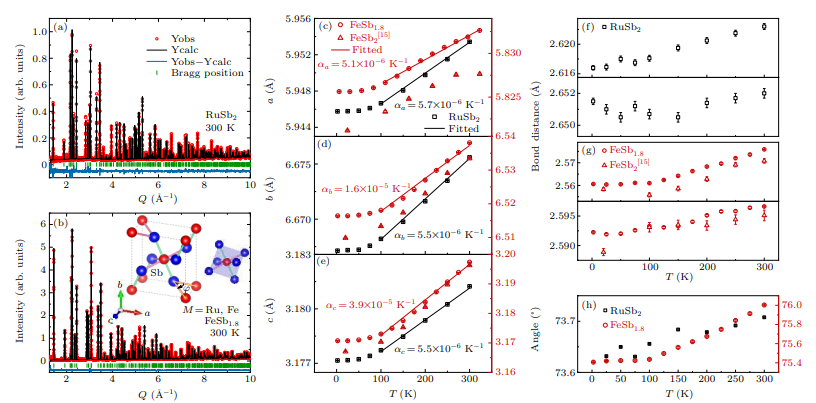
The family of transition-metal dipnictides, $MX_{2}$ ($M$: metal, $X$: N, P, As, Sb, and Bi), has emerged as an important quantum material system due to its unique physical properties, such as large magnetoresistance, colossal Seebeck coefficients, and Weyl semimetal characteristics. In order to study the $M$-site ions effect on the lattice structure and the related dynamics, we compared two isostructural compounds, FeSb$_{2}$ and RuSb$_{2}$. Neutron diffraction, specific heat, and Raman scattering spectra of RuSb$_{2}$ were measured. We found that the thermal expansion coefficients are isotropic for RuSb$_{2}$, in contrast to the anisotropic behavior reported previously in FeSb$_{2}$. Moreover, the specific heat of RuSb$_{2}$ shows a boson-like anomaly around 25 K. Four of the six predicted vibrational modes were identified by polarized Raman scattering spectra and successfully simulated by ab initio calculations. Meanwhile, the temperature-dependent linewidths reveal that phonon-phonon interactions might dominate above 50 K, while electron-phonon coupling remains relatively weak.
|