|
|
In-plane negative magnetoresistance and quantum oscillations in van der Waals antiferromagnet DyTe3
Hot! 
Qi Qi(齐琦), Senhao Lv(吕森浩), Ke Zhu(祝轲), Yaofeng Xie(谢耀锋), Guojing Hu(胡国静), Zhen Zhao(赵振), Guoyu Xian(冼国裕), Yechao Han(韩烨超), Yang Yang(杨洋), Lihong Bao(鲍丽宏), Xiao Lin(林晓), Hui Guo(郭辉), Haitao Yang(杨海涛), and Hong-Jun Gao(高鸿钧)
Chin. Phys. B, 2025, 34 (7):
077305.
DOI: 10.1088/1674-1056/adcc87
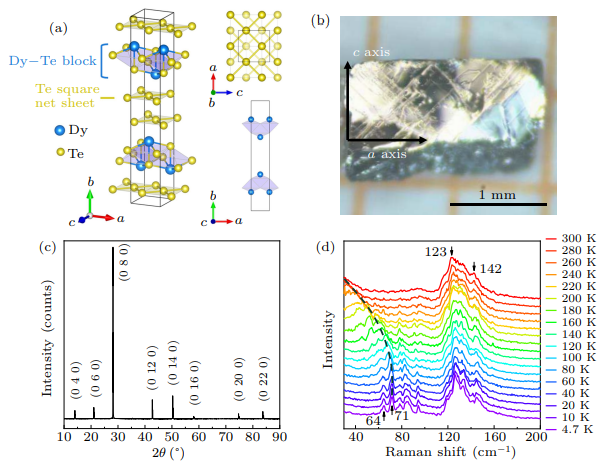
Two-dimensional van der Waals (vdW) magnetic materials, characterized by their tunable magnetism, spin transport properties, and remarkable quantum effects, provide significant promise for the development of efficient, low-power spintronic devices. Intriguingly, the rare earth tritelluride ($R$Te$_3$) materials have attracted great attention due to their unique magnetic structure, exotic electronic properties, multiple charge density wave (CDW), and superconductivity under pressure. Here, we report the successful synthesis of high-quality DyTe$_{3}$ single crystals using a self-flux method. DyTe$_{3}$ shows an antiferromagnetic transition at 4.5 K and demonstrates the magnetic field-induced ferromagnetism. The high-quality DyTe$_{3}$ single crystal demonstrates outstanding transport properties, featuring a high carrier mobility of approximately 1.4$\times10^{4}$ cm$^{2}\cdot$V$^{-1}\cdot$s$^{-1}$ and large linear magnetoresistance of 1300%. Furthermore, distinct Shubnikov-de Haas (SdH) oscillations are observed in DyTe$_{3}$, revealing a small Fermi pocket and an effective mass of 0.24 $m_{\rm e}$. Remarkably, the unconventional in-plane negative magnetoresistances appear along the $a$-axis below 2 T and $c$-axis until 9 T from 2 K to 17 K, which are attributed to the complex helimagnetic structures caused by CDW coupling and weak single-ion anisotropy. Our findings offer a significant platform for understanding the complex magnetoresistance behavior and quantum transport effects in $R$Te$_{3}$-type materials, holding great promise for advancing applications in electronic and spintronic devices.
|