|
|
Phonon bottleneck effect due to finite shrinking gap revealed by high-pressure ultrafast dynamics
Hot! 
Yanling Wu(吴艳玲), Q. Wu(吴穹), X. Yin(尹霞), Y. X. Huang(黄逸轩), Takeshi Nakagawa, Z. Y. Tian(田珍耘), Fei Sun(孙飞), Q. M. Zhang(张清明), Jun Chang(昌峻), Ho-kwang Mao(毛河光), Yang Ding(丁阳), and Jimin Zhao(赵继民)
Chin. Phys. B, 2026, 35 (3):
037802.
DOI: 10.1088/1674-1056/ae3122
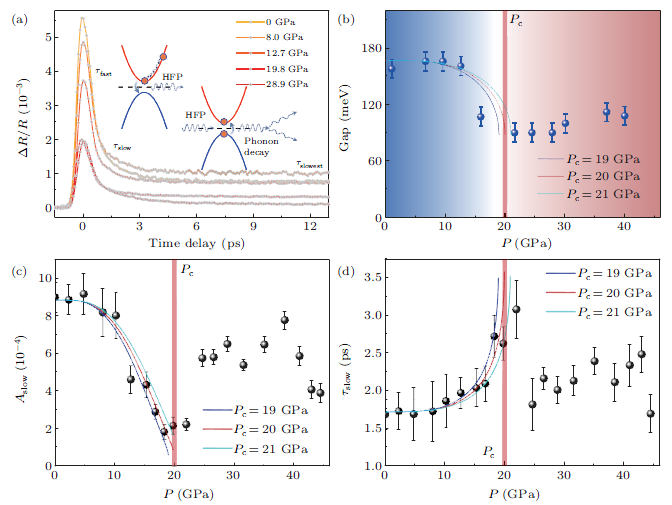
High-pressure ultrafast dynamics has been recently developed, enabling the exploration of non-equilibrium properties of various quantum materials under high pressure. Particularly, by investigating the pressure dependence of time-resolved ultrafast dynamics, we have discovered a pressure-induced phonon bottleneck effect (PBE). To date, all reported PBEs are due to fully closed gaps, which was reflected in the simultaneous characteristic changes in both amplitude and lifetime of the phonon-phonon scattering slow relaxation component. However, as reflected through its connection to Euler disk, incompletely closed gaps can also induce PBEs. In this work, we report the first PBE due to a finite shrinking gap. As is known, it is challenging to directly observe high-pressure-induced variations in electronic band gaps due to the diamond anvil cell. Here, by investigating Sr$_{{2}}$IrO$_{{4}}$ in our previous work, we obtain an empirical formula for the pressure-induced energy gap variation at room temperature. Our quantitative analysis shows that the gap is finite shrinking rather than fully closed.
|