Loading...

Table of contents

    28 May 2026, Volume 35 Issue 6 Previous issue   
    RAPID COMMUNICATION
    Many-body multipole indices revealed by real-space dynamical mean-field theory
    Guoao Yang(杨国骜), Jianhui Zhou(周建辉), and Tao Qin(秦涛)
    Chin. Phys. B, 2026, 35 (6):  060301.  DOI: 10.1088/1674-1056/ae48c3
    Abstract ( 42 )   PDF (852KB) ( 14 )  
    Multipole moments, fundamental characteristics of insulating materials, have garnered significant interest with the recent emergence of higher-order topological insulators. However, a practical method to explore them in correlated insulators is still lacking. Here, we introduce a systematic approach, which combines the general Green’s function formula for multipoles with real-space dynamical mean-field theory, to calculate multipole moments in correlated materials. Our demonstration calculations for the correlated two-dimensional Benalcazar-Bernevig-Hughes model are consistent with symmetry analysis. This method opens a new avenue to study topological phase transitions in correlated multipole insulators and other crucial physical quantities closely related to multipole moments.
    Experimental demonstration of quantum optimal control via the alternating control-evolution protocol
    Ruiqi Tang(汤睿琪), Yanjun Hou(侯彦君), Zhenyue Du(杜臻越), Zhuoyue Xu(徐卓越), Yuquan Chen(陈昱全), Zhaokai Li(李兆凯), and Xinhua Peng(彭新华)
    Chin. Phys. B, 2026, 35 (6):  060302.  DOI: 10.1088/1674-1056/ae56e0
    Abstract ( 7 )   PDF (2488KB) ( 7 )  
    As a crucial component of quantum technologies, quantum optimal control enables the high-fidelity engineering of desired quantum states and operations. Conventional approaches, such as the widely used gradient ascent pulse engineering (GRAPE) algorithm, typically rely on dense pulse sequences with a large number of control parameters, leading to inefficient optimization and increased sensitivity to experimental imperfections. In this work, we propose the alternating control–evolution (ACE) protocol, a flexible framework that constructs quantum operations by interleaving elementary control operations with tunable free evolutions, thereby enabling the design of sparse pulse sequences that exploit intrinsic system dynamics. This design substantially reduces the number of control parameters while retaining high expressibility and control fidelity. Numerical simulations on nuclear magnetic resonance systems show that the ACE protocol achieves more than a 20-fold reduction in the number of control parameters compared to GRAPE, with comparable fidelity in state preparation tasks. We further experimentally validate the ACE protocol on a four-qubit NMR platform by preparing a Greenberger–Horne–Zeilinger (GHZ) state with a fidelity of 99.52%. These results demonstrate that the ACE protocol provides an efficient and experimentally robust strategy for quantum optimal control, particularly suitable for the noisy intermediate-scale quantum (NISQ) era.
    GENERAL
    Dynamics of spin-orbital-angular-momentum coupled Bose-Einstein condensates on a ring
    Lin Wen(文林), Yi-Han Huang(黄燚寒), Lei Zhao(赵磊), Xu Qiu(邱旭), and Ming-Yue Yang(杨明月)
    Chin. Phys. B, 2026, 35 (6):  060305.  DOI: 10.1088/1674-1056/ae5b5c
    Abstract ( 15 )   PDF (465KB) ( 8 )  
    We investigate the dynamics of a two-component Bose-Einstein condensate subject to spin-orbital-angular-momentum coupling and confined to a ring, via the variational approach. Adopting a single-mode approximation by assuming that the BEC carries a single angular momentum for SU(2)-symmetric spin interactions, the equations of motion for the variational parameters are derived. The phase diagram of the ground state in the plane of the Raman coupling and detuning contains three different phases which meet at a tricritical point, and the exact phase boundaries between the three phases are determined. Linear stability analysis shows that the stationary state is dynamically stable, and there exists an oscillation eigenmode with frequency determined by detuning, angular momentum, and Raman coupling. The time-evolution results indicate that the spin vector undergoes periodic rotation along a closed orbit on the Bloch sphere, which can be interpreted as a precession of the collective spin around an effective field determined by the Raman coupling strength, the detuning, and the angular momentum.
    SPECIAL TOPIC — Biophysical circuits: Modeling & applications in neuroscience
    Chaotic bursting and burst synchronization in a discrete dual-Rulkov neural network with memristive synaptic coupling
    Ke Meng(孟珂), Yifan Bu(卜一帆), Yinghong Cao(曹颖鸿), Suo Gao(高锁), Qi Li(李琦), Chunpeng Wang(王春鹏), and Jun Mou(牟俊)
    Chin. Phys. B, 2026, 35 (6):  060501.  DOI: 10.1088/1674-1056/ae5f06
    Abstract ( 12 )   PDF (9168KB) ( 0 )  
    A discrete dual-Rulkov neural network with memristive synaptic coupling is constructed to investigate chaotic bursting dynamics and burst synchronization. First, a memristive synapse model suitable for discrete-time neurons is established, and its pinched hysteresis loop (PHL) fingerprint and local activity are verified. Based on this synapse model, a five-dimensional memristively coupled discrete neural system is formulated. By combining Lyapunov exponent spectra (LEs), bifurcation analysis, and equilibrium stability analysis, chaotic and hyperchaotic bursting behaviors induced by variations in the coupling gain are revealed, together with their dynamical evolution characteristics. Furthermore, to characterize irregular spiking activities during chaotic bursting, a joint framework based on the phase-locking value (PLV) and burst envelope correlation (EnvCorr) is introduced, through which three bursting regimes, namely, in-phase bursting (IPB), phaseshifted bursting (PSB), and desynchronized bursting (DB), are identified. Finally, a digital signal processor (DSP)-based real-time hardware implementation is carried out, and the good qualitative agreement between experimental and numerical results demonstrates the physical feasibility of the proposed model.
    Meminductor synaptic coupling in a heterogeneous HR-FHN neuron network: Model, dynamics, and DSP implementation
    Yang Yin(尹扬) and Zhijun Li(李志军)
    Chin. Phys. B, 2026, 35 (6):  060503.  DOI: 10.1088/1674-1056/ae56e2
    Abstract ( 6 )   PDF (3369KB) ( 1 )  
    To functionally emulate the history-dependent plasticity and electromagnetic induction effects inherent in biochemical synapses, this paper proposes a heterogeneous neural network model in which Hindmarsh–Rose (HR) neurons and FitzHugh–Nagumo (FHN) neurons are coupled via a synaptic connection composed of a meminductor in series with a resistor. This architecture explicitly decouples synaptic function: the linear resistor models the instantaneous conductive pathway, while the meminductor implements the history-dependent plastic pathway. The complex firing dynamics of the coupled system are systematically investigated through bifurcation diagrams, Lyapunov exponent spectra, phase portraits, and time-series analysis. The results show that variations in synaptic coupling strength and coupling resistance can induce transitions between diverse firing patterns, including chaotic spiking, periodic bursting, and alternations between periodic and chaotic states. Crucially, the meminductive synapse introduces activity-dependent multistability, manifested as the coexistence of multiple firing patterns determined by its initial internal state. Phase synchronization analysis further demonstrates that adjusting the coupling resistance provides an independent control mechanism that effectively enhances or suppresses synchronous firing between the two heterogeneous neurons, even at a fixed coupling strength. Finally, the physical feasibility of the system is validated through successful digital implementation on a digital signal processor (DSP) platform, as experimental measurements show excellent agreement with numerical simulations. This study establishes the meminductor as a biomimetically grounded element for chemical synapse emulation and provides a dynamically rich, hardware-validated platform for neuromorphic computing and information processing.
    Studying relationships from the perspective of chaos theory
    Xiyu Ren(任玺谕), Xianying Xu(徐宪莹), Xiaodong Liu(刘晓东), Minghui Zhang(张明会), Santo Banerjee, Suo Gao(高锁), and Jun Mou(牟俊)
    Chin. Phys. B, 2026, 35 (6):  060504.  DOI: 10.1088/1674-1056/ae27b6
    Abstract ( 11 )   PDF (10512KB) ( 0 )  
    The study of relationship emotions, a set of emotional and psychological responses that arise in a relationship, can help develop more humanized artificial intelligence, improve human–computer interaction, and even create more immersive experiences in virtual and augmented reality. Due to the nonlinear and feedback-driven nature of relational affect, which aligns closely with chaos theory, and the ability of leaky integrate-and-fire (LIF) neuron models to simulate dopaminerelated electrical activity in brain nuclei, this study innovatively integrates both approaches. By linking the membrane potential signals of LIF neurons to relational affect equations, it achieves a refined modeling of the mechanisms underlying relational affect generation. This paper adds the LIF neuron model to the relationship emotion model to construct a new LIF relationship emotion model (LRM). The effect of the parameters in the LRM on the relationship emotions generated by the model is investigated using numerical analysis. This includes the firing behavior produced by LIF neurons and a study of relationship emotions produced by different initial relationship emotion states under the same conditions. Finally, the feasibility of LRM is verified using a digital signal processing (DSP) platform. This process not only verifies the feasibility of LRM but also provides new ideas and methods for future research in affective computing and human–computer interaction.
    Multiple transitions between coherence resonances induced by mixed-mode bursting with complex fast-slow dynamics
    Lirui Yuan(袁理睿), Huaguang Gu(古华光), and Juntian Li(李钧天)
    Chin. Phys. B, 2026, 35 (6):  060506.  DOI: 10.1088/1674-1056/ae5520
    Abstract ( 9 )   PDF (5429KB) ( 27 )  
    Coherence resonance (CR) in neurons, which highlights the beneficial effects of noise, is generally induced from the resting state. In this study, multiple transitions between CR and anti-CR arise from mixed-mode bursting that includes a quiescent state (QS), bursting, and other dynamic behaviors. In addition to beginning from a saddle-node bifurcation and terminating at a limit-point bifurcation, the burst exhibits other special fast-slow dynamics, i.e., shuttling back and forth across the limit-point bifurcation twice to form two clusters of multiple spikes. These clusters are induced by cooperation among three factors: the coexistence of a stable focus and a limit cycle separated by an unstable limit cycle, the weak attraction of the stable focus due to the small negative real parts of its eigenvalues, and the dependence of the slow-variable nullcline on the membrane potential. Weak noise ($D$) can induce various numbers of clusters, resulting in various interburst intervals (IBIs) and burst durations (BDs). For strong $D$, the burst begins at a delayed phase and terminates at an advanced phase, resulting in the disappearance of the clusters and shortened IBIs and BDs. With increasing $D$, the number of clusters increases, decreases, increases, and then decreases, which induces similar changes in the coefficients of variation of the IBIs and BDs, i.e., multiple transitions between CR and anti-CR. The results include the special dynamics of a burst, a novel example of CR, the dynamic mechanism of CRs, and potential functions of synaptic noise in bursting neurons.
    GENERAL
    Modulation of multi-timescale compound Ca-NMDA-Na oscillations in pyramidal neuron by extracellular electric fields
    Yaqin Fan(樊亚琴), Meili Lu(卢梅丽), and Xile Wei(魏熙乐)
    Chin. Phys. B, 2026, 35 (6):  060508.  DOI: 10.1088/1674-1056/ae0897
    Abstract ( 12 )   PDF (1503KB) ( 0 )  
    Evidence shows that there exist dendritic Ca$^{2+}$-spike-dependent and NMDA-spike-dependent multi-timescale compound oscillations in epileptiform activity, and the electric field (EF) plays a significant role in the propagation of compound oscillations. However, it is still unclear how the EF-induced spatial polarization modulates the interaction between dendritic Ca$^{2+}$ oscillations and NMDA oscillations, and subsequently influences somatic Na$^{+}$ spikes. To address this issue, we built a biophysical pyramidal neuron model with complex dendritic morphology, which is capable of reproducing multi-timescale neuronal oscillations observed in epileptiform discharges. By investigating the EF stimulation thresholds for triggering dendritic Ca$^{2+}$ and NMDA spikes as well as somatic Na$^{+}$ discharges, we found that the dendritic depolarization first activates dendritic Ca$^{2+}$ oscillations, subsequently leading to the generation of dendritic NMDA oscillations, which together facilitate Na$^{+}$ spike generation by counteracting somatic hyperpolarization. Finally, we proposed a minimal three-compartment neuronal model that successfully reproduces the Ca-NMDA-Na compound oscillations. Through singular perturbation and bifurcation analysis, we demonstrated the modulatory influence of EF on multi-timescale neuronal compound oscillations. Additionally, our results indicate that the EF-induced depolarization at the apical dendrite causes the system equilibrium point to experience an invariant circle saddle-node bifurcation to trigger dendritic Ca$^{2+}$ oscillations. These oscillations then drive the basal dendrite to generate dendritic NMDA oscillations by experiencing a subcritical Hopf bifurcation. In this case, the soma experiences a subcritical Hopf bifurcation to produce Na$^{+}$ spikes. These results provide valuable insights into the mechanisms underlying the generation of epileptiform discharges in the brain, which is helpful for developing therapeutic strategies for epilepsy.
    RAPID COMMUNICATION
    Thermodynamic and real-time dynamic properties of complex Sachdev-Ye-Kitaev model
    Sizheng Cao(曹思政), Xian-Hui Ge(葛先辉), and Yi-Cheng Rui(芮易成)
    Chin. Phys. B, 2026, 35 (6):  060512.  DOI: 10.1088/1674-1056/ae48c6
    Abstract ( 8 )   PDF (1429KB) ( 2 )  
    We study the complex Sachdev–Ye–Kitaev (cSYK) model numerically and investigate the thermodynamic behavior of the cSYK model across varying chemical potentials. We discover that the cSYK model remarkably mirrors the first-order phase transition seen in the van der Waals–Maxwell system, culminating at a non-mean-field critical point with distinctively different critical exponents. We analyze in detail the similarity between the van der Waals phase transition and the cSYK model, and further explore the mechanism by which the chemical potential drives the phase transition in the system. Exact diagonalization at finite N resolves the conserved U(1) charge sectors, showing that the chemical potential reshapes the density of states. Within each charge sector we find a strong level repulsion, while mixing sectors shows a Poisson distribution. The normalized spectral form factor displays a clear dip-ramp-plateau at low temperature for the neutral case, whereas for non-vanishing chemical potential the ramp is weakened by finite N reweighting of small edge sectors and only becomes visible at relatively high temperatures. Real-time dynamics, analyzed via analytical continuation of Schwinger–Dyson equations, show rapid decay in the gapless phase and prolonged oscillation lifetimes in the gapped regime. Spectral functions imply a shift from a continuous to a discrete energy level distribution, emphasizing the critical role of chemical potential in shaping spectral properties.
    GENERAL
    Characterization of picosecond-scale response time of superconducting NbN hot electron bolometric mixers
    Guoao Xie(谢国傲), Ruixuan Tang(唐睿轩), Zhengheng Luo(罗政恒), Jiameng Wang(王家萌), Kangmin Zhou(周康敏), Wei Miao(缪巍), Wen Zhang(张文), Yuan Ren(任远), and Shengcai Shi(史生才)
    Chin. Phys. B, 2026, 35 (6):  060601.  DOI: 10.1088/1674-1056/ae067a
    Abstract ( 14 )   PDF (786KB) ( 1 )  
    A superconducting hot electron bolometer (HEB) mixer is an ultra-sensitive detector widely used for heterodyne detection of electromagnetic radiation, particularly at terahertz (THz) and submillimeter wavelengths. The response time of an HEB mixer is a critical parameter that defines its dynamic properties. In this work, we employ a pump-probe optical technique to investigate how the response time varies with temperature and bias voltage. Our measurements, conducted at 7 K under bias voltages of 1 mV and 2 mV, reveal a response time of approximately 40 ps. The pump-probe method was introduced to measure the HEB response time for the first time, overcoming conventional electronic bandwidth limitations and achieving picosecond-scale temporal resolution to characterize its ultrafast dynamics in the time domain. Additionally, the results not only reflect the intermediate-frequency noise bandwidth performance of the device but also provide direct guidance for material and fabrication process verification.
    In-situ measurement of cell temperature by spin-relaxation rate analysis for an atomic magnetometer
    Bing-Quan Zhao(赵丙权), Zhe Qi(祁喆), Jian-Long Wang(王建龙), Li-Hua Wu(武丽花), Qian-Yun Zhao(赵倩云), Jun-Xin Wei(韦俊新), Wei-Ren Liu(刘为任), and Ling-Xin Kong(孔令鑫)
    Chin. Phys. B, 2026, 35 (6):  060703.  DOI: 10.1088/1674-1056/ae07bf
    Abstract ( 7 )   PDF (869KB) ( 2 )  
    Alkali-metal vapor cells are the core sensing components of atomic magnetometers. To achieve high-sensitivity magnetic field measurements, the cells require heating and stabilization at high temperatures. Here, we propose an in-situ temperature measurement method for a vapor cell of an atomic magnetometer based on spin-relaxation analysis. This technique establishes a direct functional correlation between the cell temperature and the spin-relaxation rate under low pumping power conditions. Experimental validation within the temperature range of 90 $^\circ$C-130 $^\circ$C confirms the accuracy of this approach. We further investigate the effects of magnetic fields on measurement precision and demonstrate the long-term, high-precision capabilities of temperature detection. This non-invasive technique presents a critical advantage for precise thermal optimization of atomic magnetometers.
    REVIEW
    Multi-beam scanning electron microscope (MBSEM): Technological evolution, core breakthroughs, and cross-field applications
    Wuyang Tan(谭吴洋), Mengni Liu(刘梦妮), Ke Pei(裴科), Chendi Yang(杨辰迪), Jiazhuan Qin(覃家转), Chao Wang(王超), Xuebing Zhao(赵雪冰), and Renchao Che(车仁超)
    Chin. Phys. B, 2026, 35 (6):  060705.  DOI: 10.1088/1674-1056/ae4c69
    Abstract ( 6 )   PDF (1332KB) ( 0 )  
    Multi-beam scanning electron microscope (MBSEM) reconciles the inherent contradiction between “resolution and throughput” of traditional scanning electron microscopes (SEMs) through parallel electron beam manipulation, emerging as a key technology to address the bottlenecks in large-volume, high-resolution imaging and advanced industrial inspection. This article provides a comprehensive overview of MBSEM, covering its evolutionary course of technology, core design fundamentals, and interdisciplinary applications. First, it sorts out the evolutionary process from conceptualization in the early 21st century to commercialization in the 2010s, clarifying the core logic of breaking through the physical limitations of single-beam systems via “multi-beam parallelism”. Subsequently, focusing on the core technological chain of “beam generation–optical focusing–signal detection–data processing”, it conducts an in-depth analysis of the design concepts, technical characteristics, and applicable scenarios of three mainstream architectures: the single-source single-column, split optical system, and semiconductor-specific multi-beam inspection (MBI). Combined with representative research and product data from teams such as Delft University of Technology, Zeiss, and ASML/HMI, it reveals the differentiated advantages of each architecture in beam uniformity (the relative deviation percentage of the current density and probe size of each sub-beam in the multi-beam array from the central beam, with a smaller deviation value indicating better uniformity) and signal crosstalk (the percentage of the interference signal intensity to the target signal intensity when the detection signal of a single beam in the multi-beam array interferes with the detection channel of adjacent beams) control, and throughput (the percentage of the interference signal intensity to the target signal intensity when the detection signal of a single beam in the multi-beam array interferes with the detection channel of adjacent beams) improvement. Finally, integrating the practical demands of neuroscience connectomics, advanced semiconductor manufacturing processes, and biomedicine, it elaborates on the application breakthroughs of MBSEM in the three-dimensional (3D) reconstruction of large-volume brain tissue, wafer defect screening for 7 nm and smaller nodes, and low-damage imaging of thin biological tissues, and compares its disruptive value relative to traditional technologies (single-beam SEM, optical inspection).Unlike previous reviews, this work systematically integrates both academic prototypes and industrial systems for the first time, providing an in-depth analysis of the differentiated trade-offs among imaging speed, resolution, and sample adaptability across different architectures, offering a systematic reference for MBSEM R & D and interdisciplinary applications.
    DATA PAPER
    High-precision calculations of highly excited and autoionizing states of the nickel atom
    Sheng-Bo Niu(牛生波), Jun-Yao Zhang(张钧尧), Rui Jin(金锐), and Yi-Zhi Qu(屈一至)
    Chin. Phys. B, 2026, 35 (6):  063101.  DOI: 10.1088/1674-1056/ae2a01
    Abstract ( 25 )   PDF (1109KB) ( 7 )  
    High-precision atomic data, including highly excited energy levels and their lifetimes, as well as autoionizing states, are essential for astrophysics, materials science, and energy research applications. Despite the increasing demand for high-precision databases, the availability of data concerning complex transition-metal atoms remains limited. In this work, we present a systematic high-precision theoretical study of highly excited and autoionizing states of the nickel atom for $J^{\pi } = 4^{-}$ symmetry, considering the indispensable correlation effects between bound and continuum configurations. Calculations for discrete highly excited states and autoionizing states are conducted under the same theoretical scheme, which employs the relativistic multichannel theory (RMCT), to obtain an eigenchannel scattering matrix that varies smoothly over a wide energy region. The scattering matrix is then used with the multichannel quantum defect theory (MQDT) to semi-analytically obtain highly excited states and autoionizing states. Excellent agreement is achieved between the theoretical results and existing experimental discrete levels with a maximum of 0.02% deviation. An abnormal lifetime variation of the autoionizing states along the same series is observed. The resonance energy, lifetime, and assignment of autoionizing states are systematically presented for the first time, with the objective of contributing to the fields of astrophysics, materials science, and energy research. The datasets presented in this paper, including the energy levels and lifetimes of autoionizing states, are openly available at https://doi.org/10.57760/sciencedb.j00113.00279.
    SPECIAL TOPIC — Advances in thorium nuclear optical clocks
    Robust excitation of 229Th via generalized composite pulses: Compensating generic errors across arbitrary pulse shapes
    Rui Zhao(赵睿), and Yingdan Wang(王颖丹)
    Chin. Phys. B, 2026, 35 (6):  063201.  DOI: 10.1088/1674-1056/ae4e8d
    Abstract ( 9 )   PDF (423KB) ( 0 )  
    High-fidelity coherent control is a universal challenge due to complex errors and imperfect pulse shapes. Here, we propose a generalized composite pulses scheme independent of pulse profile to correct generic errors. This approach could simultaneously compensate for pulse area errors, detuning, and phase imperfections. We demonstrate its application in the direct laser excitation of the 229Th nucleus isomer state, and show a significant improvement in the robustness against various operation errors, such as detuning, phase error, and pulse area error.
    RAPID COMMUNICATION
    Accurate electron affinity of atomic rhodium and fine structure of its anion
    Jiayi Chen(陈嘉逸), Rui Zhang(张瑞), Wenru Jie(揭文茹), Qihan Liu(柳淇瀚), and Chuangang Ning(宁传刚)
    Chin. Phys. B, 2026, 35 (6):  063202.  DOI: 10.1088/1674-1056/ae5173
    Abstract ( 9 )   PDF (304KB) ( 1 )  
    Rhodium (Rh) is a rare and expensive metal, mainly used as a catalyst. Investigating its electronic structure aids in elucidating the mechanisms that govern catalytic reactions. In this work, we employed the high-resolution slow-electron velocity-map imaging (SEVI) method to measure the electron affinity (EA) of Rh and the electronic structure of its atomic anion Rh$^{-}$. The EA of the Rh atom was determined to be 9216.8(4) cm$^{-1}$ or 1.14273(5) eV, representing a fourfold enhancement in precision over the previous best result. Moreover, the energy levels of Rh$^-$ were measured to be 0.41178(15) eV ($ {}^{3}{\rm F}_{2}$) and 0.28668(7) eV ($ {}^{3}{\rm F}_{3}$) above the ground state $^{3}{\rm F}_{4}$, with an accuracy improved by factors of 110 and 50, respectively, compared to earlier measurements.
    SPECIAL TOPIC — Advances in thorium nuclear optical clocks
    Shortcut to adiabatic isomeric population transfer of the 229Th nucleus via hyperfine electronic bridge
    Bo Liu(刘博), Wu Wang(王武), and Yong Li(李勇)
    Chin. Phys. B, 2026, 35 (6):  064201.  DOI: 10.1088/1674-1056/ae39ce
    Abstract ( 4 )   PDF (361KB) ( 0 )  
    The $^{229}$Th nucleus is well known for its exceptionally low-lying nuclear isomeric level, which provides a unique platform for exploring electron-nucleus interactions and gives rise to a variety of rich physical phenomena. One such phenomenon is the hyperfine electronic bridge, which has recently been shown to enable efficient and precise manipulation of the nuclear isomeric levels of $^{229}$Th [Phys. Rev. Lett. 133 223001 (2024)]. However, that study used the stimulated Raman adiabatic passage method, which requires relatively long operation times. In this work, we employ the stimulated Raman shortcut-to-adiabatic passage method, which dramatically shortens the operation time from the order of hundreds of milliseconds to hundreds of microseconds while maintaining a transfer efficiency of about 79.38%.
    INVITED REVIEW
    Phonons at functional oxide interfaces: An in situ sum-frequency spectroscopic perspective
    Shiyu Zhang(张诗雨), Junjie Dong(董俊杰), Tongying Liu(刘彤影), and Wei-Tao Liu(刘韡韬)
    Chin. Phys. B, 2026, 35 (6):  064203.  DOI: 10.1088/1674-1056/ae5787
    Abstract ( 11 )   PDF (1340KB) ( 1 )  
    Functional oxides host emergent interfacial phenomena from superconductivity to catalysis, intimately tied to lattice phonons that mediate many-body interactions. Sum-frequency generation (SFG) spectroscopy, a second-order nonlinear optical technique with intrinsic surface specificity, enables in situ and operando probing of lattice vibrations at surfaces and interfaces. In this review, we introduce the basic theory of SFG and survey its application in investigating functional oxide surfaces and interfaces - tracking oxygen vacancies on anatase TiO$_{2}$, unveiling electron-phonon coupling modulation in LaAlO$_{3}$/SrTiO$_{3}$ heterostructures, and detecting polaronic signatures in Nb-doped SrTiO$_{3}$ - thereby offering microscopic insights into the physics of oxide interfaces.
    RAPID COMMUNICATION
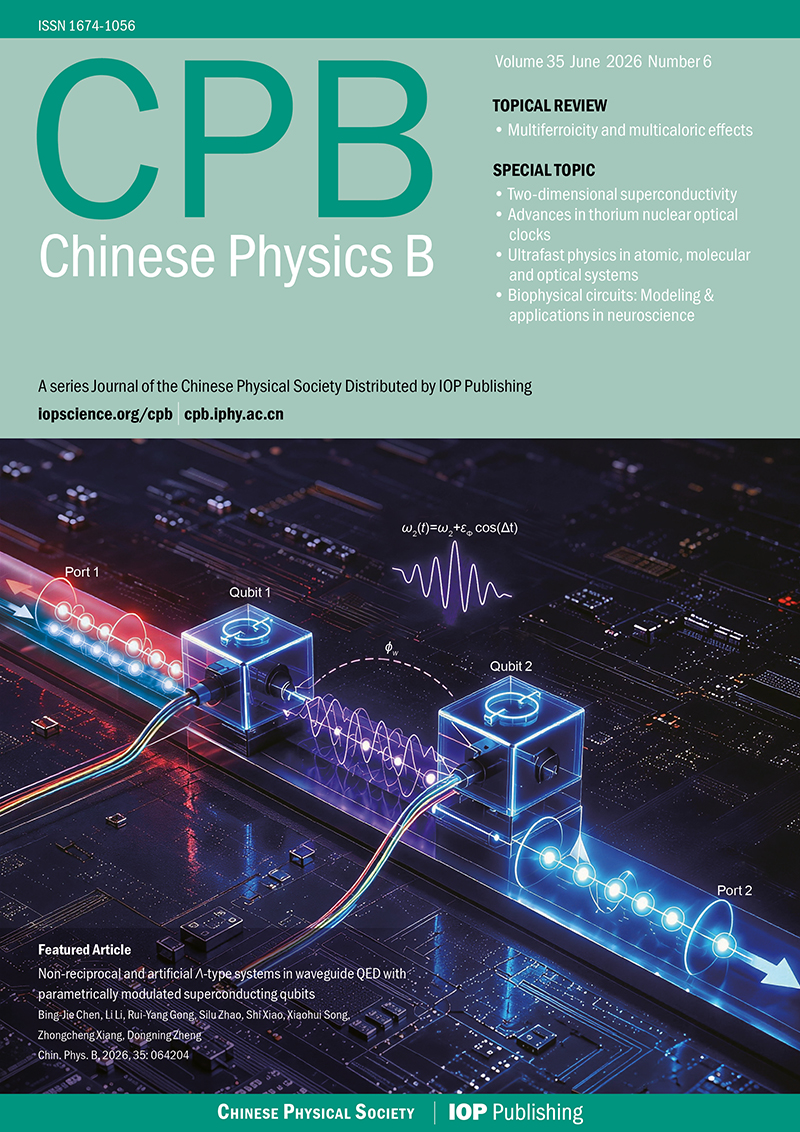
    Non-reciprocal and artificial Λ-type systems in waveguide QED with parametrically modulated superconducting qubits
    Bing-Jie Chen(陈炳杰), Li Li(李力), Rui-Yang Gong(龚锐洋), Silu Zhao(赵思路), Shi Xiao(肖师), Xiaohui Song(宋小会), Zhongcheng Xiang(相忠诚), and Dongning Zheng(郑东宁)
    Chin. Phys. B, 2026, 35 (6):  064204.  DOI: 10.1088/1674-1056/ae4f71
    Abstract ( 10 )   PDF (2749KB) ( 0 )  
    We present a non-local quantum system based on a waveguide QED architecture, comprising two spatially separated and largely detuned superconducting transmon qubits. By applying parametric frequency modulation to one of the qubits, we establish a tunable coherent channel between the two far-detuned qubits, thereby forming an L-type three-level system. We demonstrate that tuning the modulation amplitude enables the observation of spectral evolution from electromagnetically induced transparency (EIT) to Autler–Townes splitting (ATS). Furthermore, by exploiting the interplay between the non-local waveguide phase and system dissipation, the system achieves significant non-reciprocal microwave transmission and direction-selective photon emission. The scheme operates without external magnetic fields, offering an efficient pathway for realizing on-chip integrated quantum routers and isolators.
    Fast-moving target tracking by dual-geometric moment detection
    Chao Shen(申超), Xu-Ri Yao(姚旭日), Fan Liu(刘璠), and Shijian Li(李世剑)
    Chin. Phys. B, 2026, 35 (6):  064205.  DOI: 10.1088/1674-1056/ae4c73
    Abstract ( 10 )   PDF (602KB) ( 1 )  
    This paper presents a high-speed single-pixel tracking method that exceeds the modulation speed limit of the digital micromirror device (DMD) in conventional approaches. The proposed method adopts a polarization system to split the target image into two identical beams, which are modulated by two orthogonal steady-state geometric moment patterns and input into the dual channels of the DMD. This allows separate extraction of the target's $x$- and $y$-direction positional information without DMD pattern switching. The localization speed is no longer constrained by DMD switching but determined by high-speed single-pixel detectors. Experimental results demonstrate a localization speed of 450 kHz, achieving a one-order-of-magnitude improvement over traditional DMD-based methods.
    ELECTROMAGNETISM, OPTICS, ACOUSTICS, HEAT TRANSFER, CLASSICAL MECHANICS, AND FLUID DYNAMICS
    A 51-dB signal-to-noise ratio carrier-envelope offset frequency in an environmentally stabilized polarization-maintaining optical frequency comb
    Yuyao Zong(宗玉瑶), Yi Han(韩羿), Jiawei Liu(刘佳伟), Cheng Ci(慈骋), Zhenyu Xue(薛振宇), and Shiying Cao(曹士英)
    Chin. Phys. B, 2026, 35 (6):  064206.  DOI: 10.1088/1674-1056/ae0924
    Abstract ( 13 )   PDF (1771KB) ( 0 )  
    A femtosecond optical frequency comb (OFC) based on a laser with a nonlinear amplification loop mirror mode-locking mechanism is proposed. The laser adopts a fully polarization-maintaining (PM) structure, which can realize self-starting mode-locking at the center wavelength of 1560.2 nm with a 195.65 MHz repetition rate at a pump power of 630 mW, and the frequency stability after phase-locking is 1.95$\times10^{-12}$ with a 1-s averaging time. Through a homemade $f$-2$f$ interferometer, the detected free-running $f_{\rm ceo}$ signal exhibits a signal-to-noise ratio (SNR) as high as 51 dB. After phase-locking, $f_{\rm ceo}$ has a frequency stability of 1.17$\times 10^{-11}$ with a 1-s averaging time.
    Distorted dislocations and OAM spectra of twisted partially coherent noncanonical vortex-pair beams in non-Kolmogorov atmospheric turbulence
    Chao Mei(梅超), Ke Cheng(程科), Hao Guo(郭豪), and Xiao-Wen Yi(易小雯)
    Chin. Phys. B, 2026, 35 (6):  064207.  DOI: 10.1088/1674-1056/ae07c1
    Abstract ( 10 )   PDF (3392KB) ( 0 )  
    The twist phase has recently exhibited better resistance to turbulence-induced degeneration of the signal mode in orbital angular momentum (OAM) spectra. However, our attention is paid to exploring the combined influence of the twist factor and noncanonical strength on “distorted dislocation” and OAM spectra in non-Kolmogorov atmospheric turbulence by introducing a noncanonical vortex-pair to twisted partially coherent beams. It is found that the twist factor or noncanonical strength can distort concentric ring dislocations in spatial correlation singularities into the so-called “distorted dislocations”. In turbulence propagation, noncanonical strengths can lead to annihilation and creation of distorted dislocations and change the number of dislocations, but twist factors cannot affect their number except for deepening the distortion in the structures. The explicit expression of the OAM flux density per photon, which was also derived, indicates that noncanonical strength can further improve the OAM capacity even if the twist factor reaches its extreme value. Compared to the twist factor, the noncanonical strength plays a more significant role in the signal modulation and detectivity of OAM spectra. If the combined effect of the twist factor and noncanonical strength is considered, the detection performance of the signal mode during long-distance turbulence propagation is distinctly better than that of only the twist factor or the noncanonical strength. The noncanonical strength should not be ignored due to its better performance in the OAM capacity and detection probability of the signal mode. This work may provide inspiration for OAM-based optical communication by the modulation of multi-degrees of freedom associated with noncanonical strengths and twist factors.
    Broadband multi-region sound insulator by utilizing quasi-Sierpinski carpet structure
    Saeed Aliakbarzadeh and Ali Bahrami
    Chin. Phys. B, 2026, 35 (6):  064302.  DOI: 10.1088/1674-1056/ae063a
    Abstract ( 7 )   PDF (12780KB) ( 2 )  
    The effects of rotation, size, and geometric shape of rods within a quasi-Sierpinski carpet fractal structure on bandgap behavior were investigated. In the first stage of the Sierpinski carpet ($L=1$), rotating the central rod from 0$^{\circ}$ to 45$^{\circ}$ led to a slight increase in the bandgap width at frequencies between 0 kHz and 5 kHz. In the second stage ($L=2$), rotating the side rods gradually expanded the bandgap width, increasing it from approximately 2.7 kHz to over 3.3 kHz. Although the bandgaps in the third stage ($L=3$) were narrower compared to those in the previous two stages, new bandgaps appeared at frequencies between 16 kHz and 20 kHz. Varying the size of the central rod from $a/27$ to $a/2$ led to an overall increase in the bandgap size from 1 kHz to 3.65 kHz. Geometric modifications also played a significant role in bandgap size; for instance, the use of a dodecagonal central rod generated the widest bandgap of 3.42 kHz, while the combination of a diamond-shaped central rod with circular side rods resulted in a bandgap size of 2.19 kHz. The results indicate that such modifications can significantly optimize the bandgaps in terms of both frequency position and width. These findings can contribute to the design of advanced materials for applications such as acoustic insulation, vibration reduction, and mechanical wave control.
    PHYSICS OF GASES, PLASMAS, AND ELECTRIC DISCHARGES
    Noise reduction via dual-grid charge averaging
    Haiyun Tan(谭海云), Tianyuan Huang(黄天源), Peiyu Ji(季佩宇), Liang Xu(徐亮), and Xuemei Wu(吴雪梅)
    Chin. Phys. B, 2026, 35 (6):  065201.  DOI: 10.1088/1674-1056/ae1018
    Abstract ( 14 )   PDF (895KB) ( 2 )  
    Numerical heating in particle-in-cell simulations arises primarily from statistical noise during the deposition process, which has long been a critical bottleneck limiting long-term simulation accuracy. This work proposes a dual-grid scheme that enhances sampling accuracy by leveraging complementary spatial information from two staggered grids, thereby reducing statistical noise. Analytical derivations show that, through its distinctive deposition mechanism, the scheme effectively elevates bilinear interpolation to a higher-order formulation. Numerical experiments validate this conclusion: compared to quadratic interpolation, the proposed method achieves comparable noise suppression and mitigation of noise-driven heating, while exhibiting superior capability in controlling grid heating and preserving energy conservation in long-term simulations. Most importantly, phase-space diagnostics confirm that the scheme delivers the highest simulation accuracy among the tested methods. These results demonstrate that the proposed approach provides an effective pathway for advancing noise control in particle-in-cell simulations.
    RAPID COMMUNICATION
    Improving electron beam quality in laser wakefield acceleration by using a plasma channel with an up-ramp density profile
    Xin-Hui Wen(温昕辉), Xin-Zhe Zhu(祝昕哲), Mo Li(李墨), Jian Gao(高健), Bo-Yuan Li(李博原), Jian-Long Li(李建龙), Lin-Lu(鲁林), Ze-Wu Bi(毕择武), Wen-Chao Yan(闫文超), Feng Liu(刘峰), and Min Chen(陈民)
    Chin. Phys. B, 2026, 35 (6):  065203.  DOI: 10.1088/1674-1056/ae4b2f
    Abstract ( 25 )   PDF (938KB) ( 5 )  
    Laser wakefield acceleration (LWFA) is a promising way for producing GeV-scale electron beams within a tabletop size. Increasing acceleration energy and reducing energy spread are extremely important for many applications. Here, we experimentally demonstrate that using a plasma channel with a longitudinally up-ramp density profile can simultaneously boost the accelerated electron energy and lower the final beam energy spread. In a plasma channel with uniform plasma density, electron beams with a peak energy of 250 MeV and a large energy spread (~40%) were obtained. In contrast, within a plasma channel of the same length with an up-ramp density profile, stable electron beams with energies up to 1 GeV and a small energy spread (~20%) were observed. Particle-in-cell simulations show that the plasma channel not only suppresses laser diffraction, but also affects the self-injection and acceleration of the electron beam. In the up-ramp plasma channel, the continual electron injection is suppressed and electrons can be locked in the acceleration phase for a longer duration, which leads to the reduction of energy spread and the increase of electron energy. This method provides a relatively simple and reliable way toward compact, high-performance tabletop electron accelerators.
    High-pressure synthesis, crystal structure, and electronic properties of Ba9Zr2.79Te15
    Runteng Chen(陈润滕), Guodong Wang(王国东), Zhe Wang(王哲), Wenmin Li(李文敏), Jianfa Zhao(赵建发), Zheng Deng(邓正), Heng Wang(王恒), Xiancheng Wang(望贤成), Jun Zhang(张俊), and Changqing Jin(靳常青)
    Chin. Phys. B, 2026, 35 (6):  066101.  DOI: 10.1088/1674-1056/ae521a
    Abstract ( 8 )   PDF (1166KB) ( 1 )  
    The polycrystalline Ba$_{9}$Zr$_{2.79}$Te$_{15}$ sample was prepared by employing a solid-state synthesis method under high-temperature and high-pressure conditions. Comprehensive characterizations of structural and electrical properties were performed. Ba$_{9}$Zr$_{2.79}$Te$_{15}$ crystallizes in a hexagonal lattice with the space group $P\bar{6}c$2 (No. 188) and lattice parameters $a = 10.1977(8)$ Å and $c = 20.2646(9)$ Å. It is mainly composed of face-sharing ZrTe$_{6}$ octahedral chains extending along the $c$-axis, which form a triangular lattice in the ab plane. The Te chains are located in the middle of the ZrTe$_{6}$ triangular lattice. Electrical transport measurements indicate that Ba$_{9}$Zr$_{2.79}$Te$_{15}$ is a semiconductor. The thermal activation band gap of 0.23 eV is qualitatively discussed when compared with that of its sister compound Ba$_{9}$Zr$_{3}$Se$_{15}$, proving that the p electrons in the Te chains, with high quantum number orbitals, dominate electron conduction. Furthermore, the Debye temperature of Ba$_{9}$Zr$_{2.79}$Te$_{15}$ is calculated to be 157.28(9) K from thermodynamic measurements. The newly synthesized Ba$_{9}$Zr$_{2.79}$Te$_{15}$ with quasi-one-dimensional chain characteristics provides an opportunity for further exploration of diverse physical properties.
    TOPICAL REVIEW — Two-dimensional superconductivity
    Spectroscopic studies of two-dimensional superconductivity
    Qiang-Jun Cheng(程强军), Xu-Cun Ma(马旭村), Qi-Kun Xue(薛其坤), and Can-Li Song(宋灿立)
    Chin. Phys. B, 2026, 35 (6):  066801.  DOI: 10.1088/1674-1056/ae4c6d
    Abstract ( 22 )   PDF (2651KB) ( 2 )  
    Two-dimensional superconductivity has become a major frontier in condensed matter physics. It holds the key to understanding the mechanism of high-temperature superconductors and offers an exceptional arena for stabilizing emergent quantum states enabled by enhanced electron correlations in reduced dimensionality. These states are frequently characterized by spatial modulations and intertwined with competing orders, calling for studies that combine real-space imaging with local spectroscopy. Scanning tunneling microscopy and spectroscopy meet this need by directly accessing the local density of states with lattice-scale resolution. In this review, we summarize recent advances in the study of several representative unconventional superconductors using this technique, focusing on the direct characterization of high-temperature super-conducting planes, pair-density waves, and topological superconductivity in both artificial heterostructures and intrinsic materials. We conclude by outlining current challenges and future directions motivated by these microscopic insights.
    COMPUTATIONAL PROGRAMS FOR PHYSICS
    Grassmann corner transfer-matrix renormalization group approach to one-dimensional fermionic models
    Jian-Gang Kong(孔建刚) and Zhi-Yuan Xie(谢志远)
    Chin. Phys. B, 2026, 35 (6):  067101.  DOI: 10.1088/1674-1056/ae56e3
    Abstract ( 17 )   PDF (2214KB) ( 4 )  
    The strongly correlated fermions play a vital role in modern physics. For a given fermionic Hamiltonian system, the most widely used approach to exploring the underlying physics is to study the wave function that incorporates Fermi-Dirac statistics, which can be obtained variationally by energy minimization or by imaginary-time evolution. In this work, we develop an accurate tensor network method for one-dimensional interacting fermionic models based on the coherentstate path-integral representation of the fermionic partition function. Employing the coherent-state representation, the partition function is effectively represented as a (1+1)-dimensional anisotropic Grassmann-valued tensor network, and the Grassmann version of the corner transfer-matrix renormalization group algorithm is developed to contract the tensor network and evaluate physical quantities. We validate our method on the one-dimensional fermionic Hubbard model with a magnetic field, where the essential features of the phase diagram in the (μ,B) plane are quantitatively captured. Our work offers a promising approach to interacting fermionic models within the framework of tensor networks.
    RAPID COMMUNICATION
    Suppression of moving-potential effect in an optical Raman lattice scheme for spin-orbit-coupled alkaline-earth fermions
    Rui Wu(吴瑞), Han Zhang(张涵), Tao Deng(邓涛), Wen-Wei Wang(王文伟), and Xibo Zhang(张熙博)
    Chin. Phys. B, 2026, 35 (6):  067102.  DOI: 10.1088/1674-1056/ae4c71
    Abstract ( 9 )   PDF (1957KB) ( 0 )  
    Optical Raman lattices in ultra-cold alkali-metal and alkaline-earth atoms provide a powerful method to synthesize spin-orbit (SO) coupling. While the ground-state energy splittings (divided by Planck's constant) can reach the range of tens of megahertz in alkali-metal atoms, the typical ground-state energy splittings are on the order of tens of kilohertz or smaller in alkaline-earth atoms (AEAs) such as $^{87}$Sr. For AEAs, because such limited ground-state energy splittings are rather close to the kilohertz-scale recoil energy that is relevant for optical lattice physics, a standard implementation of a two-dimensional (2D) optical Raman lattice can lead to parasitic periodic moving potentials that heat up the atoms and severely limit the atomic lifetime. Recently, an improved optical Raman lattice scheme was proposed and experimentally realized in ultra-cold strontium fermions, which significantly enhanced the lifetime of 2D-SO-coupled fermions. However, a concrete electro-optical setup has yet to be demonstrated, and its control precision needs to be quantified. Here we demonstrate the electro-optical setup of an improved optical Raman lattice scheme that suppresses the effect of moving lattice potentials for alkaline-earth fermions by introducing a sufficiently large frequency separation between two sets of laser polarization components, where each set yields an independent Raman coupling. To quantify the precision of this setup, we feedback-control the relative phase between the two sets of Raman couplings, which is an important parameter characterizing the 1D-2D crossover of SO couplings, and measure the stability of this phase over hour-long periods. We also investigate the optimum range for the applied frequency separation. Our approach provides a useful tool that helps achieve long-lived SO-coupled systems using AEAs.
    CONDENSED MATTER: ELECTRONIC STRUCTURE, ELECTRICAL, MAGNETIC, AND OPTICAL PROPERTIES
    Moiré superlattice on the surface of Sm films driven by surface valence transition
    Jianzhou Bian(边建州), Hao Zheng(郑浩), Yonghao Liu(刘永昊), Zongxiu Wu(邬宗秀), Yuan Zheng(郑远), Yi Yin(尹艺), Yang Liu(刘洋), and Xiaofeng Xu(许晓峰)
    Chin. Phys. B, 2026, 35 (6):  067103.  DOI: 10.1088/1674-1056/ae0b45
    Abstract ( 8 )   PDF (2404KB) ( 0 )  
    Rare earth (RE) metals exhibit unique mixed-valence behavior due to their 4f electronic configurations. In this study, we investigate the surface electronic structure and valence-mixing phenomena in samarium (Sm) films using molecular beam epitaxy (MBE), scanning tunneling microscopy (STM), angle-resolved photoemission spectroscopy (ARPES), and density functional theory (DFT). A natural moiré superlattice emerges on the Sm film surface as a result of lattice mismatch between the surface divalent Sm$^{2+}$ and bulk trivalent Sm$^{3+}$ layers. ARPES reveals the flat f electron bands corresponding to Sm$^{3+}$ and Sm$^{2+}$ states, particularly demonstrating the partial coexistence of bulk Sm$^{2+}$ flat bands. The dispersive s-d electron bands and surface-condition-induced band shifts are observed and analyzed through both STM and ARPES measurements. Our work provides direct evidence for the formation of a moiré pattern on the surface of Sm films due to its unique surface valence transition, thus paving the way for a new method to generate moiré superlattices in correlated 4f-electron systems.
    REVIEW
    Review of structure-dependent transport properties in SrIrO3
    Mingjia Chen(陈铭嘉), Shuanhu Wang(王拴虎), Yirui Chen(陈一瑞), Dailei Ren(任玳蕾), Jiatai Wang(王加泰), Jialiang Yao(姚佳良), Kexin Jin(金克新), and Hong Yan(闫虹)
    Chin. Phys. B, 2026, 35 (6):  067301.  DOI: 10.1088/1674-1056/ae4b28
    Abstract ( 14 )   PDF (3179KB) ( 5 )  
    As a prominent member of the 5d transition metal oxide family, SrIrO$_{3}$ has emerged as a critical platform for investigating correlated topological states due to the complex interaction between strong spin-orbit coupling, moderate electron correlations, and structural flexibility. This review summarizes recent advances in the study of transport properties of SrIrO$_{3}$. Both bulk and thin-film forms of this material exhibit a range of transport phenomena, including metallic conductivity modulated by correlation effects, large anomalous Hall effects originating from non-trivial band topology, and metal-insulator transitions induced by external strain, electric fields, or reduced dimensionality. In heterostructures and superlattices, in particular, interfacial charge transfer, orbital reconstruction, and proximity effects can give rise to emergent magnetism and topological transport, such as highly efficient spin-orbit torques. These observed behaviors suggest the potential realization of a Weyl semimetal or topological crystalline insulator phase in SrIrO$_{3}$. Recent progress in SrIrO$_{3}$ underscores the importance of further exploring novel quantum phases within its phase diagram via multi-field control, clarifying the underlying microscopic mechanisms using advanced characterization techniques, and developing low-power electronics and spintronic devices leveraging its intertwined topological and correlated properties.
    RAPID COMMUNICATION
    Distinctive electron localization on the surface of two-dimensional antiferromagnetic metal PdCrO2
    Jing-Zhi Chen(陈景芝), Yu-Jing Ren(任宇靖), Peng-Hao Yuan(袁鹏浩), Li-Li Meng(孟丽丽), Yu Zhu(朱玉), Yi Ou(欧仪), and Yan Zhang(张焱)
    Chin. Phys. B, 2026, 35 (6):  067302.  DOI: 10.1088/1674-1056/ae4c65
    Abstract ( 17 )   PDF (2440KB) ( 3 )  
    Electron localization is a focal topic in condensed matter physics. In materials where electrons couple with lattice/spin degrees of freedom, an accurate characterization of electron localization would not only advance our understanding of correlated electron systems but also hold potential as a key to unraveling the long-standing puzzle of high-temperature superconductivity. Here, utilizing angle-resolved photoemission spectroscopy (ARPES), we reveal an electron localization that occurs on the surface of a two-dimensional antiferromagnetic metal PdCrO$_2$. Various characteristics of electron localization were observed, including quasiparticle mass renormalization, the “waterfall” feature, high-energy incoherent states, and a pseudogap. We find that the energy scale of band renormalization is highly correlated with the mode coupling energy observed in the metallic state, suggesting that the localization behavior can be explained by polaron localization driven by an enhancement of the coupling between electrons and lattice/spin excitations. Our data highlight phenomena that emerge universally in complex correlated systems where electrons couple with lattice/spin excitations. This provides experimental validation for various theoretical models of delocalized correlated systems. Our results also demonstrate that the coupling strength can be tuned continuously on the surface of PdCrO$_2$, making it a model system for investigating exotic phenomena in complex correlated materials.
    Strain-enhanced optical gain of hexagonal Ge nanowire
    Xue-Li Zhao(赵雪丽), Shan Guan(管闪), Zhigang Song(宋志刚), and Jun-Wei Luo(骆军委)
    Chin. Phys. B, 2026, 35 (6):  067303.  DOI: 10.1088/1674-1056/ae53b7
    Abstract ( 15 )   PDF (870KB) ( 4 )  
    The absence of an efficient light source compatible with silicon complementary metal-oxide-semiconductor technology remains a pivotal bottleneck in integrated photonics. Recently, the hexagonal diamond phase of germanium (2H-Ge) has emerged as a promising alternative in light of the direct nature of its bandgap, yet its light emission efficiency falls behind that of III-V semiconductors. Here, by performing theoretical calculations using an atomistic semi-empirical pseudopotential method, we systematically investigate the electronic structure and interband optical gain of [0001]-oriented 2H-Ge nanowires (NWs). We show that quantum confinement in pure 2H-Ge NWs enables diameter-tunable bandgaps across the infrared spectrum, but retains a pseudodirect character with weak near-band-edge optical transitions at the Brillouin zone center. Interestingly, we demonstrate that a moderate uniaxial tensile strain can induce a conduction band inversion, which dramatically enhances the optical gain by over two orders of magnitude and switches the dominant polarization of the emission. We illustrate such an enhancement by correlating the gain characteristics with the energy ordering of the active conduction band states. Our results thus provide essential theoretical guidance and optimization strategies to realize high-performance, polarized light emitters based on 2H-Ge NWs for integrated photonic applications.
    CONDENSED MATTER: ELECTRONIC STRUCTURE, ELECTRICAL, MAGNETIC, AND OPTICAL PROPERTIES
    PtSSe/AlN heterojunctions with favorable photogenerated currents and structural stability
    Zhen Cui(崔真), Lannan Yan(鄢岚楠), Yuqiao Ren(任语乔), Junliang Yao(姚俊良), and Chenxing Liu(刘晨兴)
    Chin. Phys. B, 2026, 35 (6):  067305.  DOI: 10.1088/1674-1056/ae3db7
    Abstract ( 10 )   PDF (812KB) ( 0 )  
    A comprehensive first-principles and density functional theory study was conducted to explore the band structure, differential charge redistribution, optical properties, and photoelectric detection characteristics of PtSSe/AlN heterojunctions. The results identify the PtSSe/AlN heterojunction as a structurally stable, type-II semiconductor, demonstrating an indirect bandgap of 1.53 eV, and representing a typical van der Waals heterojunction capable of efficient electron–hole pair separation. The internal electric field induced by the interface serves to lower the barrier height, thus promoting carrier injection. The application of strain maintains the type-II band alignment, ensuring high stability. Meanwhile, PtSSe/AlN heterojunctions have good light-harvesting capability in the ultraviolet to visible spectrum, exhibiting three pronounced absorption peaks within the visible spectral range. The self-powered photodetector based on this heterojunction achieves high photocurrent density under different polarized lights; when the incident light energy is 2.6 eV, the maximum value of the extinction coefficient is about 14. The results indicate the device’s versatility for applications, including in photoelectric detectors, optical modulators, and sensors. This research provides theoretical foundations for developing novel photodetectors, establishes a robust basis for experimental studies and device fabrication, and holds promise for advancing high-performance multifunctional optoelectronic devices.
    TOPICAL REVIEW — Two-dimensional superconductivity
    Non-reciprocal properties of 2D superconductors
    Xingrong Ren(任星融), Huiqing Ye(叶慧清), and Tian Le(乐天)
    Chin. Phys. B, 2026, 35 (6):  067401.  DOI: 10.1088/1674-1056/ae4c67
    Abstract ( 69 )   PDF (4661KB) ( 7 )  
    Two-dimensional (2D) superconductors, characterized by inherent quantum confinement, strong spin-orbit coupling, and diverse forms of symmetry breaking, provide an ideal platform for exploring novel quantum transport phenomena. This review summarizes recent experimental progress on the non-reciprocal properties of 2D superconductors, focusing on the second harmonic resistance (SHR) in the resistive superconducting state and the supercurrent diode effect (SDE) in the dissipationless superconducting regime. We discuss the various origins of these phenomena, distinguishing between intrinsic mechanisms, such as finite-momentum Cooper pairing, and extrinsic mechanisms driven by asymmetric vortex dynamics and device geometry. We present a systematic classification of zero-field SDE into polarity-reversed and polarity-locked behaviors, a distinction governed by the interplay between intrinsic time-reversal symmetry breaking and the external magnetic response. Furthermore, we examine how the efficiency and polarity of the SDE are modulated by tuning parameters including magnetic/electric fields, strain, device geometry, thermodynamic conditions, and microwave irradiation. We conclude by highlighting the application potential of these tunable diodes in high-efficiency rectification, superconducting logic, and neuromorphic computing.
    From stacking to function: Emergent states and quantum devices in 2D superconductor heterostructures
    Sichun Zhao(赵思莼), Junlin Xiong(熊俊林), Ji Zhou(周吉), Shi-Jun Liang(梁世军), Bin Cheng(程斌), and Feng Miao(缪峰)
    Chin. Phys. B, 2026, 35 (6):  067402.  DOI: 10.1088/1674-1056/ae4c6c
    Abstract ( 19 )   PDF (3680KB) ( 4 )  
    Two-dimensional (2D) superconductors provide a powerful building block for engineering emergent quantum states shaped by reduced dimensionality, enhanced quantum fluctuations, and interfacial symmetry breaking. In van der Waals (vdW) heterostructures, atomically sharp and lattice-mismatch-free interfaces enable superconductivity to be deliberately coupled with magnetism, spin-orbit interaction, and band topology, allowing collective electronic orders to be combined and reconfigured in ways unattainable in bulk materials. This review summarizes recent advances in vdW heterostructures of 2D superconductors, focusing on superconductor/magnet (S/M), superconductor/topological material (S/T), and superconductor/superconductor (S/S) junctions. We discuss the microscopic mechanisms underlying proximity effects and highlight how interfacial exchange fields, spin-orbit coupling, and twist-controlled tunneling give rise to unconventional pairing, long-range spin-triplet supercurrents, nonreciprocal Josephson transport, and topological superconductivity potentially hosting Majorana bound states. Beyond their fundamental significance, the ability to controllably generate topological and nonreciprocal superconducting states positions 2D superconductor heterostructures as promising building blocks for emerging quantum technologies, including ultra-sensitive quantum sensing, programmable superconducting logic, and energy-efficient quantum and neuromorphic computing architectures. Looking forward, advances in materials synthesis, interface engineering, and device integration are expected to further expand the scope and functionality of 2D superconductor heterostructures, reinforcing their role as a central platform for exploring and controlling emergent quantum phases.
    SPECIAL TOPIC — Two-dimensional superconductivity
    Emergent topological superconductivity in skyrmion magnet/d-wave superconductor heterostructures
    Zhi-Jian Li(李志坚) and Qiang Han(韩强)
    Chin. Phys. B, 2026, 35 (6):  067403.  DOI: 10.1088/1674-1056/ae4c6e
    Abstract ( 17 )   PDF (1246KB) ( 3 )  
    The interplay of superconductivity with non-trivial magnetic textures is a promising route toward the engineering of topological superconductivity and Majorana quasiparticles. In this paper, we demonstrate the realization of topological superconductivity in a d-wave superconductor coupled to a skyrmion lattice. Transitions between different topological phases can be induced by tuning the chemical potential and the magnetic exchange coupling. For intermediate-coupling strength, we unveil the formation of Chern bands of conduction electrons coupled to the magnetic skyrmions and present the emergence of an effective chiral p-wave pairing induced in the non-trivial Chern band. Majorana zero modes localized at the cores of the superconducting vortex lattice are revealed for topological superconducting phases with odd superconducting Chern numbers.
    Manipulation of the Majorana Ising spin via Rashba-Dresselhaus spin-orbit coupling
    Lili Liu(刘利利), Qi-Sheng Xu(徐其胜), Cai Chen(陈才), Chui-Zhen Chen(陈垂针), and Dong-Hui Xu(许东辉)
    Chin. Phys. B, 2026, 35 (6):  067404.  DOI: 10.1088/1674-1056/ae43cd
    Abstract ( 11 )   PDF (844KB) ( 6 )  
    Majorana surface states in time-reversal invariant (TRI) topological superconductors (TSCs) typically exhibit a highly anisotropic magnetic response, a phenomenon termed “Majorana Ising spins.” This Ising character is governed by the crystalline symmetries protecting the topological phase. In this work, we investigate the orientation and tunability of Majorana Ising spins within TRI TSCs engineered in two-dimensional spin-orbit coupled systems proximitized to an extended s-wave superconductor. We demonstrate that the interplay between Rashba and Dresselhaus spin-orbit couplings (SOC) plays a decisive role in determining the Ising spin orientation. In the limit of pure Rashba SOC, the Ising spin aligns along the $x$-axis, protected by mirror symmetry $M_x$, whereas for pure Dresselhaus SOC, it orients along the $y$-axis, protected by the rotational symmetry $C_{2y}$. Crucially, we reveal that when both Rashba and Dresselhaus interactions coexist, the Ising spin direction becomes continuously tunable within the basal plane. By adjusting the relative strengths of the SOC parameters-experimentally accessible via gating in semiconductor heterostructures-any orientation between the $x$-and $y$ axes can be achieved. We validate these findings by calculating the topological winding number $W$ and elucidating the symmetry-protection mechanism for the tunable phases. Our results propose a pathway for manipulating Majorana fermions in quantum devices through purely electrical means, bridging the gap between symmetry-protected topology and functional spintronic applications.
    CONDENSED MATTER: ELECTRONIC STRUCTURE, ELECTRICAL, MAGNETIC, AND OPTICAL PROPERTIES
    Effect of buffer layer Bi2Te3 on anisotropic Gilbert damping of Fe/α-GeTe on Al2O3 substrate
    Qing-Lin Yang(杨庆林), Xu Yang(杨旭), Xiang-Qun Zhang(张向群), Wei He(何为), and Zhao-Hua Cheng(成昭华)
    Chin. Phys. B, 2026, 35 (6):  067601.  DOI: 10.1088/1674-1056/ae15f6
    Abstract ( 11 )   PDF (1324KB) ( 1 )  
    The ${\alpha}$-GeTe is a typical ferroelectric Rashba semiconductor (FERSC) that has attracted a lot of attention in spintronics. The Fe/${\alpha}$-GeTe grown on Si substrates has anisotropic Gilbert damping. However, the effect of Al$_{2}$O$_{3}$, as another common substrate, remains unknown when ${\alpha}$-GeTe is grown on it. Here, we fabricated $\alpha $-GeTe thin films using Al$_{2}$O$_{3 }$ substrates. The ${\alpha}$-GeTe directly grown on Al$_{2}$O$_{3}$ exhibits an in-plane polycrystalline structure. A Bi$_{2}$Te$_{3}$ buffer layer can make the ${\alpha}$-GeTe exhibit a single-crystal feature. The anisotropic Gilbert damping of FM layers is present in Fe/${\alpha}$-GeTe/Bi$_{2}$Te$_{3}$/Al$_{2}$O$_{3}$ and vanished in Fe/${\alpha }$-GeTe/Al$_{2}$O$_{3}$. Our finding illustrates that ${\alpha }$-GeTe growth on Al$_{2}$O$_{3}$ with a Bi$_{2}$Te$_{3}$ buffer layer can serve as a suitable platform for anisotropic research. Our work paves the way for the application of the Al$_{2}$O$_{3}$-based ${\alpha}$-GeTe thin films in anisotropic electronics.
    Double-layer cross-shaped cylinder terahertz all-dielectric metasurface with a high quality factor and giant chiral response governed by bound states in the continuum
    Xinrui Guo(郭昕蕊), Jingwei Lv(吕靖薇), Chao Liu(刘超), Qin Yu(俞钦), Jianing Shi(时佳宁), Qiang Liu(刘强), Jianxin Wang(王建鑫), Wei Liu(刘伟), and Paul K. Chu(朱剑豪)
    Chin. Phys. B, 2026, 35 (6):  067801.  DOI: 10.1088/1674-1056/ae516d
    Abstract ( 17 )   PDF (1409KB) ( 47 )  
    The combination of high-quality-factor ($Q$-factor) bound states in the continuum (BIC) and chiral metasurfaces has attracted much attention in the field of photonics. Here, we design and analyze a “sandwich” all-dielectric metasurface with two silicon cross-shaped cylinders distributed on the upper and lower surfaces of the silica. The transition from symmetry-protected BIC to chiral quasi-BIC (QBIC) is achieved by innovatively breaking both the mirror symmetry and the in-plane inversion symmetry of the structure, resulting in a transmittance-ratio circular dichroism (RCD) close to unity and a high $Q$-factor. In particular, three chiral QBICs (QBIC1, QBIC2, and QBIC3) are realized in the terahertz band without increasing the complexity of the structure at each layer. Multipole decomposition and near-field analysis demonstrate that QBIC1 and QBIC2 are dominated by the toroidal dipole and magnetic quadrupole, while QBIC3 is mainly affected by the electric quadrupole and magnetic quadrupole. In addition, the presence of positive and negative states due to the RCD values of the structure suggests a spin selectivity for different frequency bands. Theoretical assessment shows a maximum $Q$-factor of 3.94$\times10^{4}$, a maximum sensitivity of 245 GHz per refractive index unit (RIU), and a figure of merit of 7927 RIU$^{-1}$. The results reveal a novel approach for selectively modulating circularly polarized light, demonstrating significant potential in biomolecular detection, high-spectral-resolution chiral biosensors, and chemical analysis.
    Wavelength division multiplexing large-aperture multi-order differential metasurface calculator
    Liming Wei(魏黎明), Anting Gao(高安廷), Junfeng Li(李俊锋), Wenke Lan(兰文科), Xilong Liu(刘喜龙), and Yikai Chen(陈漪恺)
    Chin. Phys. B, 2026, 35 (6):  067802.  DOI: 10.1088/1674-1056/ae067d
    Abstract ( 12 )   PDF (1422KB) ( 4 )  
    Optical differentiation is crucial for high-speed image processing, but most optical analog spatial differentiators based on metasurfaces are currently limited to a single type of low-order differentiation operation. We present a dielectric metasurface composed of silicon hollow cylinders that leverages electric quadrupole (EQD) and magnetic dipole (MD) resonances to achieve wavelength-tunable two-dimensional (2D) multi-order differentiation. Specifically, at 1340 nm (MD-dominant), 1140 nm (hybrid EQD-MD), and 1010 nm (EQD-dominant), the metasurface performs second-, fourth-, and sixth-order differentiations, respectively. The device features a 430-nm bandwidth, a maximum numerical aperture of 0.71, and a maximum transmittance of 96%, enabling high-quality edge extraction for complex images. We believe this to be the first integration of wavelength-division multiplexing and multi-order differentiation in a single-layer metasurface, advancing compact and multifunctional optical computing for applications such as autonomous driving and medical imaging.
    RAPID COMMUNICATION
    Influence mechanism of temperature fluctuation on the growth of adjunct diamond under HPHT conditions
    Yadong Li(李亚东), Minghui Jin(金明辉), Lang Xie(谢浪), Wenjing Huang(黄文静), Qing Zhang(张庆), Liangchao Chen(陈良超), Chao Fang(房超), Rui Wang(王睿), and Chunlei Du(杜春雷)
    Chin. Phys. B, 2026, 35 (6):  068101.  DOI: 10.1088/1674-1056/ae5172
    Abstract ( 18 )   PDF (856KB) ( 9 )  
    The growth of adjunct crystals significantly impacts the quality of synthetic diamonds, with temperature fluctuations being the primary cause. This study investigates the influence mechanism of temperature fluctuations on the growth of synthetic diamond crystals under high temperature and high pressure (HPHT) conditions through a combination of experimental and numerical simulation approaches. Numerical simulations reveal that ambient temperature variations directly affect the temperature field within the cavity, subsequently altering the carbon solubility in the metal catalyst. Over time, the synthesis process, influenced by varying solubility due to temperature changes, leads to secondary diamond growth, resulting in the formation of adjunct diamonds. This study offers a theoretical explanation of how temperature fluctuations affect the growth of these crystals, providing valuable theoretical guidance for the experimental synthesis of high-quality diamonds in industrial settings.
    Signal propagation of a feedforward neural network under electromagnetic stimulation
    Huilan Yang(杨惠兰), Wei Zhang(张伟), and Junjie Bao(包俊杰)
    Chin. Phys. B, 2026, 35 (6):  068301.  DOI: 10.1088/1674-1056/ae5218
    Abstract ( 13 )   PDF (1048KB) ( 0 )  
    Cortical networks exhibit distinct layered characteristics, with neurons in each layer collectively responsible for the transmission and processing of external signals. Information transfer between different regions and layers of the cerebral cortex is crucial for information processing in the nervous system. Investigating signal propagation among neural networks helps us understand the top-down or bottom-up information transmission mechanisms of the nervous system. In this study, a five-layer feedforward neural network with time delay was constructed. By calculating the discharge timing, signal-to-noise ratio, and population Fano factor of the multi-layer neural network, the characteristics of signal propagation between different levels of the nervous system under electromagnetic stimulation were investigated. The results show that the delay time has a significant impact on signal propagation; under appropriate delay time conditions, the neural network can achieve effective signal propagation. Electromagnetic stimulation can significantly improve the signal-to-noise ratio of neural network signal propagation, shorten the signal propagation time, and enhance the stability of signal propagation. This study not only provides an important theoretical basis for revealing the regulatory mechanisms of signal transmission between different levels of the nervous system but also offers useful references for the future development of electromagnetic neural modulation technologies and the treatment of diseases related to impaired signal transmission in the nervous system.
    INTERDISCIPLINARY PHYSICS AND RELATED AREAS OF SCIENCE AND TECHNOLOGY
    Tri-band high temperature superconducting filter with a wide stopband designed using a step impedance hairpin ring resonator
    Zhaojiang Shang(商兆江), Weijin Yang(杨伟进), Yan Zhang(张艳), and Liguo Zhou(周立国)
    Chin. Phys. B, 2026, 35 (6):  068501.  DOI: 10.1088/1674-1056/ae13eb
    Abstract ( 11 )   PDF (907KB) ( 0 )  
    A high-temperature superconducting (HTS) tri-band bandpass filter with a step impedance hairpin ring resonator (SIHRR) was designed. The filter adopts the parallel mode of the loop resonator and the U-type step impedance resonator. The resonance mechanism of the resonator was studied, and the filter research process is described in detail. The three passbands can be independently adjusted by introducing an H-shaped secondary coupling structure. Finally, a third-order HTS filter with center frequencies and bandwidths of 3490 MHz (3.6%), 4290 MHz (3.4%), and 5190 MHz (5.1%) was successfully fabricated using photolithography and ion etching. The obtained filter had an out-of-band rejection of more than 37 dB up to 12 GHz, and the measurement results were in good agreement with the simulation results. Moreover, the structure of the filter is compact, with dimensions of 14 mm $\times$18 mm, which is equal to 0.53 $\lambda_{\rm g }\times0.3 \lambda_{\rm g}$.
    SPECIAL TOPIC — Biophysical circuits: Modeling & applications in neuroscience
    Targeted optogenetic stimulation of the thalamic reticular nucleus: A novel strategy for modulating epileptiform discharges
    Zhi-Hui Wang(王智慧), Jia-Hui Yang(杨佳慧), and Li-Xia Duan(段利霞)
    Chin. Phys. B, 2026, 35 (6):  068701.  DOI: 10.1088/1674-1056/ae516f
    Abstract ( 8 )   PDF (1473KB) ( 0 )  
    The distinct advantage of optogenetic stimulation in precise neuromodulation enables us to dissect the intrinsic mechanisms by which such stimulation of the thalamic reticular nucleus (RE) suppresses epileptic seizures. Since irradiance ($I_{\rm rr}$) is a key factor affecting optogenetic stimulation, we first explore the effect of $I_{\rm rr}$ on epileptic seizures. The results indicate that increasing $I_{\rm rr}$ can suppress the seizures and alter the system's bifurcation structure. The numbers of Hopf bifurcations and saddle-node bifurcations of limit cycles decrease as $I_{\rm rr}$ increases, and the saddle-node bifurcation of the fixed point is a key factor driving the abrupt transition of the system from a high-saturation discharge state to a low-saturation discharge state. Subsequently, we apply optogenetic stimulation in square-wave and Gaussian pulse forms to assess the impacts of three core parameters (pulse width $w_{\rm s}$, pulse frequency $f$, and $I_{\rm rr}$) on epileptic discharge states. Our numerical simulation results reveal that square-wave pulsed optogenetic stimulation effectively suppresses seizure activity when the pulse width is increased to $15$ ms ($f=40$ Hz, $I_{\rm rr}=0.3$ mW/mm$^2$), the pulse frequency to $100$ Hz ($w_{\rm s}=5$ ms, $I_{\rm rr}=0.3$ mW/mm$^2$), and the irradiance to $0.8 $ mW/mm$^2$ ($w_{\rm s}=5$ ms, $f=40$ Hz), respectively. In contrast, using the same analytical method, we find that Gaussian pulsed stimulation requires elevating the respective parameters (pulse width, frequency, irradiance) to $30$ ms, $250 $ Hz, and $1.9 $ mW/mm$^2$ for the effective suppression of seizure activity. Therefore, square-wave pulses require a smaller parameter threshold to achieve the effect of inhibiting epileptic seizures. From a physiological perspective, square-wave pulsed optogenetic stimulation is thus more suitable as a potential candidate for clinical trials.
    Anti-interference ability of spiking neuron-astrocyte networks in working memory
    Lin Li(李琳), Bingyi Mo(莫冰毅), Shanshan Cheng(程姗姗), Zhouchao Wei(魏周超), Ming Yi(易鸣), and Lulu Lu(鹿露露)
    Chin. Phys. B, 2026, 35 (6):  068703.  DOI: 10.1088/1674-1056/ae4e8c
    Abstract ( 8 )   PDF (4232KB) ( 1 )  
    Working memory is a fundamental aspect of brain cognitive function. Its anti-interference ability relies on the network structure and the balance between excitatory and inhibitory neurons in neural systems. Here, we discuss the resistance of the spiking neuron-astrocyte network (SNAN) to noise interference of the input signal during working memory tasks, and we underscore that astrocytes play an essential regulatory role in synaptic plasticity. These results indicate that, compared to the SNAN and spiking neuron network (SNN), the improved SNAN incorporated 2-Arachidonoylglycerol (2-AG) modulation displays notable resistance to high noise interference. The improved SNAN shows optimal working memory performance, demonstrating a greater correlation between recalled patterns and input patterns. This may be due to the reduced connection sparsity of the neural network and decreased neural firing frequency caused by 2-AG, as well as its simultaneous impact on the secretion of glutamate. At the same time, astrocytes affecting memory maintenance generate overlapping calcium signals in multi-task working memory. In addition, astrocytes can significantly enhance working memory performance by modulating synaptic coupling under high noise interference. This study may provide insights into understanding the role of astrocytes in the neural mechanisms of working memory and information processing.
    Bursting synchronization induced by time-delay excitatory or inhibitory autapse in a minimal neuron-astrocyte network
    Liao Yu(余廖), Wenlong Zhu(朱文龙), Zhuoqin Yang(杨卓琴), and Zehan Luo (罗泽翰)
    Chin. Phys. B, 2026, 35 (6):  068705.  DOI: 10.1088/1674-1056/ae48c2
    Abstract ( 16 )   PDF (4457KB) ( 0 )  
    A growing body of research has focused on neuron-astrocyte networks; however, relatively few studies have explored the modulatory role of physiologically relevant time-delayed autapses in such network architectures. In this work, we conduct a preliminary investigation into lag synchronization and phase synchronization of bursting for a pyramidal neuron and an interneuron within a neuron-astrocyte network, which are respectively induced by time delays in excitatory and inhibitory autapses. Our results reveal distinct synchronizations under the regulatory effects of the two types of time-delayed autapses. As the time delay of the excitatory autapses varies, neuronal firing transits from synchronization of the initial bursting through chaotic dynamics and back to synchronized bursting. In contrast, under the modulation of timedelayed inhibitory autapses, the two neurons first exhibit synchronized behaviors across diverse bursting patterns, followed by burst desynchronization. The results uncover the differential regulatory mechanisms of excitatory and inhibitory time-delayed autapses on neuronal synchronization, providing critical empirical evidence for understanding autaptic functions in glia-modulated networks. Moreover, this study lays a solid theoretical foundation for future investigations on autaptic effects in more complex neuron-astrocyte networks and enriches the research landscape of neurodynamics and nonlinear dynamics.
    SPECIAL TOPIC — Biophysical circuits: Modeling & applications in neuroscience
    Conduction failure in axonal signal propagation: Effects of Ih in a Hodgkin-Huxley cable model
    Rong Hu(胡榕) and Yong Xie(谢勇)
    Chin. Phys. B, 2026, 35 (6):  068706.  DOI: 10.1088/1674-1056/ae5c7a
    Abstract ( 10 )   PDF (1381KB) ( 0 )  
    Axonal conduction failure, characterized by spike loss during propagation, represents a fundamental nonlinear phenomenon underlying unreliable signal conduction in excitable media, but its dynamical origins remain unclear. Here, we develop a Hodgkin-Huxley cable model to investigate conduction failure during axonal propagation, incorporating the hyperpolarization-activated cyclic nucleotide-gated ($I_{h}$) current. By varying the $I_{h}$ conductance $g_{h}$, diffusion coefficient $D$, stimulation period $T_{\rm s}$, and temperature $T$, we quantify conduction reliability using conduction rate and conduction velocity. Increasing $g_{h}$ elevates the resting potential and expands the parameter region supporting faithful conduction. Conduction rate maps in the ($T_{\rm s}$, $D$) plane reveal that reliable conduction requires sufficient axial diffusion and appropriate input timing. Conduction velocity increases monotonically with $D$ but shows nontrivial dependence on $T_{\rm s}$ and $g_{h}$. Temperature reshapes axonal conduction dynamics by suppressing spike initiation at low $T$ and inducing spike multiplication at high $T$. Bifurcation analysis links these effects to $T$- and $g_{h}$-dependent shifts of saddle-node and Hopf bifurcation boundaries.
    INTERDISCIPLINARY PHYSICS AND RELATED AREAS OF SCIENCE AND TECHNOLOGY
    Evolutionary hypergraph dismantling via deep reinforcement learning
    Junjie Qian(钱俊杰), Wenlan Wang(王文蓝), Hanyun Wang(王涵韵), Qiqi Wang(王萁淇), Yao Zhang(张瑶), and Huijia Li(李慧嘉)
    Chin. Phys. B, 2026, 35 (6):  068901.  DOI: 10.1088/1674-1056/ae5a12
    Abstract ( 13 )   PDF (1723KB) ( 2 )  
    Assessing the vulnerability of complex systems requires effective hypergraph dismantling strategies, yet existing methods struggle with the dynamic nature of cascading failures and the rugged optimization landscapes of high-order networks. In this paper, we propose a novel framework: hypergraph dismantling via evolutionary deep reinforcement learning (HD-EDR). First, we model a realistic dismantling environment incorporating hyperdegree-based and residual-capacity-based load redistribution mechanisms. Second, we introduce a hybrid learning architecture that synergizes the global exploration of evolutionary strategies with the gradient-based exploitation of deep reinforcement learning. A bidirectional parameter synchronization mechanism is designed to prevent the agent from being trapped in local optima. Furthermore, we integrate an inductive encoder to capture the evolving high-order dependencies of the residual network in real time. Extensive experiments across nine real-world datasets demonstrate that our framework significantly outperforms state-of-the-art baselines, providing a highly effective and robust strategy for maximizing structural damage in high-order networks.
ISSN 1674-1056   CN 11-5639/O4
, Vol. 35, No. 6

Previous issues

1992 - present