Magnetic skyrmions are two-dimensional localized topological spin-structures characterized by the skyrmion number that measures the number of times of spins wrapping the Bloch sphere. Skyrmions behave like particles under an external stimulus and are promising information carriers. Skyrmions can exist as an isolated object as well as skyrmion condensates in crystal structures, helical/conical states, mazes or irregular stripy states with emergent electromagnetic fields. Thus, skyrmions provide a nice platform for studying fundamental physics, other than its applications in spintronics. In this perspective, we briefly review some recent progress in the field and present an outlook of the fundamental challenges in device applications.
We have witnessed a fast development of spintronics in the past decades. The field was born from the discovery of giant magnetoresistance (GMR)[1,2] and its subsequent applications.[3–6] It was fueled and expanded by the prediction[7–9] and experimental confirmation[10,11] of spin-transfer torque (STT) that allows direct control and manipulation of magnetization by an electric current. STT magnetoresistive random-access memory (MRAM),[12] spin–orbit torque magnetoresistive random-access memory (SOT-MRAM),[13,14] spin-transfer-torque-oscillators,[15] racetrack memory,[16] magnonic STT[17,18] have been proposed and realized. The discovery of spin pumping[19] and spin-Seebeck[20,21] and confirmation of the spin-Hall effect[22] and inverse spin-Hall effect[23] made spin current an important concept in spintronics. The related studies contribute partially to the discovery of topological materials and topological states in all fields of physics, including magnetism.[24–27] Scientific research keeps generating new concepts and physics like ultra-fast magnetization dynamics[28–30] and spin-caloritronics.[31]
In the fertile land of spintronics, one particular fast-growing subfield is magnetic skyrmion or skyrmionics. Skyrmion is a topological soliton initially proposed by British physicist Tony Skyme for describing the resonance states of baryons.[32] However, it was first unambiguously observed in magnetism,[33,34] although the notion was long used in superconductivity,[35] quantum Hall effect,[36] Bose–Einstein condensates,[37] nematic liquid crystal[38] as well as ferromagnets.[39–42] Magnetic skyrmions are believed to be potential information carriers and have potential device applications.[43]
A magnetic skyrmion is characterized by the winding of magnetic moments, forming a particle-like magnetic whirl with a non-trivial topology. The skyrmion number Q is defined as , which counts the number of times that magnetization vector field m wraps the Bloch sphere.[44] It was first discovered in a chiral magnet MnSi in 2009.[33] One year later, experiments showed that the skyrmions lattice could be driven with an ultra-low critical current density.[45] Together with its small size, these features open the door to skyrmion-based spintronic devices.[43] Accordingly, magnetic skyrmions have been intensively investigated in the last decade, and many review articles have been published.[44,46–62] Therefore, in this perspective, we try not to review the details on skyrmion materials, physics, and devices but only focus on the recent advances in the field and real challenges for device applications.
Magnetic skyrmion materials
Magnetic skyrmions were first discovered in non-centrosymmetric crystals where the Dzyaloshinsky–Moriya (DM) interaction exists. The DM interaction, proposed in 1950–60s by Dzyaloshinsky and Moriya independently,[63,64] is induced by spin–orbit coupling in the absence of inversion symmetry. The interaction was initially used to explain the helimagnetism and abnormal weak ferromagnetism in materials such as MnF2, MnCo3, and α-Fe2O3.[65] Consider two spins Si and Sj,[66] an effective field E imposes on the spins due to the broken inversion symmetry when the spin flips/flops from site i to site j. Following the spins, the field E moves from site j to site i, generating a magnetic field , where is the unit vector of displacement from i to j. This magnetic field B yields a spin procession and contributes an extra energy to the spin at site j with Si ⋅ (B × Sj) = B ⋅ (Si × Sj). This is the origin of DM interaction. When one defines the DM tensor D as D ∥ B, the DM interaction can be expressed in the conventional form[66]
The DM interaction in Eq. (1) prefers spins in a non-collinear alignment, while the Heisenberg exchange interaction characterized by stiffness constant J wants to parallelly or anti-parallelly align the spins (in collinear), depending on the sign of the interaction. These two competing interactions define a length scale of λ = 2π J/D,[67] in the absence of a magnetic field and anisotropy. One recent progress is the recognition of fundamental difference between isolated skyrmions and condensed skyrmions.[68] In the absence of a magnetic field, [68] is an important parameter for a chiral magnetic film with perpendicular magnetic anisotropy K. The perpendicular magnetic anisotropy also affects the topology of skyrmions.[69] Isolated skyrmions are circular and metastable with positive formation energy when κ < 1.[70] Condensed skyrmions are the ground state with negative formation energy when κ > 1.[68] Interestingly[67,68,70,71] individual skyrmion in its condensate has a stripe morphology. Skyrmion condensates can form regular stripy patterns, conventionally called helical or conical states in the literature. However, they often appear as irregular stripy patterns, including maze-type structures. When the skyrmion density increase through external stimulus, a skyrmion condensate transforms from stripy patterns to a crystal structure.[71] The width of stripe skyrmions λ decreases with D and increases with J. This is in contrast to the isolated skyrmion whose size increases with D and decreases with J.[68] One should characterize a skyrmion by its size and wall thickness.[70] Skyrmion dynamics is often sensitive to the skyrmion wall thickness.[72]
Spin helix (stripe) evolves into skyrmion crystals and subsequently into the ferromagnetic state as an external magnetic field increases.[67,68,70,71] The featured size of magnetic skyrmions is comparable to λ. According to the symmetry of crystal structure, four types of magnetic skyrmions are discovered in chiral magnets, including the Bloch (vortex-like) skyrmions, Néel (hedgehog) skyrmions, antiskyrmions, and mixed-type skyrmions,[73] as shown in Fig. 1. The first three types have been experimentally confirmed, but the mixed-type skyrmion is still missing experimentally. There are more than ten types of skyrmion-hosting chiral magnets (Fig. 1), in which magnetic skyrmions show the features of uniform morphology, nanoscale size, and high mobility under current.[44] However, these advantages are not present in one system. For example, the chiral magnet MnGe has the smallest size of skyrmions down to a few nanometers,[74] which can meet the requirements of high storage density, while the stabilized temperature is below room temperature.
One of the prerequisites for skyrmion-based devices is the stabilization of ultra-small individual skyrmions at or above room temperature. A high Curie temperature and small skyrmion size correspond to a large J and a small ratio of J/D, respectively, which means a large D in materials is needed. Since D is proportional to the strength of spin–orbit coupling (SOC), the materials must have strong SOC. Commonly, DM interaction arises from the second or higher-order effect of SOC in non-centrosymmetric ferromagnets, with a usual value of |J/D | ≈ 102. So, it is challenging to find materials with large J and D and small J/D to meet the device requirements.
Aside from the broken inversion symmetry in crystals, DM interactions can also appear in ferromagnet/heavy metal heterostructures.[75] Recent advances in preparing perpendicularly magnetized multilayers from sputtering deposition have demonstrated the possibility of obtaining additive DM interactions at successive interfaces and magnetic skyrmions at room temperature.[76,77] Around the same time, the current-induced creation and displacement of magnetic skyrmions have been demonstrated.[78–82] Since the heterostructures are compatible with common spintronic technologies, interfacial magnetic skyrmions are promising objects in practical applications. The main obstacle is the quality of magnetic films since the defects around the interface may lead to an inhomogeneous DM interaction and firmly pin the skyrmions. The current density required to drive skyrmion is comparable to that for domain wall motion.[52,83,84]
Fig. 1. Summary of the featured size and Curie temperature of three types of skyrmion-hosting materials.
Beside the DM interactions, other mechanisms such as dipolar–dipolar interactions,[85–87] frustrated exchange interactions,[88–91] as well as four-spin-exchange interactions,[92,93] can also stabilize magnetic skyrmions. The dipolar–dipolar interactions correspond to the uniaxial ferromagents.[86] One can easily write the total energy and/or free energy functional of this system and can derive solutions for the system by minimizing the energy functional. Garel et al. obtained two basic modulated solutions corresponding to the ground state of stripe and B-driven bubble solutions, respectively.[86] The physics shows that the dipole–dipole interaction aligns the spins in a coplanar way, while the uniaxial magnetic anisotropy makes the spins out of the plane. A type of bubble shares the same skyrmion number as the conventional magnetic skyrmions and is thus termed as a skyrmion bubble.
In frustrated magnetic materials, magnetic skyrmions originate from the competition between the nearest and next-nearest exchange interactions.[94] The ground state is incommensurate, which will evolve into a triple-q state (skyrmion state) when the external magnetic field turns on.[88] In experiments, two types of frustrated materials could host the magnetic skyrmions, i.e., Gd2PdSi3[89] and Gd3Ru4Al12.[90] The origin of the frustrated spin interactions comes from the Ruderman–Kittel–Kasuya–Yosida (RKKY) mechanism rather than the direct Heisenberg exchange interaction. This aspect makes them very different from other materials, for example, the giant Hall effect.[89,90] The four-spin-exchange model was first proposed to explain the experimental observation that an atomic-scale magnetic skyrmion lattice was observed on a hexagonal Fe film of one-atomic-layer thickness on Ir(111) surface.[92] Later, the skyrmion lattice observed in bulk GdRu2Si2 is also interpreted with this model.[93] One of the outstanding properties of these skyrmions is that the size is much smaller than those generated by other mechanisms. Apart from the above-mentioned mechanisms, higher order magnetic anisotropic interactions are also possible to stabilize magnetic skyrmions, e.g., MnSc2S4.[95] For the magnetic skyrmions induced by the non-DM interactions, the present investigations are only focused on the static magnetic configurations. Their dynamics, especially driven by current, is still at its infancy and should be explored in future.
Another challenge is the stability of complex magnetic phases in skyrmion-hosting materials. For example, the magnetic phases of typical B20 chiral magnets[33] include spin helix, conical, skyrmions, and ferromagnetic states (Fig. 2). The lack of more than one type of skyrmions complexes the design of the skyrmionic device. In comparison with the conventional hard disk driver (HDD) where magnetic moments have up and down states as bits “1” and “0”, one strategy in skyrmions-based devices is to encode “1” and “0” by the presence and the absence of a magnetic skyrmion, or vice versa. The stability of data in a HDD is guaranteed by a high enough energy barrier of a strongly perpendicular magnetic anisotropy. However, a high energy barrier between skyrmion and other phases such as a ferromagnetic state is a challenging issue and an applied magnetic field is often used in practice. In this circumstance, a slight magnetic field variation from the external stimuli may destroy the skyrmion due to its narrow stable field window. At extremely sparse conditions, the skyrmions evolve into ramified stripe or stripe state.[67] All these lead to the loss of data bits. It is still a challenge to balance the requirement of the applied field to stabilize the magnetic skyrmion and the obstruction of the field to deform and even destroy the magnetic skyrmion in the devices.
Fig. 2. A represented magnetic field vs. temperature phase diagram for a chiral magnet.
Magnetic skyrmion dynamics
The manipulation of the magnetic skyrmions lies at the heart of its application. Magnetic skyrmions can be driven using spin-polarized currents,[45,96–99] temperature gradients,[100–102] magnetic or electric field gradients, magnons, and even microwave fields.[103] From the viewpoint of applications, electrical manipulation is the most important choice because of its compatibility with contemporary electronics.[12,45,97,98] An ultralow critical current density (∼ 106 m/A2) is able to move the skyrmion lattice in MnSi[45] via STT,[12,104] whereas the typical current threshold of the current-driven domain wall dynamics is much larger (∼ 1011 m/A2) in ferromagnetic metals and semiconductors. However, from the technological point of view, the controllable creation, deletion, and motion of isolated skyrmions,[105–107] rather than skyrmion lattices, using nanosecond current pulses, are essential in practical applications.[75,106,108] An ultralow critical current density to move the isolated skyrmions has not reported yet.
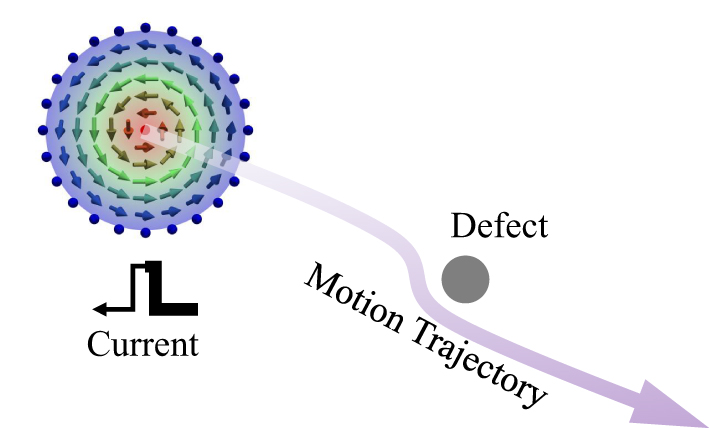
The mechanisms of the current-driven skyrmion motion in chiral magnets and heterostructures are different. In chiral magnets, the mechanism is the spin transfer torques (STT),[12] which results from the angular momentum transfer from itinerant electrons to the magnetization. The effect of STT can be included in the Landau–Lifshitz–Gilbert (LLG) equation by adding an adiabatic torque and nonadiabatic torque (β-term). From this extended LLG equation, a Thiele equation for describing the skyrmion dynamics can be obtained as[96,97,109]where the first term with G = 4π Qez describes the Magnus force, vy=−(α−β)DGG2+α2D2u,where the pinning forces due to disorders are ignored. Equation (3) shows that the skyrmion velocity is proportional to u, and other parameters such as Gilbert damping α and nonadiabatic coefficient β have little influence on vx, indicating a universal current–velocity relation.[97] Meanwhile, the y-component velocity vy is sensitive to Gilbert damping α and nonadiabatic coefficient β. In general, vy is nonzero, showing the skyrmion Hall effect.[110,111] Clearly, the sign of skyrmion Hall effect depends on the value of α – β as well as the skyrmion number Q. Note that in chiral magnets the skyrmion Hall effect is influenced strongly by disorders, and the skyrmion Hall angle is enhanced by disorders at a lower current density.[97] This enhancement of the skyrmion Hall angle has been observed experimentally[112] (Fig. 3).
In the adiabatic limit in which the spins of itinerant electrons follow the local magnetization direction,[44] the itinerant electrons experience an emergent electromagnetic field. This emergent field can be expressed in terms of Berry curvatures in space–time[113]The emergent magnetic field [Eq. (4)] is directly associated with the skyrmion number Q. Meanwhile, the spatial-temporal change of the magnetization induces an emergent electric field Eq. (5), also known as the spin motive force.[113] The spin motive force can also be considered as the inverse effect of the spin-transfer torque.[111] Equation (4) shows that both the spatial and temporal variations of magnetization are necessary for the emergent electric field. Therefore, a moving or oscillating skyrmion can induce such emergent electric fields, which have been observed experimentally.[114] Interestingly, the oscillating skyrmion also contributes to a DC voltage when its axial symmetry is broken by a tilted magnetic field.[115]
Fig. 3. Schematic skyrmion Hall effect. The defects in materials may increase the Hall angle.
Thermal fluctuation effects on skyrmion dynamics at the room-temperature are unavoidable. Thermal fluctuations were demonstrated to promote skyrmion motion, allowing for finite mobility even in the pinning regime.[116] The particle model shows that the skyrmion can exhibit avalanche dynamics, and the average avalanche shape is influenced by the non-dissipative Magnus term.[117] The influence of disorders and temperatures requires more detailed experimental studies and theoretical development beyond the current model.
The underlying skyrmion driving force in magnetic-insulator/heavy-metal heterostructures is the SOT.[75,108,110,118] Mathematically, the SOTs are different from the STTs. The difference shows in the Thiele equation. For the STT case, the current u and the skyrmion velocity v are in the same position. However, the contribution of the spin–orbit torques is summed up to the total force F. Therefore, the skyrmion dynamics induced by STT is relatively simple, especially in the presence of impurities or disorders. Unlike the STT case in which the skyrmion Hall angle decreases as the current density increases,[112] the skyrmion Hall angle in heterostructures shows a complicated relationship with the current density.[81,110,119] Moreover, in heterostructures, the skyrmion velocity is comparable to the magnetic domain wall velocity under the same current density, and thus the advantage of skyrmions is not fully realized. Therefore, searching for new systems with high current-driving efficiency is very important for future skyrmion application.
Electric fields can also be used to manipulate magnetic skyrmions either through magnetoelectric coupling such as that for multiferroic insulators Cu2OSeO3,[120–122] or using voltage-controlled magnetic anisotropy (VCMA).[114,123,124] Interestingly, the frequency of driving fields is not close to the resonance frequency of the internal skyrmion magnon modes when the magnetoelectric coupling mechanism is used.[121] The advantage of VCMA is the tunability of the interfacial perpendicular magnetic anisotropy via a voltage (an electric field) without the flow of the charges. The extra potential from anisotropy change can achieve a designed skyrmion motion.[114]
Magnetic skyrmion devices
Magnetic skyrmions have a clear goal in spintronic devices. The fundamental functional operations are achieved by electric-induced and/or strain to creation, deletion, motion, and detection of isolated skyrmions.[62,125] The writing/erasing operations correspond to the creations/deletions of individual skyrmions in the ferromagnetic background. Such operations should also be reversible and reliable with a free error rate and low energy cost. Some progress has been made by using artificial notch-like defects in a chiral magnet Co8Zn10Mn2 and pinning impurities in a magnetic multilayer of W/CoFeB/Ta with perpendicular magnetic anisotropy (PMA).[112,126,127] The controlled skyrmion-bubble transformations using STT and Joule thermal effects have also been shown in the nanoblock of uniaxial ferromagnet Fe3Sn2.[128] The creation and deletion of skyrmions have been demonstrated in multiferroic heterostructures by inverting the voltage[129–131] with VCMA. Romming et al. have shown the mutual writing/deleting skyrmions using tunneling spin current from an atomic scanning tunneling microscopy (STM) tip, but only at a low temperature of 4 K.[105] However, some improvements are still needed for real applications, such as zero error rate for defect-dominated creation/deletion, single skyrmions operations for skyrmion-bubble transformation and voltage-controlled creation/deletion, and room-temperature operations for tunneling spin current.
Skyrmionic devices achieve key functions such as addressing and logic computing using current-controlled skyrmion motions due to the high mobility of skyrmions. The current-driven coherent motion of isolated skyrmions was experimentally observed in CoFeB and Pt/Co/Ta films in 2016.[75,110] Because of the topological nature of magnetic skyrmions, skyrmion Hall effect appears[96] and has been observed in CoFeB,[110,111] Co/Pt,[80] GdFeCo,[132] FeGe,[133] CoZnMn,[112] etc. The skyrmion Hall angle shows a complex relationship with external stimuli and is tunable with respect to the field,[110] current density,[80,82,110,132] and skyrmion diameter,[111] as stated in Section 3. The current density threshold required to drive isolated skyrmions to move is typical of 109–1012A ⋅ m−2, depending on the materials and current pulse width.[75,110,112,132,133] The transverse velocity of skyrmion motion increases as the current increases and could reach ∼ 120 m/s at the current density of ∼ 1011 A ⋅ m−2.[75] As stated in Section 3, some issues are still needed to be overcome despite this experimental progress on skyrmion motion, such as defect induced skyrmion pinning,[133] the instability due to the skyrmion Hall effect,[110] the inexact dynamics response to each current stimuli,[112] and the relatively high energy-cost.[75,110,112,132,133]
The transformation from the skyrmion strucutres to electrical signals is related to data reading.[134] Ye et al. predicted the quantum topological Hall and Nernst effects of skyrmions,[135,136] which have been experimentally identified in MnGe,[137,138] FeGe,[139] MnSi,[140] Gd2PdSi3,[141] etc. We observed quantized changes in magnetoresistance in MnSi nanowires.[142,143] Contaminant Hall measurements and real-space magnetic imaging demonstrate that a skyrmion contributes to ∼ 22–25 nΩ ⋅ cm Hall resistance.[144,145] In 2019, Penthorn et al. realized the electrical detection of single skyrmions in magnetic tunnel junctions, where a single skyrmion could contribute to a 10% change of resistance.[146] However, the longitudinal magnetoresistance and Hall effects are too small for applications. The tunneling magnetoresistance could be a more promising technique for reading skyrmions but is only sensitive to the out-of-plane magnetization component. Skyrmions have a smaller fraction of out-of-plane magnetization components than the traditional perpendicularly magnetized domains. The reading efficiency of skyrmions using tunneling magnetoresistance is lower than that of magnetic domains. Highly efficient electrical detection of skyrmions is yet to be found.
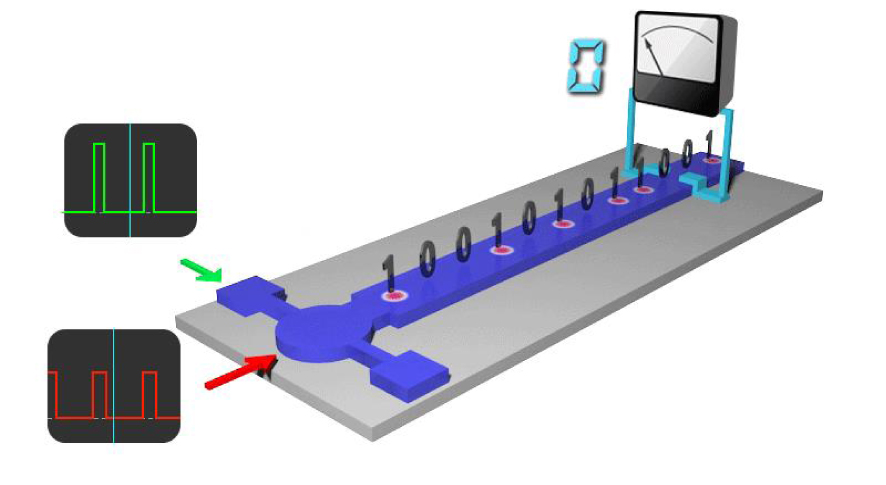
Fig. 4. Schematic skyrmion-based racetrack memory device. The binary bits “1” and “0” are encoded in skyrmions and ferromagnetic gaps, respectively. The data addressing is realized by the current-driven motion of a chain of ordered isolated skyrmions.
Based on the above-mentioned electrical manipulation of magnetic skyrmions, various skyrmion-based spintronics devices have been proposed and partially been experimentally demonstrated. The most famous one is the racetrack memory originating from the bubble memory (Fig. 4). The information bits in the skyrmion-based racetrack memory are encoded by a single skyrmion–ferromagnet chain, where skyrmions and ferromagnetic gaps represent bits “1” and “0”, respectively. The bit addressing in the racetrack memory is realized by the current-driven motion of a chain of ordered isolated skyrmions. Despite the realization of the current-driven motion of a single skyrmion and skyrmion cluster,[79,110,112,133] the feasibility and the reliability of the steady motion of a bitstream in an ultra-narrow nanostripe remain a challenge.
The other challenge for skyrmionic memory devices is the high mobility of skyrmions in the uniform ferromagnetic magnetization background. The skyrmions could easily occupy the bit space of ferromagnetic gaps because of skyrmion interactions and thermal fluctuations, resulting in interruption of the data bitstream. To improve data bitstream’s stability, it is desirable to replace the ferromagnetic gaps by other more stable localized magnetic solitons.[133,147–149] It has been shown that bobbers, bubbles, and antiskyrmions can coexist with skyrmions. The skyrmion-based racetrack memories can thus be expanded as skyrmion–bobber, skyrmion–bubble, and skyrmion–antiskyrmion racetrack memories. However, the collective motion of these skyrmionic textures remains to be demonstrated.
Besides racetrack memory, other current-driven skyrmion devices are possible. Topology-sign dependent skyrmion Hall effect can be used to make signal multiplexing of interconnecting devices.[150] Skyrmions in the nanostructured unit can be applied for write/delete operations in RAM.[151,152] Zhang et al. have numerically demonstrated the logic operations such as AND and OR gates using the current-induced two skyrmions merge, duplication, and conversion.[153] Luo et al. have proposed reconfigurable skyrmion logic gates using the skyrmion Hall effect.[154] Pinna et al. have proposed stochastic computing using random reshuffle operations on a skyrmion assembly before reading them.[155] Neural network devices include neurons for computing and synapses for memory.[156] The “leaky-integrate-fire” neurons have been proposed by using skyrmion-based nano-oscillators and coherent motions.[156–158] The weight of synapses can be represented by the skyrmion number dependent multi-resistance states.[159] However, most of these skyrmionic devices are still at the conceptual level. Only a few basic functional operations have been demonstrated so far, such as the topology-related skyrmion Hall effects of bundles for interconnecting devices,[62,133] thermal skyrmion diffusion for reshuffling operations of stochastic computing,[160] and the potentiation/depression of the synapses using the current-controlled skyrmion numbers in GdFeCo films.[161] The challenges in experiments are the rough and random dynamic responses of skyrmions to current stimuli due to the multiple complexities in realistic devices, including defects, inhomogeneity, and three-dimensional spin twists of magnetic configurations. It would be important to greatly improve device quality for realizing reliable and deterministic manipulations of skyrmions.
Summary and outlook
In summary, recent progress in skyrmion materials, dynamics, and devices is reviewed. The main stabilizing mechanisms of magnetic skyrmion are discussed, and skyrmion materials are listed. The current-driven dynamics is reviewed, followed by the recent progress of various types of skyrmion devices. However, the implementation of skyrmion devices in practice faces many challenges, and more endeavors are needed to overcome these obstacles. Despite the challenges described in the previous sections, implementing a demo device of the skyrmion-based racetrack memory is still very far away. The research along this direction is one of the most important ones. Besides the typical systems of chiral magnets and multilayers, searching other systems such as the synthetic antiferromagnetic systems, ferrimagnetic systems,[132] or van der Waals ferromagnets[162] could also bring us surprises. Moreover, the CMOS compatibility[57] is a necessity for integrating with other on-chip semiconductor components.
The particle nature of skyrmions enables its potential application as information carriers, and thus, a direct application is to use them in logic computing.[153] The skyrmions can also be used in non-von Neumann computing.[57] For example, magnetic skyrmion gas is proposed for probabilistic computing[155] and demonstrated experimentally as a reshuffle device.[160] By using nonlinear response, skyrmions can be used in reservoir computing networks.[163,164] Therefore, exploring its application in non-von Neumann computing is an important direction.
Magnetic skyrmions are proposed as information entropy carriers.[165] The nature of skyrmion entropy is also an interesting issue.[165,166] Moreover, skyrmion qubits can be constructed by using the energy-level quantization of the helicity degree of freedom.[167] Quantum computing using chiral spin textures is worth of exploring further.
Acknowledgments
H. D. acknowledges the financial support from the Strategic Priority Research Program of Chinese Academy of Sciences (Grant No. XDB33030100) and the Equipment Development Project of Chinese Academy of Sciences (Grant No. YJKYYQ20180012). X. R. W. is supported by the National Natural Science Foundation of China (Grant No. 11974296) and Hong Kong RGC, China (Grant Nos. 16301518, 16301619, and 6302321).
WangX SWangX R2021Chirality, Magnetism and Magnetoelectricity: Separate Phenomena and Joint Effects in Metamaterial StructuresKamenetskiiE.ChamSpringer International Publishing357
... Besides racetrack memory, other current-driven skyrmion devices are possible. Topology-sign dependent skyrmion Hall effect can be used to make signal multiplexing of interconnecting devices.[150] Skyrmions in the nanostructured unit can be applied for write/delete operations in RAM.[151,152] Zhang et al. have numerically demonstrated the logic operations such as AND and OR gates using the current-induced two skyrmions merge, duplication, and conversion.[153] Luo et al. have proposed reconfigurable skyrmion logic gates using the skyrmion Hall effect.[154] Pinna et al. have proposed stochastic computing using random reshuffle operations on a skyrmion assembly before reading them.[155] Neural network devices include neurons for computing and synapses for memory.[156] The “leaky-integrate-fire” neurons have been proposed by using skyrmion-based nano-oscillators and coherent motions.[156–158] The weight of synapses can be represented by the skyrmion number dependent multi-resistance states.[159] However, most of these skyrmionic devices are still at the conceptual level. Only a few basic functional operations have been demonstrated so far, such as the topology-related skyrmion Hall effects of bundles for interconnecting devices,[62,133] thermal skyrmion diffusion for reshuffling operations of stochastic computing,[160] and the potentiation/depression of the synapses using the current-controlled skyrmion numbers in GdFeCo films.[161] The challenges in experiments are the rough and random dynamic responses of skyrmions to current stimuli due to the multiple complexities in realistic devices, including defects, inhomogeneity, and three-dimensional spin twists of magnetic configurations. It would be important to greatly improve device quality for realizing reliable and deterministic manipulations of skyrmions. ...
1
2019
... Besides racetrack memory, other current-driven skyrmion devices are possible. Topology-sign dependent skyrmion Hall effect can be used to make signal multiplexing of interconnecting devices.[150] Skyrmions in the nanostructured unit can be applied for write/delete operations in RAM.[151,152] Zhang et al. have numerically demonstrated the logic operations such as AND and OR gates using the current-induced two skyrmions merge, duplication, and conversion.[153] Luo et al. have proposed reconfigurable skyrmion logic gates using the skyrmion Hall effect.[154] Pinna et al. have proposed stochastic computing using random reshuffle operations on a skyrmion assembly before reading them.[155] Neural network devices include neurons for computing and synapses for memory.[156] The “leaky-integrate-fire” neurons have been proposed by using skyrmion-based nano-oscillators and coherent motions.[156–158] The weight of synapses can be represented by the skyrmion number dependent multi-resistance states.[159] However, most of these skyrmionic devices are still at the conceptual level. Only a few basic functional operations have been demonstrated so far, such as the topology-related skyrmion Hall effects of bundles for interconnecting devices,[62,133] thermal skyrmion diffusion for reshuffling operations of stochastic computing,[160] and the potentiation/depression of the synapses using the current-controlled skyrmion numbers in GdFeCo films.[161] The challenges in experiments are the rough and random dynamic responses of skyrmions to current stimuli due to the multiple complexities in realistic devices, including defects, inhomogeneity, and three-dimensional spin twists of magnetic configurations. It would be important to greatly improve device quality for realizing reliable and deterministic manipulations of skyrmions. ...
1
2016
... Besides racetrack memory, other current-driven skyrmion devices are possible. Topology-sign dependent skyrmion Hall effect can be used to make signal multiplexing of interconnecting devices.[150] Skyrmions in the nanostructured unit can be applied for write/delete operations in RAM.[151,152] Zhang et al. have numerically demonstrated the logic operations such as AND and OR gates using the current-induced two skyrmions merge, duplication, and conversion.[153] Luo et al. have proposed reconfigurable skyrmion logic gates using the skyrmion Hall effect.[154] Pinna et al. have proposed stochastic computing using random reshuffle operations on a skyrmion assembly before reading them.[155] Neural network devices include neurons for computing and synapses for memory.[156] The “leaky-integrate-fire” neurons have been proposed by using skyrmion-based nano-oscillators and coherent motions.[156–158] The weight of synapses can be represented by the skyrmion number dependent multi-resistance states.[159] However, most of these skyrmionic devices are still at the conceptual level. Only a few basic functional operations have been demonstrated so far, such as the topology-related skyrmion Hall effects of bundles for interconnecting devices,[62,133] thermal skyrmion diffusion for reshuffling operations of stochastic computing,[160] and the potentiation/depression of the synapses using the current-controlled skyrmion numbers in GdFeCo films.[161] The challenges in experiments are the rough and random dynamic responses of skyrmions to current stimuli due to the multiple complexities in realistic devices, including defects, inhomogeneity, and three-dimensional spin twists of magnetic configurations. It would be important to greatly improve device quality for realizing reliable and deterministic manipulations of skyrmions. ...
2
2015
... Besides racetrack memory, other current-driven skyrmion devices are possible. Topology-sign dependent skyrmion Hall effect can be used to make signal multiplexing of interconnecting devices.[150] Skyrmions in the nanostructured unit can be applied for write/delete operations in RAM.[151,152] Zhang et al. have numerically demonstrated the logic operations such as AND and OR gates using the current-induced two skyrmions merge, duplication, and conversion.[153] Luo et al. have proposed reconfigurable skyrmion logic gates using the skyrmion Hall effect.[154] Pinna et al. have proposed stochastic computing using random reshuffle operations on a skyrmion assembly before reading them.[155] Neural network devices include neurons for computing and synapses for memory.[156] The “leaky-integrate-fire” neurons have been proposed by using skyrmion-based nano-oscillators and coherent motions.[156–158] The weight of synapses can be represented by the skyrmion number dependent multi-resistance states.[159] However, most of these skyrmionic devices are still at the conceptual level. Only a few basic functional operations have been demonstrated so far, such as the topology-related skyrmion Hall effects of bundles for interconnecting devices,[62,133] thermal skyrmion diffusion for reshuffling operations of stochastic computing,[160] and the potentiation/depression of the synapses using the current-controlled skyrmion numbers in GdFeCo films.[161] The challenges in experiments are the rough and random dynamic responses of skyrmions to current stimuli due to the multiple complexities in realistic devices, including defects, inhomogeneity, and three-dimensional spin twists of magnetic configurations. It would be important to greatly improve device quality for realizing reliable and deterministic manipulations of skyrmions. ...
... The particle nature of skyrmions enables its potential application as information carriers, and thus, a direct application is to use them in logic computing.[153] The skyrmions can also be used in non-von Neumann computing.[57] For example, magnetic skyrmion gas is proposed for probabilistic computing[155] and demonstrated experimentally as a reshuffle device.[160] By using nonlinear response, skyrmions can be used in reservoir computing networks.[163,164] Therefore, exploring its application in non-von Neumann computing is an important direction. ...
1
2018
... Besides racetrack memory, other current-driven skyrmion devices are possible. Topology-sign dependent skyrmion Hall effect can be used to make signal multiplexing of interconnecting devices.[150] Skyrmions in the nanostructured unit can be applied for write/delete operations in RAM.[151,152] Zhang et al. have numerically demonstrated the logic operations such as AND and OR gates using the current-induced two skyrmions merge, duplication, and conversion.[153] Luo et al. have proposed reconfigurable skyrmion logic gates using the skyrmion Hall effect.[154] Pinna et al. have proposed stochastic computing using random reshuffle operations on a skyrmion assembly before reading them.[155] Neural network devices include neurons for computing and synapses for memory.[156] The “leaky-integrate-fire” neurons have been proposed by using skyrmion-based nano-oscillators and coherent motions.[156–158] The weight of synapses can be represented by the skyrmion number dependent multi-resistance states.[159] However, most of these skyrmionic devices are still at the conceptual level. Only a few basic functional operations have been demonstrated so far, such as the topology-related skyrmion Hall effects of bundles for interconnecting devices,[62,133] thermal skyrmion diffusion for reshuffling operations of stochastic computing,[160] and the potentiation/depression of the synapses using the current-controlled skyrmion numbers in GdFeCo films.[161] The challenges in experiments are the rough and random dynamic responses of skyrmions to current stimuli due to the multiple complexities in realistic devices, including defects, inhomogeneity, and three-dimensional spin twists of magnetic configurations. It would be important to greatly improve device quality for realizing reliable and deterministic manipulations of skyrmions. ...
2
2018
... Besides racetrack memory, other current-driven skyrmion devices are possible. Topology-sign dependent skyrmion Hall effect can be used to make signal multiplexing of interconnecting devices.[150] Skyrmions in the nanostructured unit can be applied for write/delete operations in RAM.[151,152] Zhang et al. have numerically demonstrated the logic operations such as AND and OR gates using the current-induced two skyrmions merge, duplication, and conversion.[153] Luo et al. have proposed reconfigurable skyrmion logic gates using the skyrmion Hall effect.[154] Pinna et al. have proposed stochastic computing using random reshuffle operations on a skyrmion assembly before reading them.[155] Neural network devices include neurons for computing and synapses for memory.[156] The “leaky-integrate-fire” neurons have been proposed by using skyrmion-based nano-oscillators and coherent motions.[156–158] The weight of synapses can be represented by the skyrmion number dependent multi-resistance states.[159] However, most of these skyrmionic devices are still at the conceptual level. Only a few basic functional operations have been demonstrated so far, such as the topology-related skyrmion Hall effects of bundles for interconnecting devices,[62,133] thermal skyrmion diffusion for reshuffling operations of stochastic computing,[160] and the potentiation/depression of the synapses using the current-controlled skyrmion numbers in GdFeCo films.[161] The challenges in experiments are the rough and random dynamic responses of skyrmions to current stimuli due to the multiple complexities in realistic devices, including defects, inhomogeneity, and three-dimensional spin twists of magnetic configurations. It would be important to greatly improve device quality for realizing reliable and deterministic manipulations of skyrmions. ...
... The particle nature of skyrmions enables its potential application as information carriers, and thus, a direct application is to use them in logic computing.[153] The skyrmions can also be used in non-von Neumann computing.[57] For example, magnetic skyrmion gas is proposed for probabilistic computing[155] and demonstrated experimentally as a reshuffle device.[160] By using nonlinear response, skyrmions can be used in reservoir computing networks.[163,164] Therefore, exploring its application in non-von Neumann computing is an important direction. ...
2
2017
... Besides racetrack memory, other current-driven skyrmion devices are possible. Topology-sign dependent skyrmion Hall effect can be used to make signal multiplexing of interconnecting devices.[150] Skyrmions in the nanostructured unit can be applied for write/delete operations in RAM.[151,152] Zhang et al. have numerically demonstrated the logic operations such as AND and OR gates using the current-induced two skyrmions merge, duplication, and conversion.[153] Luo et al. have proposed reconfigurable skyrmion logic gates using the skyrmion Hall effect.[154] Pinna et al. have proposed stochastic computing using random reshuffle operations on a skyrmion assembly before reading them.[155] Neural network devices include neurons for computing and synapses for memory.[156] The “leaky-integrate-fire” neurons have been proposed by using skyrmion-based nano-oscillators and coherent motions.[156–158] The weight of synapses can be represented by the skyrmion number dependent multi-resistance states.[159] However, most of these skyrmionic devices are still at the conceptual level. Only a few basic functional operations have been demonstrated so far, such as the topology-related skyrmion Hall effects of bundles for interconnecting devices,[62,133] thermal skyrmion diffusion for reshuffling operations of stochastic computing,[160] and the potentiation/depression of the synapses using the current-controlled skyrmion numbers in GdFeCo films.[161] The challenges in experiments are the rough and random dynamic responses of skyrmions to current stimuli due to the multiple complexities in realistic devices, including defects, inhomogeneity, and three-dimensional spin twists of magnetic configurations. It would be important to greatly improve device quality for realizing reliable and deterministic manipulations of skyrmions. ...
... [156–158] The weight of synapses can be represented by the skyrmion number dependent multi-resistance states.[159] However, most of these skyrmionic devices are still at the conceptual level. Only a few basic functional operations have been demonstrated so far, such as the topology-related skyrmion Hall effects of bundles for interconnecting devices,[62,133] thermal skyrmion diffusion for reshuffling operations of stochastic computing,[160] and the potentiation/depression of the synapses using the current-controlled skyrmion numbers in GdFeCo films.[161] The challenges in experiments are the rough and random dynamic responses of skyrmions to current stimuli due to the multiple complexities in realistic devices, including defects, inhomogeneity, and three-dimensional spin twists of magnetic configurations. It would be important to greatly improve device quality for realizing reliable and deterministic manipulations of skyrmions. ...
0
2020
1
2018
... Besides racetrack memory, other current-driven skyrmion devices are possible. Topology-sign dependent skyrmion Hall effect can be used to make signal multiplexing of interconnecting devices.[150] Skyrmions in the nanostructured unit can be applied for write/delete operations in RAM.[151,152] Zhang et al. have numerically demonstrated the logic operations such as AND and OR gates using the current-induced two skyrmions merge, duplication, and conversion.[153] Luo et al. have proposed reconfigurable skyrmion logic gates using the skyrmion Hall effect.[154] Pinna et al. have proposed stochastic computing using random reshuffle operations on a skyrmion assembly before reading them.[155] Neural network devices include neurons for computing and synapses for memory.[156] The “leaky-integrate-fire” neurons have been proposed by using skyrmion-based nano-oscillators and coherent motions.[156–158] The weight of synapses can be represented by the skyrmion number dependent multi-resistance states.[159] However, most of these skyrmionic devices are still at the conceptual level. Only a few basic functional operations have been demonstrated so far, such as the topology-related skyrmion Hall effects of bundles for interconnecting devices,[62,133] thermal skyrmion diffusion for reshuffling operations of stochastic computing,[160] and the potentiation/depression of the synapses using the current-controlled skyrmion numbers in GdFeCo films.[161] The challenges in experiments are the rough and random dynamic responses of skyrmions to current stimuli due to the multiple complexities in realistic devices, including defects, inhomogeneity, and three-dimensional spin twists of magnetic configurations. It would be important to greatly improve device quality for realizing reliable and deterministic manipulations of skyrmions. ...
1
2017
... Besides racetrack memory, other current-driven skyrmion devices are possible. Topology-sign dependent skyrmion Hall effect can be used to make signal multiplexing of interconnecting devices.[150] Skyrmions in the nanostructured unit can be applied for write/delete operations in RAM.[151,152] Zhang et al. have numerically demonstrated the logic operations such as AND and OR gates using the current-induced two skyrmions merge, duplication, and conversion.[153] Luo et al. have proposed reconfigurable skyrmion logic gates using the skyrmion Hall effect.[154] Pinna et al. have proposed stochastic computing using random reshuffle operations on a skyrmion assembly before reading them.[155] Neural network devices include neurons for computing and synapses for memory.[156] The “leaky-integrate-fire” neurons have been proposed by using skyrmion-based nano-oscillators and coherent motions.[156–158] The weight of synapses can be represented by the skyrmion number dependent multi-resistance states.[159] However, most of these skyrmionic devices are still at the conceptual level. Only a few basic functional operations have been demonstrated so far, such as the topology-related skyrmion Hall effects of bundles for interconnecting devices,[62,133] thermal skyrmion diffusion for reshuffling operations of stochastic computing,[160] and the potentiation/depression of the synapses using the current-controlled skyrmion numbers in GdFeCo films.[161] The challenges in experiments are the rough and random dynamic responses of skyrmions to current stimuli due to the multiple complexities in realistic devices, including defects, inhomogeneity, and three-dimensional spin twists of magnetic configurations. It would be important to greatly improve device quality for realizing reliable and deterministic manipulations of skyrmions. ...
2
2019
... Besides racetrack memory, other current-driven skyrmion devices are possible. Topology-sign dependent skyrmion Hall effect can be used to make signal multiplexing of interconnecting devices.[150] Skyrmions in the nanostructured unit can be applied for write/delete operations in RAM.[151,152] Zhang et al. have numerically demonstrated the logic operations such as AND and OR gates using the current-induced two skyrmions merge, duplication, and conversion.[153] Luo et al. have proposed reconfigurable skyrmion logic gates using the skyrmion Hall effect.[154] Pinna et al. have proposed stochastic computing using random reshuffle operations on a skyrmion assembly before reading them.[155] Neural network devices include neurons for computing and synapses for memory.[156] The “leaky-integrate-fire” neurons have been proposed by using skyrmion-based nano-oscillators and coherent motions.[156–158] The weight of synapses can be represented by the skyrmion number dependent multi-resistance states.[159] However, most of these skyrmionic devices are still at the conceptual level. Only a few basic functional operations have been demonstrated so far, such as the topology-related skyrmion Hall effects of bundles for interconnecting devices,[62,133] thermal skyrmion diffusion for reshuffling operations of stochastic computing,[160] and the potentiation/depression of the synapses using the current-controlled skyrmion numbers in GdFeCo films.[161] The challenges in experiments are the rough and random dynamic responses of skyrmions to current stimuli due to the multiple complexities in realistic devices, including defects, inhomogeneity, and three-dimensional spin twists of magnetic configurations. It would be important to greatly improve device quality for realizing reliable and deterministic manipulations of skyrmions. ...
... The particle nature of skyrmions enables its potential application as information carriers, and thus, a direct application is to use them in logic computing.[153] The skyrmions can also be used in non-von Neumann computing.[57] For example, magnetic skyrmion gas is proposed for probabilistic computing[155] and demonstrated experimentally as a reshuffle device.[160] By using nonlinear response, skyrmions can be used in reservoir computing networks.[163,164] Therefore, exploring its application in non-von Neumann computing is an important direction. ...
1
2020
... Besides racetrack memory, other current-driven skyrmion devices are possible. Topology-sign dependent skyrmion Hall effect can be used to make signal multiplexing of interconnecting devices.[150] Skyrmions in the nanostructured unit can be applied for write/delete operations in RAM.[151,152] Zhang et al. have numerically demonstrated the logic operations such as AND and OR gates using the current-induced two skyrmions merge, duplication, and conversion.[153] Luo et al. have proposed reconfigurable skyrmion logic gates using the skyrmion Hall effect.[154] Pinna et al. have proposed stochastic computing using random reshuffle operations on a skyrmion assembly before reading them.[155] Neural network devices include neurons for computing and synapses for memory.[156] The “leaky-integrate-fire” neurons have been proposed by using skyrmion-based nano-oscillators and coherent motions.[156–158] The weight of synapses can be represented by the skyrmion number dependent multi-resistance states.[159] However, most of these skyrmionic devices are still at the conceptual level. Only a few basic functional operations have been demonstrated so far, such as the topology-related skyrmion Hall effects of bundles for interconnecting devices,[62,133] thermal skyrmion diffusion for reshuffling operations of stochastic computing,[160] and the potentiation/depression of the synapses using the current-controlled skyrmion numbers in GdFeCo films.[161] The challenges in experiments are the rough and random dynamic responses of skyrmions to current stimuli due to the multiple complexities in realistic devices, including defects, inhomogeneity, and three-dimensional spin twists of magnetic configurations. It would be important to greatly improve device quality for realizing reliable and deterministic manipulations of skyrmions. ...
1
1988
... We have witnessed a fast development of spintronics in the past decades. The field was born from the discovery of giant magnetoresistance (GMR)[1,2] and its subsequent applications.[3–6] It was fueled and expanded by the prediction[7–9] and experimental confirmation[10,11] of spin-transfer torque (STT) that allows direct control and manipulation of magnetization by an electric current. STT magnetoresistive random-access memory (MRAM),[12] spin–orbit torque magnetoresistive random-access memory (SOT-MRAM),[13,14] spin-transfer-torque-oscillators,[15] racetrack memory,[16] magnonic STT[17,18] have been proposed and realized. The discovery of spin pumping[19] and spin-Seebeck[20,21] and confirmation of the spin-Hall effect[22] and inverse spin-Hall effect[23] made spin current an important concept in spintronics. The related studies contribute partially to the discovery of topological materials and topological states in all fields of physics, including magnetism.[24–27] Scientific research keeps generating new concepts and physics like ultra-fast magnetization dynamics[28–30] and spin-caloritronics.[31] ...
1
1989
... We have witnessed a fast development of spintronics in the past decades. The field was born from the discovery of giant magnetoresistance (GMR)[1,2] and its subsequent applications.[3–6] It was fueled and expanded by the prediction[7–9] and experimental confirmation[10,11] of spin-transfer torque (STT) that allows direct control and manipulation of magnetization by an electric current. STT magnetoresistive random-access memory (MRAM),[12] spin–orbit torque magnetoresistive random-access memory (SOT-MRAM),[13,14] spin-transfer-torque-oscillators,[15] racetrack memory,[16] magnonic STT[17,18] have been proposed and realized. The discovery of spin pumping[19] and spin-Seebeck[20,21] and confirmation of the spin-Hall effect[22] and inverse spin-Hall effect[23] made spin current an important concept in spintronics. The related studies contribute partially to the discovery of topological materials and topological states in all fields of physics, including magnetism.[24–27] Scientific research keeps generating new concepts and physics like ultra-fast magnetization dynamics[28–30] and spin-caloritronics.[31] ...
1
1995
... We have witnessed a fast development of spintronics in the past decades. The field was born from the discovery of giant magnetoresistance (GMR)[1,2] and its subsequent applications.[3–6] It was fueled and expanded by the prediction[7–9] and experimental confirmation[10,11] of spin-transfer torque (STT) that allows direct control and manipulation of magnetization by an electric current. STT magnetoresistive random-access memory (MRAM),[12] spin–orbit torque magnetoresistive random-access memory (SOT-MRAM),[13,14] spin-transfer-torque-oscillators,[15] racetrack memory,[16] magnonic STT[17,18] have been proposed and realized. The discovery of spin pumping[19] and spin-Seebeck[20,21] and confirmation of the spin-Hall effect[22] and inverse spin-Hall effect[23] made spin current an important concept in spintronics. The related studies contribute partially to the discovery of topological materials and topological states in all fields of physics, including magnetism.[24–27] Scientific research keeps generating new concepts and physics like ultra-fast magnetization dynamics[28–30] and spin-caloritronics.[31] ...
0
1995
0
2004
1
2004
... We have witnessed a fast development of spintronics in the past decades. The field was born from the discovery of giant magnetoresistance (GMR)[1,2] and its subsequent applications.[3–6] It was fueled and expanded by the prediction[7–9] and experimental confirmation[10,11] of spin-transfer torque (STT) that allows direct control and manipulation of magnetization by an electric current. STT magnetoresistive random-access memory (MRAM),[12] spin–orbit torque magnetoresistive random-access memory (SOT-MRAM),[13,14] spin-transfer-torque-oscillators,[15] racetrack memory,[16] magnonic STT[17,18] have been proposed and realized. The discovery of spin pumping[19] and spin-Seebeck[20,21] and confirmation of the spin-Hall effect[22] and inverse spin-Hall effect[23] made spin current an important concept in spintronics. The related studies contribute partially to the discovery of topological materials and topological states in all fields of physics, including magnetism.[24–27] Scientific research keeps generating new concepts and physics like ultra-fast magnetization dynamics[28–30] and spin-caloritronics.[31] ...
1
1996
... We have witnessed a fast development of spintronics in the past decades. The field was born from the discovery of giant magnetoresistance (GMR)[1,2] and its subsequent applications.[3–6] It was fueled and expanded by the prediction[7–9] and experimental confirmation[10,11] of spin-transfer torque (STT) that allows direct control and manipulation of magnetization by an electric current. STT magnetoresistive random-access memory (MRAM),[12] spin–orbit torque magnetoresistive random-access memory (SOT-MRAM),[13,14] spin-transfer-torque-oscillators,[15] racetrack memory,[16] magnonic STT[17,18] have been proposed and realized. The discovery of spin pumping[19] and spin-Seebeck[20,21] and confirmation of the spin-Hall effect[22] and inverse spin-Hall effect[23] made spin current an important concept in spintronics. The related studies contribute partially to the discovery of topological materials and topological states in all fields of physics, including magnetism.[24–27] Scientific research keeps generating new concepts and physics like ultra-fast magnetization dynamics[28–30] and spin-caloritronics.[31] ...
0
1996
1
2002
... We have witnessed a fast development of spintronics in the past decades. The field was born from the discovery of giant magnetoresistance (GMR)[1,2] and its subsequent applications.[3–6] It was fueled and expanded by the prediction[7–9] and experimental confirmation[10,11] of spin-transfer torque (STT) that allows direct control and manipulation of magnetization by an electric current. STT magnetoresistive random-access memory (MRAM),[12] spin–orbit torque magnetoresistive random-access memory (SOT-MRAM),[13,14] spin-transfer-torque-oscillators,[15] racetrack memory,[16] magnonic STT[17,18] have been proposed and realized. The discovery of spin pumping[19] and spin-Seebeck[20,21] and confirmation of the spin-Hall effect[22] and inverse spin-Hall effect[23] made spin current an important concept in spintronics. The related studies contribute partially to the discovery of topological materials and topological states in all fields of physics, including magnetism.[24–27] Scientific research keeps generating new concepts and physics like ultra-fast magnetization dynamics[28–30] and spin-caloritronics.[31] ...
1
1998
... We have witnessed a fast development of spintronics in the past decades. The field was born from the discovery of giant magnetoresistance (GMR)[1,2] and its subsequent applications.[3–6] It was fueled and expanded by the prediction[7–9] and experimental confirmation[10,11] of spin-transfer torque (STT) that allows direct control and manipulation of magnetization by an electric current. STT magnetoresistive random-access memory (MRAM),[12] spin–orbit torque magnetoresistive random-access memory (SOT-MRAM),[13,14] spin-transfer-torque-oscillators,[15] racetrack memory,[16] magnonic STT[17,18] have been proposed and realized. The discovery of spin pumping[19] and spin-Seebeck[20,21] and confirmation of the spin-Hall effect[22] and inverse spin-Hall effect[23] made spin current an important concept in spintronics. The related studies contribute partially to the discovery of topological materials and topological states in all fields of physics, including magnetism.[24–27] Scientific research keeps generating new concepts and physics like ultra-fast magnetization dynamics[28–30] and spin-caloritronics.[31] ...
1
1999
... We have witnessed a fast development of spintronics in the past decades. The field was born from the discovery of giant magnetoresistance (GMR)[1,2] and its subsequent applications.[3–6] It was fueled and expanded by the prediction[7–9] and experimental confirmation[10,11] of spin-transfer torque (STT) that allows direct control and manipulation of magnetization by an electric current. STT magnetoresistive random-access memory (MRAM),[12] spin–orbit torque magnetoresistive random-access memory (SOT-MRAM),[13,14] spin-transfer-torque-oscillators,[15] racetrack memory,[16] magnonic STT[17,18] have been proposed and realized. The discovery of spin pumping[19] and spin-Seebeck[20,21] and confirmation of the spin-Hall effect[22] and inverse spin-Hall effect[23] made spin current an important concept in spintronics. The related studies contribute partially to the discovery of topological materials and topological states in all fields of physics, including magnetism.[24–27] Scientific research keeps generating new concepts and physics like ultra-fast magnetization dynamics[28–30] and spin-caloritronics.[31] ...
4
2008
... We have witnessed a fast development of spintronics in the past decades. The field was born from the discovery of giant magnetoresistance (GMR)[1,2] and its subsequent applications.[3–6] It was fueled and expanded by the prediction[7–9] and experimental confirmation[10,11] of spin-transfer torque (STT) that allows direct control and manipulation of magnetization by an electric current. STT magnetoresistive random-access memory (MRAM),[12] spin–orbit torque magnetoresistive random-access memory (SOT-MRAM),[13,14] spin-transfer-torque-oscillators,[15] racetrack memory,[16] magnonic STT[17,18] have been proposed and realized. The discovery of spin pumping[19] and spin-Seebeck[20,21] and confirmation of the spin-Hall effect[22] and inverse spin-Hall effect[23] made spin current an important concept in spintronics. The related studies contribute partially to the discovery of topological materials and topological states in all fields of physics, including magnetism.[24–27] Scientific research keeps generating new concepts and physics like ultra-fast magnetization dynamics[28–30] and spin-caloritronics.[31] ...
... The manipulation of the magnetic skyrmions lies at the heart of its application. Magnetic skyrmions can be driven using spin-polarized currents,[45,96–99] temperature gradients,[100–102] magnetic or electric field gradients, magnons, and even microwave fields.[103] From the viewpoint of applications, electrical manipulation is the most important choice because of its compatibility with contemporary electronics.[12,45,97,98] An ultralow critical current density (∼ 106 m/A2) is able to move the skyrmion lattice in MnSi[45] via STT,[12,104] whereas the typical current threshold of the current-driven domain wall dynamics is much larger (∼ 1011 m/A2) in ferromagnetic metals and semiconductors. However, from the technological point of view, the controllable creation, deletion, and motion of isolated skyrmions,[105–107] rather than skyrmion lattices, using nanosecond current pulses, are essential in practical applications.[75,106,108] An ultralow critical current density to move the isolated skyrmions has not reported yet. ...
... [12,104] whereas the typical current threshold of the current-driven domain wall dynamics is much larger (∼ 1011 m/A2) in ferromagnetic metals and semiconductors. However, from the technological point of view, the controllable creation, deletion, and motion of isolated skyrmions,[105–107] rather than skyrmion lattices, using nanosecond current pulses, are essential in practical applications.[75,106,108] An ultralow critical current density to move the isolated skyrmions has not reported yet. ...
... The mechanisms of the current-driven skyrmion motion in chiral magnets and heterostructures are different. In chiral magnets, the mechanism is the spin transfer torques (STT),[12] which results from the angular momentum transfer from itinerant electrons to the magnetization. The effect of STT can be included in the Landau–Lifshitz–Gilbert (LLG) equation by adding an adiabatic torque and nonadiabatic torque (β-term). From this extended LLG equation, a Thiele equation for describing the skyrmion dynamics can be obtained as[96,97,109]where the first term with G = 4π Qez describes the Magnus force, measures STT and is proportional to the current density j, ez is the unit vector perpendicular to the film. The second term denotes the dissipative force with dissipative dyadic . For a circular magnetic skyrmion without distortion and η is close to unity. The pinning force F originates from the impurity of the material and is given by Fi = ∫ γ m ⋅ [∂im × (m × Hpin)] d x d y. For the current applied in the x-direction, i.e., u = (u,0), the skyrmion velocity can be obtained aswhere the pinning forces due to disorders are ignored. Equation (3) shows that the skyrmion velocity is proportional to u, and other parameters such as Gilbert damping α and nonadiabatic coefficient β have little influence on vx, indicating a universal current–velocity relation.[97] Meanwhile, the y-component velocity vy is sensitive to Gilbert damping α and nonadiabatic coefficient β. In general, vy is nonzero, showing the skyrmion Hall effect.[110,111] Clearly, the sign of skyrmion Hall effect depends on the value of α – β as well as the skyrmion number Q. Note that in chiral magnets the skyrmion Hall effect is influenced strongly by disorders, and the skyrmion Hall angle is enhanced by disorders at a lower current density.[97] This enhancement of the skyrmion Hall angle has been observed experimentally[112] (Fig. 3). ...
1
2012
... We have witnessed a fast development of spintronics in the past decades. The field was born from the discovery of giant magnetoresistance (GMR)[1,2] and its subsequent applications.[3–6] It was fueled and expanded by the prediction[7–9] and experimental confirmation[10,11] of spin-transfer torque (STT) that allows direct control and manipulation of magnetization by an electric current. STT magnetoresistive random-access memory (MRAM),[12] spin–orbit torque magnetoresistive random-access memory (SOT-MRAM),[13,14] spin-transfer-torque-oscillators,[15] racetrack memory,[16] magnonic STT[17,18] have been proposed and realized. The discovery of spin pumping[19] and spin-Seebeck[20,21] and confirmation of the spin-Hall effect[22] and inverse spin-Hall effect[23] made spin current an important concept in spintronics. The related studies contribute partially to the discovery of topological materials and topological states in all fields of physics, including magnetism.[24–27] Scientific research keeps generating new concepts and physics like ultra-fast magnetization dynamics[28–30] and spin-caloritronics.[31] ...
1
2018
... We have witnessed a fast development of spintronics in the past decades. The field was born from the discovery of giant magnetoresistance (GMR)[1,2] and its subsequent applications.[3–6] It was fueled and expanded by the prediction[7–9] and experimental confirmation[10,11] of spin-transfer torque (STT) that allows direct control and manipulation of magnetization by an electric current. STT magnetoresistive random-access memory (MRAM),[12] spin–orbit torque magnetoresistive random-access memory (SOT-MRAM),[13,14] spin-transfer-torque-oscillators,[15] racetrack memory,[16] magnonic STT[17,18] have been proposed and realized. The discovery of spin pumping[19] and spin-Seebeck[20,21] and confirmation of the spin-Hall effect[22] and inverse spin-Hall effect[23] made spin current an important concept in spintronics. The related studies contribute partially to the discovery of topological materials and topological states in all fields of physics, including magnetism.[24–27] Scientific research keeps generating new concepts and physics like ultra-fast magnetization dynamics[28–30] and spin-caloritronics.[31] ...
1
2003
... We have witnessed a fast development of spintronics in the past decades. The field was born from the discovery of giant magnetoresistance (GMR)[1,2] and its subsequent applications.[3–6] It was fueled and expanded by the prediction[7–9] and experimental confirmation[10,11] of spin-transfer torque (STT) that allows direct control and manipulation of magnetization by an electric current. STT magnetoresistive random-access memory (MRAM),[12] spin–orbit torque magnetoresistive random-access memory (SOT-MRAM),[13,14] spin-transfer-torque-oscillators,[15] racetrack memory,[16] magnonic STT[17,18] have been proposed and realized. The discovery of spin pumping[19] and spin-Seebeck[20,21] and confirmation of the spin-Hall effect[22] and inverse spin-Hall effect[23] made spin current an important concept in spintronics. The related studies contribute partially to the discovery of topological materials and topological states in all fields of physics, including magnetism.[24–27] Scientific research keeps generating new concepts and physics like ultra-fast magnetization dynamics[28–30] and spin-caloritronics.[31] ...
1
2008
... We have witnessed a fast development of spintronics in the past decades. The field was born from the discovery of giant magnetoresistance (GMR)[1,2] and its subsequent applications.[3–6] It was fueled and expanded by the prediction[7–9] and experimental confirmation[10,11] of spin-transfer torque (STT) that allows direct control and manipulation of magnetization by an electric current. STT magnetoresistive random-access memory (MRAM),[12] spin–orbit torque magnetoresistive random-access memory (SOT-MRAM),[13,14] spin-transfer-torque-oscillators,[15] racetrack memory,[16] magnonic STT[17,18] have been proposed and realized. The discovery of spin pumping[19] and spin-Seebeck[20,21] and confirmation of the spin-Hall effect[22] and inverse spin-Hall effect[23] made spin current an important concept in spintronics. The related studies contribute partially to the discovery of topological materials and topological states in all fields of physics, including magnetism.[24–27] Scientific research keeps generating new concepts and physics like ultra-fast magnetization dynamics[28–30] and spin-caloritronics.[31] ...
1
2011
... We have witnessed a fast development of spintronics in the past decades. The field was born from the discovery of giant magnetoresistance (GMR)[1,2] and its subsequent applications.[3–6] It was fueled and expanded by the prediction[7–9] and experimental confirmation[10,11] of spin-transfer torque (STT) that allows direct control and manipulation of magnetization by an electric current. STT magnetoresistive random-access memory (MRAM),[12] spin–orbit torque magnetoresistive random-access memory (SOT-MRAM),[13,14] spin-transfer-torque-oscillators,[15] racetrack memory,[16] magnonic STT[17,18] have been proposed and realized. The discovery of spin pumping[19] and spin-Seebeck[20,21] and confirmation of the spin-Hall effect[22] and inverse spin-Hall effect[23] made spin current an important concept in spintronics. The related studies contribute partially to the discovery of topological materials and topological states in all fields of physics, including magnetism.[24–27] Scientific research keeps generating new concepts and physics like ultra-fast magnetization dynamics[28–30] and spin-caloritronics.[31] ...
1
2019
... We have witnessed a fast development of spintronics in the past decades. The field was born from the discovery of giant magnetoresistance (GMR)[1,2] and its subsequent applications.[3–6] It was fueled and expanded by the prediction[7–9] and experimental confirmation[10,11] of spin-transfer torque (STT) that allows direct control and manipulation of magnetization by an electric current. STT magnetoresistive random-access memory (MRAM),[12] spin–orbit torque magnetoresistive random-access memory (SOT-MRAM),[13,14] spin-transfer-torque-oscillators,[15] racetrack memory,[16] magnonic STT[17,18] have been proposed and realized. The discovery of spin pumping[19] and spin-Seebeck[20,21] and confirmation of the spin-Hall effect[22] and inverse spin-Hall effect[23] made spin current an important concept in spintronics. The related studies contribute partially to the discovery of topological materials and topological states in all fields of physics, including magnetism.[24–27] Scientific research keeps generating new concepts and physics like ultra-fast magnetization dynamics[28–30] and spin-caloritronics.[31] ...
1
2002
... We have witnessed a fast development of spintronics in the past decades. The field was born from the discovery of giant magnetoresistance (GMR)[1,2] and its subsequent applications.[3–6] It was fueled and expanded by the prediction[7–9] and experimental confirmation[10,11] of spin-transfer torque (STT) that allows direct control and manipulation of magnetization by an electric current. STT magnetoresistive random-access memory (MRAM),[12] spin–orbit torque magnetoresistive random-access memory (SOT-MRAM),[13,14] spin-transfer-torque-oscillators,[15] racetrack memory,[16] magnonic STT[17,18] have been proposed and realized. The discovery of spin pumping[19] and spin-Seebeck[20,21] and confirmation of the spin-Hall effect[22] and inverse spin-Hall effect[23] made spin current an important concept in spintronics. The related studies contribute partially to the discovery of topological materials and topological states in all fields of physics, including magnetism.[24–27] Scientific research keeps generating new concepts and physics like ultra-fast magnetization dynamics[28–30] and spin-caloritronics.[31] ...
1
2008
... We have witnessed a fast development of spintronics in the past decades. The field was born from the discovery of giant magnetoresistance (GMR)[1,2] and its subsequent applications.[3–6] It was fueled and expanded by the prediction[7–9] and experimental confirmation[10,11] of spin-transfer torque (STT) that allows direct control and manipulation of magnetization by an electric current. STT magnetoresistive random-access memory (MRAM),[12] spin–orbit torque magnetoresistive random-access memory (SOT-MRAM),[13,14] spin-transfer-torque-oscillators,[15] racetrack memory,[16] magnonic STT[17,18] have been proposed and realized. The discovery of spin pumping[19] and spin-Seebeck[20,21] and confirmation of the spin-Hall effect[22] and inverse spin-Hall effect[23] made spin current an important concept in spintronics. The related studies contribute partially to the discovery of topological materials and topological states in all fields of physics, including magnetism.[24–27] Scientific research keeps generating new concepts and physics like ultra-fast magnetization dynamics[28–30] and spin-caloritronics.[31] ...
1
2010
... We have witnessed a fast development of spintronics in the past decades. The field was born from the discovery of giant magnetoresistance (GMR)[1,2] and its subsequent applications.[3–6] It was fueled and expanded by the prediction[7–9] and experimental confirmation[10,11] of spin-transfer torque (STT) that allows direct control and manipulation of magnetization by an electric current. STT magnetoresistive random-access memory (MRAM),[12] spin–orbit torque magnetoresistive random-access memory (SOT-MRAM),[13,14] spin-transfer-torque-oscillators,[15] racetrack memory,[16] magnonic STT[17,18] have been proposed and realized. The discovery of spin pumping[19] and spin-Seebeck[20,21] and confirmation of the spin-Hall effect[22] and inverse spin-Hall effect[23] made spin current an important concept in spintronics. The related studies contribute partially to the discovery of topological materials and topological states in all fields of physics, including magnetism.[24–27] Scientific research keeps generating new concepts and physics like ultra-fast magnetization dynamics[28–30] and spin-caloritronics.[31] ...
1
2004
... We have witnessed a fast development of spintronics in the past decades. The field was born from the discovery of giant magnetoresistance (GMR)[1,2] and its subsequent applications.[3–6] It was fueled and expanded by the prediction[7–9] and experimental confirmation[10,11] of spin-transfer torque (STT) that allows direct control and manipulation of magnetization by an electric current. STT magnetoresistive random-access memory (MRAM),[12] spin–orbit torque magnetoresistive random-access memory (SOT-MRAM),[13,14] spin-transfer-torque-oscillators,[15] racetrack memory,[16] magnonic STT[17,18] have been proposed and realized. The discovery of spin pumping[19] and spin-Seebeck[20,21] and confirmation of the spin-Hall effect[22] and inverse spin-Hall effect[23] made spin current an important concept in spintronics. The related studies contribute partially to the discovery of topological materials and topological states in all fields of physics, including magnetism.[24–27] Scientific research keeps generating new concepts and physics like ultra-fast magnetization dynamics[28–30] and spin-caloritronics.[31] ...
1
2006
... We have witnessed a fast development of spintronics in the past decades. The field was born from the discovery of giant magnetoresistance (GMR)[1,2] and its subsequent applications.[3–6] It was fueled and expanded by the prediction[7–9] and experimental confirmation[10,11] of spin-transfer torque (STT) that allows direct control and manipulation of magnetization by an electric current. STT magnetoresistive random-access memory (MRAM),[12] spin–orbit torque magnetoresistive random-access memory (SOT-MRAM),[13,14] spin-transfer-torque-oscillators,[15] racetrack memory,[16] magnonic STT[17,18] have been proposed and realized. The discovery of spin pumping[19] and spin-Seebeck[20,21] and confirmation of the spin-Hall effect[22] and inverse spin-Hall effect[23] made spin current an important concept in spintronics. The related studies contribute partially to the discovery of topological materials and topological states in all fields of physics, including magnetism.[24–27] Scientific research keeps generating new concepts and physics like ultra-fast magnetization dynamics[28–30] and spin-caloritronics.[31] ...
1
2017
... We have witnessed a fast development of spintronics in the past decades. The field was born from the discovery of giant magnetoresistance (GMR)[1,2] and its subsequent applications.[3–6] It was fueled and expanded by the prediction[7–9] and experimental confirmation[10,11] of spin-transfer torque (STT) that allows direct control and manipulation of magnetization by an electric current. STT magnetoresistive random-access memory (MRAM),[12] spin–orbit torque magnetoresistive random-access memory (SOT-MRAM),[13,14] spin-transfer-torque-oscillators,[15] racetrack memory,[16] magnonic STT[17,18] have been proposed and realized. The discovery of spin pumping[19] and spin-Seebeck[20,21] and confirmation of the spin-Hall effect[22] and inverse spin-Hall effect[23] made spin current an important concept in spintronics. The related studies contribute partially to the discovery of topological materials and topological states in all fields of physics, including magnetism.[24–27] Scientific research keeps generating new concepts and physics like ultra-fast magnetization dynamics[28–30] and spin-caloritronics.[31] ...
0
2018
0
2017
1
2017
... We have witnessed a fast development of spintronics in the past decades. The field was born from the discovery of giant magnetoresistance (GMR)[1,2] and its subsequent applications.[3–6] It was fueled and expanded by the prediction[7–9] and experimental confirmation[10,11] of spin-transfer torque (STT) that allows direct control and manipulation of magnetization by an electric current. STT magnetoresistive random-access memory (MRAM),[12] spin–orbit torque magnetoresistive random-access memory (SOT-MRAM),[13,14] spin-transfer-torque-oscillators,[15] racetrack memory,[16] magnonic STT[17,18] have been proposed and realized. The discovery of spin pumping[19] and spin-Seebeck[20,21] and confirmation of the spin-Hall effect[22] and inverse spin-Hall effect[23] made spin current an important concept in spintronics. The related studies contribute partially to the discovery of topological materials and topological states in all fields of physics, including magnetism.[24–27] Scientific research keeps generating new concepts and physics like ultra-fast magnetization dynamics[28–30] and spin-caloritronics.[31] ...
1
1996
... We have witnessed a fast development of spintronics in the past decades. The field was born from the discovery of giant magnetoresistance (GMR)[1,2] and its subsequent applications.[3–6] It was fueled and expanded by the prediction[7–9] and experimental confirmation[10,11] of spin-transfer torque (STT) that allows direct control and manipulation of magnetization by an electric current. STT magnetoresistive random-access memory (MRAM),[12] spin–orbit torque magnetoresistive random-access memory (SOT-MRAM),[13,14] spin-transfer-torque-oscillators,[15] racetrack memory,[16] magnonic STT[17,18] have been proposed and realized. The discovery of spin pumping[19] and spin-Seebeck[20,21] and confirmation of the spin-Hall effect[22] and inverse spin-Hall effect[23] made spin current an important concept in spintronics. The related studies contribute partially to the discovery of topological materials and topological states in all fields of physics, including magnetism.[24–27] Scientific research keeps generating new concepts and physics like ultra-fast magnetization dynamics[28–30] and spin-caloritronics.[31] ...
0
2007
1
2005
... We have witnessed a fast development of spintronics in the past decades. The field was born from the discovery of giant magnetoresistance (GMR)[1,2] and its subsequent applications.[3–6] It was fueled and expanded by the prediction[7–9] and experimental confirmation[10,11] of spin-transfer torque (STT) that allows direct control and manipulation of magnetization by an electric current. STT magnetoresistive random-access memory (MRAM),[12] spin–orbit torque magnetoresistive random-access memory (SOT-MRAM),[13,14] spin-transfer-torque-oscillators,[15] racetrack memory,[16] magnonic STT[17,18] have been proposed and realized. The discovery of spin pumping[19] and spin-Seebeck[20,21] and confirmation of the spin-Hall effect[22] and inverse spin-Hall effect[23] made spin current an important concept in spintronics. The related studies contribute partially to the discovery of topological materials and topological states in all fields of physics, including magnetism.[24–27] Scientific research keeps generating new concepts and physics like ultra-fast magnetization dynamics[28–30] and spin-caloritronics.[31] ...
1
2012
... We have witnessed a fast development of spintronics in the past decades. The field was born from the discovery of giant magnetoresistance (GMR)[1,2] and its subsequent applications.[3–6] It was fueled and expanded by the prediction[7–9] and experimental confirmation[10,11] of spin-transfer torque (STT) that allows direct control and manipulation of magnetization by an electric current. STT magnetoresistive random-access memory (MRAM),[12] spin–orbit torque magnetoresistive random-access memory (SOT-MRAM),[13,14] spin-transfer-torque-oscillators,[15] racetrack memory,[16] magnonic STT[17,18] have been proposed and realized. The discovery of spin pumping[19] and spin-Seebeck[20,21] and confirmation of the spin-Hall effect[22] and inverse spin-Hall effect[23] made spin current an important concept in spintronics. The related studies contribute partially to the discovery of topological materials and topological states in all fields of physics, including magnetism.[24–27] Scientific research keeps generating new concepts and physics like ultra-fast magnetization dynamics[28–30] and spin-caloritronics.[31] ...
1
1962
... In the fertile land of spintronics, one particular fast-growing subfield is magnetic skyrmion or skyrmionics. Skyrmion is a topological soliton initially proposed by British physicist Tony Skyme for describing the resonance states of baryons.[32] However, it was first unambiguously observed in magnetism,[33,34] although the notion was long used in superconductivity,[35] quantum Hall effect,[36] Bose–Einstein condensates,[37] nematic liquid crystal[38] as well as ferromagnets.[39–42] Magnetic skyrmions are believed to be potential information carriers and have potential device applications.[43] ...
3
2009
... In the fertile land of spintronics, one particular fast-growing subfield is magnetic skyrmion or skyrmionics. Skyrmion is a topological soliton initially proposed by British physicist Tony Skyme for describing the resonance states of baryons.[32] However, it was first unambiguously observed in magnetism,[33,34] although the notion was long used in superconductivity,[35] quantum Hall effect,[36] Bose–Einstein condensates,[37] nematic liquid crystal[38] as well as ferromagnets.[39–42] Magnetic skyrmions are believed to be potential information carriers and have potential device applications.[43] ...
... A magnetic skyrmion is characterized by the winding of magnetic moments, forming a particle-like magnetic whirl with a non-trivial topology. The skyrmion number Q is defined as , which counts the number of times that magnetization vector field m wraps the Bloch sphere.[44] It was first discovered in a chiral magnet MnSi in 2009.[33] One year later, experiments showed that the skyrmions lattice could be driven with an ultra-low critical current density.[45] Together with its small size, these features open the door to skyrmion-based spintronic devices.[43] Accordingly, magnetic skyrmions have been intensively investigated in the last decade, and many review articles have been published.[44,46–62] Therefore, in this perspective, we try not to review the details on skyrmion materials, physics, and devices but only focus on the recent advances in the field and real challenges for device applications. ...
... Another challenge is the stability of complex magnetic phases in skyrmion-hosting materials. For example, the magnetic phases of typical B20 chiral magnets[33] include spin helix, conical, skyrmions, and ferromagnetic states (Fig. 2). The lack of more than one type of skyrmions complexes the design of the skyrmionic device. In comparison with the conventional hard disk driver (HDD) where magnetic moments have up and down states as bits “1” and “0”, one strategy in skyrmions-based devices is to encode “1” and “0” by the presence and the absence of a magnetic skyrmion, or vice versa. The stability of data in a HDD is guaranteed by a high enough energy barrier of a strongly perpendicular magnetic anisotropy. However, a high energy barrier between skyrmion and other phases such as a ferromagnetic state is a challenging issue and an applied magnetic field is often used in practice. In this circumstance, a slight magnetic field variation from the external stimuli may destroy the skyrmion due to its narrow stable field window. At extremely sparse conditions, the skyrmions evolve into ramified stripe or stripe state.[67] All these lead to the loss of data bits. It is still a challenge to balance the requirement of the applied field to stabilize the magnetic skyrmion and the obstruction of the field to deform and even destroy the magnetic skyrmion in the devices. ...
1
2010
... In the fertile land of spintronics, one particular fast-growing subfield is magnetic skyrmion or skyrmionics. Skyrmion is a topological soliton initially proposed by British physicist Tony Skyme for describing the resonance states of baryons.[32] However, it was first unambiguously observed in magnetism,[33,34] although the notion was long used in superconductivity,[35] quantum Hall effect,[36] Bose–Einstein condensates,[37] nematic liquid crystal[38] as well as ferromagnets.[39–42] Magnetic skyrmions are believed to be potential information carriers and have potential device applications.[43] ...
1
1957
... In the fertile land of spintronics, one particular fast-growing subfield is magnetic skyrmion or skyrmionics. Skyrmion is a topological soliton initially proposed by British physicist Tony Skyme for describing the resonance states of baryons.[32] However, it was first unambiguously observed in magnetism,[33,34] although the notion was long used in superconductivity,[35] quantum Hall effect,[36] Bose–Einstein condensates,[37] nematic liquid crystal[38] as well as ferromagnets.[39–42] Magnetic skyrmions are believed to be potential information carriers and have potential device applications.[43] ...
1
1993
... In the fertile land of spintronics, one particular fast-growing subfield is magnetic skyrmion or skyrmionics. Skyrmion is a topological soliton initially proposed by British physicist Tony Skyme for describing the resonance states of baryons.[32] However, it was first unambiguously observed in magnetism,[33,34] although the notion was long used in superconductivity,[35] quantum Hall effect,[36] Bose–Einstein condensates,[37] nematic liquid crystal[38] as well as ferromagnets.[39–42] Magnetic skyrmions are believed to be potential information carriers and have potential device applications.[43] ...
1
1998
... In the fertile land of spintronics, one particular fast-growing subfield is magnetic skyrmion or skyrmionics. Skyrmion is a topological soliton initially proposed by British physicist Tony Skyme for describing the resonance states of baryons.[32] However, it was first unambiguously observed in magnetism,[33,34] although the notion was long used in superconductivity,[35] quantum Hall effect,[36] Bose–Einstein condensates,[37] nematic liquid crystal[38] as well as ferromagnets.[39–42] Magnetic skyrmions are believed to be potential information carriers and have potential device applications.[43] ...
1
1989
... In the fertile land of spintronics, one particular fast-growing subfield is magnetic skyrmion or skyrmionics. Skyrmion is a topological soliton initially proposed by British physicist Tony Skyme for describing the resonance states of baryons.[32] However, it was first unambiguously observed in magnetism,[33,34] although the notion was long used in superconductivity,[35] quantum Hall effect,[36] Bose–Einstein condensates,[37] nematic liquid crystal[38] as well as ferromagnets.[39–42] Magnetic skyrmions are believed to be potential information carriers and have potential device applications.[43] ...
0
1994
0
2006
1
2006
... In the fertile land of spintronics, one particular fast-growing subfield is magnetic skyrmion or skyrmionics. Skyrmion is a topological soliton initially proposed by British physicist Tony Skyme for describing the resonance states of baryons.[32] However, it was first unambiguously observed in magnetism,[33,34] although the notion was long used in superconductivity,[35] quantum Hall effect,[36] Bose–Einstein condensates,[37] nematic liquid crystal[38] as well as ferromagnets.[39–42] Magnetic skyrmions are believed to be potential information carriers and have potential device applications.[43] ...
2
2013
... In the fertile land of spintronics, one particular fast-growing subfield is magnetic skyrmion or skyrmionics. Skyrmion is a topological soliton initially proposed by British physicist Tony Skyme for describing the resonance states of baryons.[32] However, it was first unambiguously observed in magnetism,[33,34] although the notion was long used in superconductivity,[35] quantum Hall effect,[36] Bose–Einstein condensates,[37] nematic liquid crystal[38] as well as ferromagnets.[39–42] Magnetic skyrmions are believed to be potential information carriers and have potential device applications.[43] ...
... A magnetic skyrmion is characterized by the winding of magnetic moments, forming a particle-like magnetic whirl with a non-trivial topology. The skyrmion number Q is defined as , which counts the number of times that magnetization vector field m wraps the Bloch sphere.[44] It was first discovered in a chiral magnet MnSi in 2009.[33] One year later, experiments showed that the skyrmions lattice could be driven with an ultra-low critical current density.[45] Together with its small size, these features open the door to skyrmion-based spintronic devices.[43] Accordingly, magnetic skyrmions have been intensively investigated in the last decade, and many review articles have been published.[44,46–62] Therefore, in this perspective, we try not to review the details on skyrmion materials, physics, and devices but only focus on the recent advances in the field and real challenges for device applications. ...
4
2013
... A magnetic skyrmion is characterized by the winding of magnetic moments, forming a particle-like magnetic whirl with a non-trivial topology. The skyrmion number Q is defined as , which counts the number of times that magnetization vector field m wraps the Bloch sphere.[44] It was first discovered in a chiral magnet MnSi in 2009.[33] One year later, experiments showed that the skyrmions lattice could be driven with an ultra-low critical current density.[45] Together with its small size, these features open the door to skyrmion-based spintronic devices.[43] Accordingly, magnetic skyrmions have been intensively investigated in the last decade, and many review articles have been published.[44,46–62] Therefore, in this perspective, we try not to review the details on skyrmion materials, physics, and devices but only focus on the recent advances in the field and real challenges for device applications. ...
... [44,46–62] Therefore, in this perspective, we try not to review the details on skyrmion materials, physics, and devices but only focus on the recent advances in the field and real challenges for device applications. ...
... Spin helix (stripe) evolves into skyrmion crystals and subsequently into the ferromagnetic state as an external magnetic field increases.[67,68,70,71] The featured size of magnetic skyrmions is comparable to λ. According to the symmetry of crystal structure, four types of magnetic skyrmions are discovered in chiral magnets, including the Bloch (vortex-like) skyrmions, Néel (hedgehog) skyrmions, antiskyrmions, and mixed-type skyrmions,[73] as shown in Fig. 1. The first three types have been experimentally confirmed, but the mixed-type skyrmion is still missing experimentally. There are more than ten types of skyrmion-hosting chiral magnets (Fig. 1), in which magnetic skyrmions show the features of uniform morphology, nanoscale size, and high mobility under current.[44] However, these advantages are not present in one system. For example, the chiral magnet MnGe has the smallest size of skyrmions down to a few nanometers,[74] which can meet the requirements of high storage density, while the stabilized temperature is below room temperature. ...
... In the adiabatic limit in which the spins of itinerant electrons follow the local magnetization direction,[44] the itinerant electrons experience an emergent electromagnetic field. This emergent field can be expressed in terms of Berry curvatures in space–time[113]The emergent magnetic field [Eq. (4)] is directly associated with the skyrmion number Q. Meanwhile, the spatial-temporal change of the magnetization induces an emergent electric field Eq. (5), also known as the spin motive force.[113] The spin motive force can also be considered as the inverse effect of the spin-transfer torque.[111] Equation (4) shows that both the spatial and temporal variations of magnetization are necessary for the emergent electric field. Therefore, a moving or oscillating skyrmion can induce such emergent electric fields, which have been observed experimentally.[114] Interestingly, the oscillating skyrmion also contributes to a DC voltage when its axial symmetry is broken by a tilted magnetic field.[115] ...
4
2010
... A magnetic skyrmion is characterized by the winding of magnetic moments, forming a particle-like magnetic whirl with a non-trivial topology. The skyrmion number Q is defined as , which counts the number of times that magnetization vector field m wraps the Bloch sphere.[44] It was first discovered in a chiral magnet MnSi in 2009.[33] One year later, experiments showed that the skyrmions lattice could be driven with an ultra-low critical current density.[45] Together with its small size, these features open the door to skyrmion-based spintronic devices.[43] Accordingly, magnetic skyrmions have been intensively investigated in the last decade, and many review articles have been published.[44,46–62] Therefore, in this perspective, we try not to review the details on skyrmion materials, physics, and devices but only focus on the recent advances in the field and real challenges for device applications. ...
... The manipulation of the magnetic skyrmions lies at the heart of its application. Magnetic skyrmions can be driven using spin-polarized currents,[45,96–99] temperature gradients,[100–102] magnetic or electric field gradients, magnons, and even microwave fields.[103] From the viewpoint of applications, electrical manipulation is the most important choice because of its compatibility with contemporary electronics.[12,45,97,98] An ultralow critical current density (∼ 106 m/A2) is able to move the skyrmion lattice in MnSi[45] via STT,[12,104] whereas the typical current threshold of the current-driven domain wall dynamics is much larger (∼ 1011 m/A2) in ferromagnetic metals and semiconductors. However, from the technological point of view, the controllable creation, deletion, and motion of isolated skyrmions,[105–107] rather than skyrmion lattices, using nanosecond current pulses, are essential in practical applications.[75,106,108] An ultralow critical current density to move the isolated skyrmions has not reported yet. ...
... ,45,97,98] An ultralow critical current density (∼ 106 m/A2) is able to move the skyrmion lattice in MnSi[45] via STT,[12,104] whereas the typical current threshold of the current-driven domain wall dynamics is much larger (∼ 1011 m/A2) in ferromagnetic metals and semiconductors. However, from the technological point of view, the controllable creation, deletion, and motion of isolated skyrmions,[105–107] rather than skyrmion lattices, using nanosecond current pulses, are essential in practical applications.[75,106,108] An ultralow critical current density to move the isolated skyrmions has not reported yet. ...
... [45] via STT,[12,104] whereas the typical current threshold of the current-driven domain wall dynamics is much larger (∼ 1011 m/A2) in ferromagnetic metals and semiconductors. However, from the technological point of view, the controllable creation, deletion, and motion of isolated skyrmions,[105–107] rather than skyrmion lattices, using nanosecond current pulses, are essential in practical applications.[75,106,108] An ultralow critical current density to move the isolated skyrmions has not reported yet. ...
1
2016
... A magnetic skyrmion is characterized by the winding of magnetic moments, forming a particle-like magnetic whirl with a non-trivial topology. The skyrmion number Q is defined as , which counts the number of times that magnetization vector field m wraps the Bloch sphere.[44] It was first discovered in a chiral magnet MnSi in 2009.[33] One year later, experiments showed that the skyrmions lattice could be driven with an ultra-low critical current density.[45] Together with its small size, these features open the door to skyrmion-based spintronic devices.[43] Accordingly, magnetic skyrmions have been intensively investigated in the last decade, and many review articles have been published.[44,46–62] Therefore, in this perspective, we try not to review the details on skyrmion materials, physics, and devices but only focus on the recent advances in the field and real challenges for device applications. ...
0
2017
0
2017
0
2017
0
2018
0
2019
1
2020
... Aside from the broken inversion symmetry in crystals, DM interactions can also appear in ferromagnet/heavy metal heterostructures.[75] Recent advances in preparing perpendicularly magnetized multilayers from sputtering deposition have demonstrated the possibility of obtaining additive DM interactions at successive interfaces and magnetic skyrmions at room temperature.[76,77] Around the same time, the current-induced creation and displacement of magnetic skyrmions have been demonstrated.[78–82] Since the heterostructures are compatible with common spintronic technologies, interfacial magnetic skyrmions are promising objects in practical applications. The main obstacle is the quality of magnetic films since the defects around the interface may lead to an inhomogeneous DM interaction and firmly pin the skyrmions. The current density required to drive skyrmion is comparable to that for domain wall motion.[52,83,84] ...
0
2020
0
2020
0
2021
0
2021
2
2021
... In summary, recent progress in skyrmion materials, dynamics, and devices is reviewed. The main stabilizing mechanisms of magnetic skyrmion are discussed, and skyrmion materials are listed. The current-driven dynamics is reviewed, followed by the recent progress of various types of skyrmion devices. However, the implementation of skyrmion devices in practice faces many challenges, and more endeavors are needed to overcome these obstacles. Despite the challenges described in the previous sections, implementing a demo device of the skyrmion-based racetrack memory is still very far away. The research along this direction is one of the most important ones. Besides the typical systems of chiral magnets and multilayers, searching other systems such as the synthetic antiferromagnetic systems, ferrimagnetic systems,[132] or van der Waals ferromagnets[162] could also bring us surprises. Moreover, the CMOS compatibility[57] is a necessity for integrating with other on-chip semiconductor components. ...
... The particle nature of skyrmions enables its potential application as information carriers, and thus, a direct application is to use them in logic computing.[153] The skyrmions can also be used in non-von Neumann computing.[57] For example, magnetic skyrmion gas is proposed for probabilistic computing[155] and demonstrated experimentally as a reshuffle device.[160] By using nonlinear response, skyrmions can be used in reservoir computing networks.[163,164] Therefore, exploring its application in non-von Neumann computing is an important direction. ...
0
2021
0
2021
0
2021
0
2021
3
2018
... A magnetic skyrmion is characterized by the winding of magnetic moments, forming a particle-like magnetic whirl with a non-trivial topology. The skyrmion number Q is defined as , which counts the number of times that magnetization vector field m wraps the Bloch sphere.[44] It was first discovered in a chiral magnet MnSi in 2009.[33] One year later, experiments showed that the skyrmions lattice could be driven with an ultra-low critical current density.[45] Together with its small size, these features open the door to skyrmion-based spintronic devices.[43] Accordingly, magnetic skyrmions have been intensively investigated in the last decade, and many review articles have been published.[44,46–62] Therefore, in this perspective, we try not to review the details on skyrmion materials, physics, and devices but only focus on the recent advances in the field and real challenges for device applications. ...
... Magnetic skyrmions have a clear goal in spintronic devices. The fundamental functional operations are achieved by electric-induced and/or strain to creation, deletion, motion, and detection of isolated skyrmions.[62,125] The writing/erasing operations correspond to the creations/deletions of individual skyrmions in the ferromagnetic background. Such operations should also be reversible and reliable with a free error rate and low energy cost. Some progress has been made by using artificial notch-like defects in a chiral magnet Co8Zn10Mn2 and pinning impurities in a magnetic multilayer of W/CoFeB/Ta with perpendicular magnetic anisotropy (PMA).[112,126,127] The controlled skyrmion-bubble transformations using STT and Joule thermal effects have also been shown in the nanoblock of uniaxial ferromagnet Fe3Sn2.[128] The creation and deletion of skyrmions have been demonstrated in multiferroic heterostructures by inverting the voltage[129–131] with VCMA. Romming et al. have shown the mutual writing/deleting skyrmions using tunneling spin current from an atomic scanning tunneling microscopy (STM) tip, but only at a low temperature of 4 K.[105] However, some improvements are still needed for real applications, such as zero error rate for defect-dominated creation/deletion, single skyrmions operations for skyrmion-bubble transformation and voltage-controlled creation/deletion, and room-temperature operations for tunneling spin current. ...
... Besides racetrack memory, other current-driven skyrmion devices are possible. Topology-sign dependent skyrmion Hall effect can be used to make signal multiplexing of interconnecting devices.[150] Skyrmions in the nanostructured unit can be applied for write/delete operations in RAM.[151,152] Zhang et al. have numerically demonstrated the logic operations such as AND and OR gates using the current-induced two skyrmions merge, duplication, and conversion.[153] Luo et al. have proposed reconfigurable skyrmion logic gates using the skyrmion Hall effect.[154] Pinna et al. have proposed stochastic computing using random reshuffle operations on a skyrmion assembly before reading them.[155] Neural network devices include neurons for computing and synapses for memory.[156] The “leaky-integrate-fire” neurons have been proposed by using skyrmion-based nano-oscillators and coherent motions.[156–158] The weight of synapses can be represented by the skyrmion number dependent multi-resistance states.[159] However, most of these skyrmionic devices are still at the conceptual level. Only a few basic functional operations have been demonstrated so far, such as the topology-related skyrmion Hall effects of bundles for interconnecting devices,[62,133] thermal skyrmion diffusion for reshuffling operations of stochastic computing,[160] and the potentiation/depression of the synapses using the current-controlled skyrmion numbers in GdFeCo films.[161] The challenges in experiments are the rough and random dynamic responses of skyrmions to current stimuli due to the multiple complexities in realistic devices, including defects, inhomogeneity, and three-dimensional spin twists of magnetic configurations. It would be important to greatly improve device quality for realizing reliable and deterministic manipulations of skyrmions. ...
1
1958
... Magnetic skyrmions were first discovered in non-centrosymmetric crystals where the Dzyaloshinsky–Moriya (DM) interaction exists. The DM interaction, proposed in 1950–60s by Dzyaloshinsky and Moriya independently,[63,64] is induced by spin–orbit coupling in the absence of inversion symmetry. The interaction was initially used to explain the helimagnetism and abnormal weak ferromagnetism in materials such as MnF2, MnCo3, and α-Fe2O3.[65] Consider two spins Si and Sj,[66] an effective field E imposes on the spins due to the broken inversion symmetry when the spin flips/flops from site i to site j. Following the spins, the field E moves from site j to site i, generating a magnetic field , where is the unit vector of displacement from i to j. This magnetic field B yields a spin procession and contributes an extra energy to the spin at site j with Si ⋅ (B × Sj) = B ⋅ (Si × Sj). This is the origin of DM interaction. When one defines the DM tensor D as D ∥ B, the DM interaction can be expressed in the conventional form[66] ...
1
1960
... Magnetic skyrmions were first discovered in non-centrosymmetric crystals where the Dzyaloshinsky–Moriya (DM) interaction exists. The DM interaction, proposed in 1950–60s by Dzyaloshinsky and Moriya independently,[63,64] is induced by spin–orbit coupling in the absence of inversion symmetry. The interaction was initially used to explain the helimagnetism and abnormal weak ferromagnetism in materials such as MnF2, MnCo3, and α-Fe2O3.[65] Consider two spins Si and Sj,[66] an effective field E imposes on the spins due to the broken inversion symmetry when the spin flips/flops from site i to site j. Following the spins, the field E moves from site j to site i, generating a magnetic field , where is the unit vector of displacement from i to j. This magnetic field B yields a spin procession and contributes an extra energy to the spin at site j with Si ⋅ (B × Sj) = B ⋅ (Si × Sj). This is the origin of DM interaction. When one defines the DM tensor D as D ∥ B, the DM interaction can be expressed in the conventional form[66] ...
1
2010
... Magnetic skyrmions were first discovered in non-centrosymmetric crystals where the Dzyaloshinsky–Moriya (DM) interaction exists. The DM interaction, proposed in 1950–60s by Dzyaloshinsky and Moriya independently,[63,64] is induced by spin–orbit coupling in the absence of inversion symmetry. The interaction was initially used to explain the helimagnetism and abnormal weak ferromagnetism in materials such as MnF2, MnCo3, and α-Fe2O3.[65] Consider two spins Si and Sj,[66] an effective field E imposes on the spins due to the broken inversion symmetry when the spin flips/flops from site i to site j. Following the spins, the field E moves from site j to site i, generating a magnetic field , where is the unit vector of displacement from i to j. This magnetic field B yields a spin procession and contributes an extra energy to the spin at site j with Si ⋅ (B × Sj) = B ⋅ (Si × Sj). This is the origin of DM interaction. When one defines the DM tensor D as D ∥ B, the DM interaction can be expressed in the conventional form[66] ...
2
2018
... Magnetic skyrmions were first discovered in non-centrosymmetric crystals where the Dzyaloshinsky–Moriya (DM) interaction exists. The DM interaction, proposed in 1950–60s by Dzyaloshinsky and Moriya independently,[63,64] is induced by spin–orbit coupling in the absence of inversion symmetry. The interaction was initially used to explain the helimagnetism and abnormal weak ferromagnetism in materials such as MnF2, MnCo3, and α-Fe2O3.[65] Consider two spins Si and Sj,[66] an effective field E imposes on the spins due to the broken inversion symmetry when the spin flips/flops from site i to site j. Following the spins, the field E moves from site j to site i, generating a magnetic field , where is the unit vector of displacement from i to j. This magnetic field B yields a spin procession and contributes an extra energy to the spin at site j with Si ⋅ (B × Sj) = B ⋅ (Si × Sj). This is the origin of DM interaction. When one defines the DM tensor D as D ∥ B, the DM interaction can be expressed in the conventional form[66] ...
... [66] ...
4
2021
... The DM interaction in Eq. (1) prefers spins in a non-collinear alignment, while the Heisenberg exchange interaction characterized by stiffness constant J wants to parallelly or anti-parallelly align the spins (in collinear), depending on the sign of the interaction. These two competing interactions define a length scale of λ = 2π J/D,[67] in the absence of a magnetic field and anisotropy. One recent progress is the recognition of fundamental difference between isolated skyrmions and condensed skyrmions.[68] In the absence of a magnetic field, [68] is an important parameter for a chiral magnetic film with perpendicular magnetic anisotropy K. The perpendicular magnetic anisotropy also affects the topology of skyrmions.[69] Isolated skyrmions are circular and metastable with positive formation energy when κ < 1.[70] Condensed skyrmions are the ground state with negative formation energy when κ > 1.[68] Interestingly[67,68,70,71] individual skyrmion in its condensate has a stripe morphology. Skyrmion condensates can form regular stripy patterns, conventionally called helical or conical states in the literature. However, they often appear as irregular stripy patterns, including maze-type structures. When the skyrmion density increase through external stimulus, a skyrmion condensate transforms from stripy patterns to a crystal structure.[71] The width of stripe skyrmions λ decreases with D and increases with J. This is in contrast to the isolated skyrmion whose size increases with D and decreases with J.[68] One should characterize a skyrmion by its size and wall thickness.[70] Skyrmion dynamics is often sensitive to the skyrmion wall thickness.[72] ...
... [67,68,70,71] individual skyrmion in its condensate has a stripe morphology. Skyrmion condensates can form regular stripy patterns, conventionally called helical or conical states in the literature. However, they often appear as irregular stripy patterns, including maze-type structures. When the skyrmion density increase through external stimulus, a skyrmion condensate transforms from stripy patterns to a crystal structure.[71] The width of stripe skyrmions λ decreases with D and increases with J. This is in contrast to the isolated skyrmion whose size increases with D and decreases with J.[68] One should characterize a skyrmion by its size and wall thickness.[70] Skyrmion dynamics is often sensitive to the skyrmion wall thickness.[72] ...
... Spin helix (stripe) evolves into skyrmion crystals and subsequently into the ferromagnetic state as an external magnetic field increases.[67,68,70,71] The featured size of magnetic skyrmions is comparable to λ. According to the symmetry of crystal structure, four types of magnetic skyrmions are discovered in chiral magnets, including the Bloch (vortex-like) skyrmions, Néel (hedgehog) skyrmions, antiskyrmions, and mixed-type skyrmions,[73] as shown in Fig. 1. The first three types have been experimentally confirmed, but the mixed-type skyrmion is still missing experimentally. There are more than ten types of skyrmion-hosting chiral magnets (Fig. 1), in which magnetic skyrmions show the features of uniform morphology, nanoscale size, and high mobility under current.[44] However, these advantages are not present in one system. For example, the chiral magnet MnGe has the smallest size of skyrmions down to a few nanometers,[74] which can meet the requirements of high storage density, while the stabilized temperature is below room temperature. ...
... Another challenge is the stability of complex magnetic phases in skyrmion-hosting materials. For example, the magnetic phases of typical B20 chiral magnets[33] include spin helix, conical, skyrmions, and ferromagnetic states (Fig. 2). The lack of more than one type of skyrmions complexes the design of the skyrmionic device. In comparison with the conventional hard disk driver (HDD) where magnetic moments have up and down states as bits “1” and “0”, one strategy in skyrmions-based devices is to encode “1” and “0” by the presence and the absence of a magnetic skyrmion, or vice versa. The stability of data in a HDD is guaranteed by a high enough energy barrier of a strongly perpendicular magnetic anisotropy. However, a high energy barrier between skyrmion and other phases such as a ferromagnetic state is a challenging issue and an applied magnetic field is often used in practice. In this circumstance, a slight magnetic field variation from the external stimuli may destroy the skyrmion due to its narrow stable field window. At extremely sparse conditions, the skyrmions evolve into ramified stripe or stripe state.[67] All these lead to the loss of data bits. It is still a challenge to balance the requirement of the applied field to stabilize the magnetic skyrmion and the obstruction of the field to deform and even destroy the magnetic skyrmion in the devices. ...
6
2018
... The DM interaction in Eq. (1) prefers spins in a non-collinear alignment, while the Heisenberg exchange interaction characterized by stiffness constant J wants to parallelly or anti-parallelly align the spins (in collinear), depending on the sign of the interaction. These two competing interactions define a length scale of λ = 2π J/D,[67] in the absence of a magnetic field and anisotropy. One recent progress is the recognition of fundamental difference between isolated skyrmions and condensed skyrmions.[68] In the absence of a magnetic field, [68] is an important parameter for a chiral magnetic film with perpendicular magnetic anisotropy K. The perpendicular magnetic anisotropy also affects the topology of skyrmions.[69] Isolated skyrmions are circular and metastable with positive formation energy when κ < 1.[70] Condensed skyrmions are the ground state with negative formation energy when κ > 1.[68] Interestingly[67,68,70,71] individual skyrmion in its condensate has a stripe morphology. Skyrmion condensates can form regular stripy patterns, conventionally called helical or conical states in the literature. However, they often appear as irregular stripy patterns, including maze-type structures. When the skyrmion density increase through external stimulus, a skyrmion condensate transforms from stripy patterns to a crystal structure.[71] The width of stripe skyrmions λ decreases with D and increases with J. This is in contrast to the isolated skyrmion whose size increases with D and decreases with J.[68] One should characterize a skyrmion by its size and wall thickness.[70] Skyrmion dynamics is often sensitive to the skyrmion wall thickness.[72] ...
... [68] is an important parameter for a chiral magnetic film with perpendicular magnetic anisotropy K. The perpendicular magnetic anisotropy also affects the topology of skyrmions.[69] Isolated skyrmions are circular and metastable with positive formation energy when κ < 1.[70] Condensed skyrmions are the ground state with negative formation energy when κ > 1.[68] Interestingly[67,68,70,71] individual skyrmion in its condensate has a stripe morphology. Skyrmion condensates can form regular stripy patterns, conventionally called helical or conical states in the literature. However, they often appear as irregular stripy patterns, including maze-type structures. When the skyrmion density increase through external stimulus, a skyrmion condensate transforms from stripy patterns to a crystal structure.[71] The width of stripe skyrmions λ decreases with D and increases with J. This is in contrast to the isolated skyrmion whose size increases with D and decreases with J.[68] One should characterize a skyrmion by its size and wall thickness.[70] Skyrmion dynamics is often sensitive to the skyrmion wall thickness.[72] ...
... [68] Interestingly[67,68,70,71] individual skyrmion in its condensate has a stripe morphology. Skyrmion condensates can form regular stripy patterns, conventionally called helical or conical states in the literature. However, they often appear as irregular stripy patterns, including maze-type structures. When the skyrmion density increase through external stimulus, a skyrmion condensate transforms from stripy patterns to a crystal structure.[71] The width of stripe skyrmions λ decreases with D and increases with J. This is in contrast to the isolated skyrmion whose size increases with D and decreases with J.[68] One should characterize a skyrmion by its size and wall thickness.[70] Skyrmion dynamics is often sensitive to the skyrmion wall thickness.[72] ...
... ,68,70,71] individual skyrmion in its condensate has a stripe morphology. Skyrmion condensates can form regular stripy patterns, conventionally called helical or conical states in the literature. However, they often appear as irregular stripy patterns, including maze-type structures. When the skyrmion density increase through external stimulus, a skyrmion condensate transforms from stripy patterns to a crystal structure.[71] The width of stripe skyrmions λ decreases with D and increases with J. This is in contrast to the isolated skyrmion whose size increases with D and decreases with J.[68] One should characterize a skyrmion by its size and wall thickness.[70] Skyrmion dynamics is often sensitive to the skyrmion wall thickness.[72] ...
... [68] One should characterize a skyrmion by its size and wall thickness.[70] Skyrmion dynamics is often sensitive to the skyrmion wall thickness.[72] ...
... Spin helix (stripe) evolves into skyrmion crystals and subsequently into the ferromagnetic state as an external magnetic field increases.[67,68,70,71] The featured size of magnetic skyrmions is comparable to λ. According to the symmetry of crystal structure, four types of magnetic skyrmions are discovered in chiral magnets, including the Bloch (vortex-like) skyrmions, Néel (hedgehog) skyrmions, antiskyrmions, and mixed-type skyrmions,[73] as shown in Fig. 1. The first three types have been experimentally confirmed, but the mixed-type skyrmion is still missing experimentally. There are more than ten types of skyrmion-hosting chiral magnets (Fig. 1), in which magnetic skyrmions show the features of uniform morphology, nanoscale size, and high mobility under current.[44] However, these advantages are not present in one system. For example, the chiral magnet MnGe has the smallest size of skyrmions down to a few nanometers,[74] which can meet the requirements of high storage density, while the stabilized temperature is below room temperature. ...
1
2018
... The DM interaction in Eq. (1) prefers spins in a non-collinear alignment, while the Heisenberg exchange interaction characterized by stiffness constant J wants to parallelly or anti-parallelly align the spins (in collinear), depending on the sign of the interaction. These two competing interactions define a length scale of λ = 2π J/D,[67] in the absence of a magnetic field and anisotropy. One recent progress is the recognition of fundamental difference between isolated skyrmions and condensed skyrmions.[68] In the absence of a magnetic field, [68] is an important parameter for a chiral magnetic film with perpendicular magnetic anisotropy K. The perpendicular magnetic anisotropy also affects the topology of skyrmions.[69] Isolated skyrmions are circular and metastable with positive formation energy when κ < 1.[70] Condensed skyrmions are the ground state with negative formation energy when κ > 1.[68] Interestingly[67,68,70,71] individual skyrmion in its condensate has a stripe morphology. Skyrmion condensates can form regular stripy patterns, conventionally called helical or conical states in the literature. However, they often appear as irregular stripy patterns, including maze-type structures. When the skyrmion density increase through external stimulus, a skyrmion condensate transforms from stripy patterns to a crystal structure.[71] The width of stripe skyrmions λ decreases with D and increases with J. This is in contrast to the isolated skyrmion whose size increases with D and decreases with J.[68] One should characterize a skyrmion by its size and wall thickness.[70] Skyrmion dynamics is often sensitive to the skyrmion wall thickness.[72] ...
4
2021
... The DM interaction in Eq. (1) prefers spins in a non-collinear alignment, while the Heisenberg exchange interaction characterized by stiffness constant J wants to parallelly or anti-parallelly align the spins (in collinear), depending on the sign of the interaction. These two competing interactions define a length scale of λ = 2π J/D,[67] in the absence of a magnetic field and anisotropy. One recent progress is the recognition of fundamental difference between isolated skyrmions and condensed skyrmions.[68] In the absence of a magnetic field, [68] is an important parameter for a chiral magnetic film with perpendicular magnetic anisotropy K. The perpendicular magnetic anisotropy also affects the topology of skyrmions.[69] Isolated skyrmions are circular and metastable with positive formation energy when κ < 1.[70] Condensed skyrmions are the ground state with negative formation energy when κ > 1.[68] Interestingly[67,68,70,71] individual skyrmion in its condensate has a stripe morphology. Skyrmion condensates can form regular stripy patterns, conventionally called helical or conical states in the literature. However, they often appear as irregular stripy patterns, including maze-type structures. When the skyrmion density increase through external stimulus, a skyrmion condensate transforms from stripy patterns to a crystal structure.[71] The width of stripe skyrmions λ decreases with D and increases with J. This is in contrast to the isolated skyrmion whose size increases with D and decreases with J.[68] One should characterize a skyrmion by its size and wall thickness.[70] Skyrmion dynamics is often sensitive to the skyrmion wall thickness.[72] ...
... ,70,71] individual skyrmion in its condensate has a stripe morphology. Skyrmion condensates can form regular stripy patterns, conventionally called helical or conical states in the literature. However, they often appear as irregular stripy patterns, including maze-type structures. When the skyrmion density increase through external stimulus, a skyrmion condensate transforms from stripy patterns to a crystal structure.[71] The width of stripe skyrmions λ decreases with D and increases with J. This is in contrast to the isolated skyrmion whose size increases with D and decreases with J.[68] One should characterize a skyrmion by its size and wall thickness.[70] Skyrmion dynamics is often sensitive to the skyrmion wall thickness.[72] ...
... [70] Skyrmion dynamics is often sensitive to the skyrmion wall thickness.[72] ...
... Spin helix (stripe) evolves into skyrmion crystals and subsequently into the ferromagnetic state as an external magnetic field increases.[67,68,70,71] The featured size of magnetic skyrmions is comparable to λ. According to the symmetry of crystal structure, four types of magnetic skyrmions are discovered in chiral magnets, including the Bloch (vortex-like) skyrmions, Néel (hedgehog) skyrmions, antiskyrmions, and mixed-type skyrmions,[73] as shown in Fig. 1. The first three types have been experimentally confirmed, but the mixed-type skyrmion is still missing experimentally. There are more than ten types of skyrmion-hosting chiral magnets (Fig. 1), in which magnetic skyrmions show the features of uniform morphology, nanoscale size, and high mobility under current.[44] However, these advantages are not present in one system. For example, the chiral magnet MnGe has the smallest size of skyrmions down to a few nanometers,[74] which can meet the requirements of high storage density, while the stabilized temperature is below room temperature. ...
3
2022
... The DM interaction in Eq. (1) prefers spins in a non-collinear alignment, while the Heisenberg exchange interaction characterized by stiffness constant J wants to parallelly or anti-parallelly align the spins (in collinear), depending on the sign of the interaction. These two competing interactions define a length scale of λ = 2π J/D,[67] in the absence of a magnetic field and anisotropy. One recent progress is the recognition of fundamental difference between isolated skyrmions and condensed skyrmions.[68] In the absence of a magnetic field, [68] is an important parameter for a chiral magnetic film with perpendicular magnetic anisotropy K. The perpendicular magnetic anisotropy also affects the topology of skyrmions.[69] Isolated skyrmions are circular and metastable with positive formation energy when κ < 1.[70] Condensed skyrmions are the ground state with negative formation energy when κ > 1.[68] Interestingly[67,68,70,71] individual skyrmion in its condensate has a stripe morphology. Skyrmion condensates can form regular stripy patterns, conventionally called helical or conical states in the literature. However, they often appear as irregular stripy patterns, including maze-type structures. When the skyrmion density increase through external stimulus, a skyrmion condensate transforms from stripy patterns to a crystal structure.[71] The width of stripe skyrmions λ decreases with D and increases with J. This is in contrast to the isolated skyrmion whose size increases with D and decreases with J.[68] One should characterize a skyrmion by its size and wall thickness.[70] Skyrmion dynamics is often sensitive to the skyrmion wall thickness.[72] ...
... [71] The width of stripe skyrmions λ decreases with D and increases with J. This is in contrast to the isolated skyrmion whose size increases with D and decreases with J.[68] One should characterize a skyrmion by its size and wall thickness.[70] Skyrmion dynamics is often sensitive to the skyrmion wall thickness.[72] ...
... Spin helix (stripe) evolves into skyrmion crystals and subsequently into the ferromagnetic state as an external magnetic field increases.[67,68,70,71] The featured size of magnetic skyrmions is comparable to λ. According to the symmetry of crystal structure, four types of magnetic skyrmions are discovered in chiral magnets, including the Bloch (vortex-like) skyrmions, Néel (hedgehog) skyrmions, antiskyrmions, and mixed-type skyrmions,[73] as shown in Fig. 1. The first three types have been experimentally confirmed, but the mixed-type skyrmion is still missing experimentally. There are more than ten types of skyrmion-hosting chiral magnets (Fig. 1), in which magnetic skyrmions show the features of uniform morphology, nanoscale size, and high mobility under current.[44] However, these advantages are not present in one system. For example, the chiral magnet MnGe has the smallest size of skyrmions down to a few nanometers,[74] which can meet the requirements of high storage density, while the stabilized temperature is below room temperature. ...
1
2022
... The DM interaction in Eq. (1) prefers spins in a non-collinear alignment, while the Heisenberg exchange interaction characterized by stiffness constant J wants to parallelly or anti-parallelly align the spins (in collinear), depending on the sign of the interaction. These two competing interactions define a length scale of λ = 2π J/D,[67] in the absence of a magnetic field and anisotropy. One recent progress is the recognition of fundamental difference between isolated skyrmions and condensed skyrmions.[68] In the absence of a magnetic field, [68] is an important parameter for a chiral magnetic film with perpendicular magnetic anisotropy K. The perpendicular magnetic anisotropy also affects the topology of skyrmions.[69] Isolated skyrmions are circular and metastable with positive formation energy when κ < 1.[70] Condensed skyrmions are the ground state with negative formation energy when κ > 1.[68] Interestingly[67,68,70,71] individual skyrmion in its condensate has a stripe morphology. Skyrmion condensates can form regular stripy patterns, conventionally called helical or conical states in the literature. However, they often appear as irregular stripy patterns, including maze-type structures. When the skyrmion density increase through external stimulus, a skyrmion condensate transforms from stripy patterns to a crystal structure.[71] The width of stripe skyrmions λ decreases with D and increases with J. This is in contrast to the isolated skyrmion whose size increases with D and decreases with J.[68] One should characterize a skyrmion by its size and wall thickness.[70] Skyrmion dynamics is often sensitive to the skyrmion wall thickness.[72] ...
1
2016
... Spin helix (stripe) evolves into skyrmion crystals and subsequently into the ferromagnetic state as an external magnetic field increases.[67,68,70,71] The featured size of magnetic skyrmions is comparable to λ. According to the symmetry of crystal structure, four types of magnetic skyrmions are discovered in chiral magnets, including the Bloch (vortex-like) skyrmions, Néel (hedgehog) skyrmions, antiskyrmions, and mixed-type skyrmions,[73] as shown in Fig. 1. The first three types have been experimentally confirmed, but the mixed-type skyrmion is still missing experimentally. There are more than ten types of skyrmion-hosting chiral magnets (Fig. 1), in which magnetic skyrmions show the features of uniform morphology, nanoscale size, and high mobility under current.[44] However, these advantages are not present in one system. For example, the chiral magnet MnGe has the smallest size of skyrmions down to a few nanometers,[74] which can meet the requirements of high storage density, while the stabilized temperature is below room temperature. ...
1
2012
... Spin helix (stripe) evolves into skyrmion crystals and subsequently into the ferromagnetic state as an external magnetic field increases.[67,68,70,71] The featured size of magnetic skyrmions is comparable to λ. According to the symmetry of crystal structure, four types of magnetic skyrmions are discovered in chiral magnets, including the Bloch (vortex-like) skyrmions, Néel (hedgehog) skyrmions, antiskyrmions, and mixed-type skyrmions,[73] as shown in Fig. 1. The first three types have been experimentally confirmed, but the mixed-type skyrmion is still missing experimentally. There are more than ten types of skyrmion-hosting chiral magnets (Fig. 1), in which magnetic skyrmions show the features of uniform morphology, nanoscale size, and high mobility under current.[44] However, these advantages are not present in one system. For example, the chiral magnet MnGe has the smallest size of skyrmions down to a few nanometers,[74] which can meet the requirements of high storage density, while the stabilized temperature is below room temperature. ...
7
2016
... Aside from the broken inversion symmetry in crystals, DM interactions can also appear in ferromagnet/heavy metal heterostructures.[75] Recent advances in preparing perpendicularly magnetized multilayers from sputtering deposition have demonstrated the possibility of obtaining additive DM interactions at successive interfaces and magnetic skyrmions at room temperature.[76,77] Around the same time, the current-induced creation and displacement of magnetic skyrmions have been demonstrated.[78–82] Since the heterostructures are compatible with common spintronic technologies, interfacial magnetic skyrmions are promising objects in practical applications. The main obstacle is the quality of magnetic films since the defects around the interface may lead to an inhomogeneous DM interaction and firmly pin the skyrmions. The current density required to drive skyrmion is comparable to that for domain wall motion.[52,83,84] ...
... The manipulation of the magnetic skyrmions lies at the heart of its application. Magnetic skyrmions can be driven using spin-polarized currents,[45,96–99] temperature gradients,[100–102] magnetic or electric field gradients, magnons, and even microwave fields.[103] From the viewpoint of applications, electrical manipulation is the most important choice because of its compatibility with contemporary electronics.[12,45,97,98] An ultralow critical current density (∼ 106 m/A2) is able to move the skyrmion lattice in MnSi[45] via STT,[12,104] whereas the typical current threshold of the current-driven domain wall dynamics is much larger (∼ 1011 m/A2) in ferromagnetic metals and semiconductors. However, from the technological point of view, the controllable creation, deletion, and motion of isolated skyrmions,[105–107] rather than skyrmion lattices, using nanosecond current pulses, are essential in practical applications.[75,106,108] An ultralow critical current density to move the isolated skyrmions has not reported yet. ...
... The underlying skyrmion driving force in magnetic-insulator/heavy-metal heterostructures is the SOT.[75,108,110,118] Mathematically, the SOTs are different from the STTs. The difference shows in the Thiele equation. For the STT case, the current u and the skyrmion velocity v are in the same position. However, the contribution of the spin–orbit torques is summed up to the total force F. Therefore, the skyrmion dynamics induced by STT is relatively simple, especially in the presence of impurities or disorders. Unlike the STT case in which the skyrmion Hall angle decreases as the current density increases,[112] the skyrmion Hall angle in heterostructures shows a complicated relationship with the current density.[81,110,119] Moreover, in heterostructures, the skyrmion velocity is comparable to the magnetic domain wall velocity under the same current density, and thus the advantage of skyrmions is not fully realized. Therefore, searching for new systems with high current-driving efficiency is very important for future skyrmion application. ...
... Skyrmionic devices achieve key functions such as addressing and logic computing using current-controlled skyrmion motions due to the high mobility of skyrmions. The current-driven coherent motion of isolated skyrmions was experimentally observed in CoFeB and Pt/Co/Ta films in 2016.[75,110] Because of the topological nature of magnetic skyrmions, skyrmion Hall effect appears[96] and has been observed in CoFeB,[110,111] Co/Pt,[80] GdFeCo,[132] FeGe,[133] CoZnMn,[112] etc. The skyrmion Hall angle shows a complex relationship with external stimuli and is tunable with respect to the field,[110] current density,[80,82,110,132] and skyrmion diameter,[111] as stated in Section 3. The current density threshold required to drive isolated skyrmions to move is typical of 109–1012A ⋅ m−2, depending on the materials and current pulse width.[75,110,112,132,133] The transverse velocity of skyrmion motion increases as the current increases and could reach ∼ 120 m/s at the current density of ∼ 1011 A ⋅ m−2.[75] As stated in Section 3, some issues are still needed to be overcome despite this experimental progress on skyrmion motion, such as defect induced skyrmion pinning,[133] the instability due to the skyrmion Hall effect,[110] the inexact dynamics response to each current stimuli,[112] and the relatively high energy-cost.[75,110,112,132,133] ...
... [75,110,112,132,133] The transverse velocity of skyrmion motion increases as the current increases and could reach ∼ 120 m/s at the current density of ∼ 1011 A ⋅ m−2.[75] As stated in Section 3, some issues are still needed to be overcome despite this experimental progress on skyrmion motion, such as defect induced skyrmion pinning,[133] the instability due to the skyrmion Hall effect,[110] the inexact dynamics response to each current stimuli,[112] and the relatively high energy-cost.[75,110,112,132,133] ...
... [75] As stated in Section 3, some issues are still needed to be overcome despite this experimental progress on skyrmion motion, such as defect induced skyrmion pinning,[133] the instability due to the skyrmion Hall effect,[110] the inexact dynamics response to each current stimuli,[112] and the relatively high energy-cost.[75,110,112,132,133] ...
... [75,110,112,132,133] ...
1
2016
... Aside from the broken inversion symmetry in crystals, DM interactions can also appear in ferromagnet/heavy metal heterostructures.[75] Recent advances in preparing perpendicularly magnetized multilayers from sputtering deposition have demonstrated the possibility of obtaining additive DM interactions at successive interfaces and magnetic skyrmions at room temperature.[76,77] Around the same time, the current-induced creation and displacement of magnetic skyrmions have been demonstrated.[78–82] Since the heterostructures are compatible with common spintronic technologies, interfacial magnetic skyrmions are promising objects in practical applications. The main obstacle is the quality of magnetic films since the defects around the interface may lead to an inhomogeneous DM interaction and firmly pin the skyrmions. The current density required to drive skyrmion is comparable to that for domain wall motion.[52,83,84] ...
1
2017
... Based on the above-mentioned electrical manipulation of magnetic skyrmions, various skyrmion-based spintronics devices have been proposed and partially been experimentally demonstrated. The most famous one is the racetrack memory originating from the bubble memory (Fig. 4). The information bits in the skyrmion-based racetrack memory are encoded by a single skyrmion–ferromagnet chain, where skyrmions and ferromagnetic gaps represent bits “1” and “0”, respectively. The bit addressing in the racetrack memory is realized by the current-driven motion of a chain of ordered isolated skyrmions. Despite the realization of the current-driven motion of a single skyrmion and skyrmion cluster,[79,110,112,133] the feasibility and the reliability of the steady motion of a bitstream in an ultra-narrow nanostripe remain a challenge. ...
2
2019
... Skyrmionic devices achieve key functions such as addressing and logic computing using current-controlled skyrmion motions due to the high mobility of skyrmions. The current-driven coherent motion of isolated skyrmions was experimentally observed in CoFeB and Pt/Co/Ta films in 2016.[75,110] Because of the topological nature of magnetic skyrmions, skyrmion Hall effect appears[96] and has been observed in CoFeB,[110,111] Co/Pt,[80] GdFeCo,[132] FeGe,[133] CoZnMn,[112] etc. The skyrmion Hall angle shows a complex relationship with external stimuli and is tunable with respect to the field,[110] current density,[80,82,110,132] and skyrmion diameter,[111] as stated in Section 3. The current density threshold required to drive isolated skyrmions to move is typical of 109–1012A ⋅ m−2, depending on the materials and current pulse width.[75,110,112,132,133] The transverse velocity of skyrmion motion increases as the current increases and could reach ∼ 120 m/s at the current density of ∼ 1011 A ⋅ m−2.[75] As stated in Section 3, some issues are still needed to be overcome despite this experimental progress on skyrmion motion, such as defect induced skyrmion pinning,[133] the instability due to the skyrmion Hall effect,[110] the inexact dynamics response to each current stimuli,[112] and the relatively high energy-cost.[75,110,112,132,133] ...
... [80,82,110,132] and skyrmion diameter,[111] as stated in Section 3. The current density threshold required to drive isolated skyrmions to move is typical of 109–1012A ⋅ m−2, depending on the materials and current pulse width.[75,110,112,132,133] The transverse velocity of skyrmion motion increases as the current increases and could reach ∼ 120 m/s at the current density of ∼ 1011 A ⋅ m−2.[75] As stated in Section 3, some issues are still needed to be overcome despite this experimental progress on skyrmion motion, such as defect induced skyrmion pinning,[133] the instability due to the skyrmion Hall effect,[110] the inexact dynamics response to each current stimuli,[112] and the relatively high energy-cost.[75,110,112,132,133] ...
1
2020
... The underlying skyrmion driving force in magnetic-insulator/heavy-metal heterostructures is the SOT.[75,108,110,118] Mathematically, the SOTs are different from the STTs. The difference shows in the Thiele equation. For the STT case, the current u and the skyrmion velocity v are in the same position. However, the contribution of the spin–orbit torques is summed up to the total force F. Therefore, the skyrmion dynamics induced by STT is relatively simple, especially in the presence of impurities or disorders. Unlike the STT case in which the skyrmion Hall angle decreases as the current density increases,[112] the skyrmion Hall angle in heterostructures shows a complicated relationship with the current density.[81,110,119] Moreover, in heterostructures, the skyrmion velocity is comparable to the magnetic domain wall velocity under the same current density, and thus the advantage of skyrmions is not fully realized. Therefore, searching for new systems with high current-driving efficiency is very important for future skyrmion application. ...
2
2020
... Aside from the broken inversion symmetry in crystals, DM interactions can also appear in ferromagnet/heavy metal heterostructures.[75] Recent advances in preparing perpendicularly magnetized multilayers from sputtering deposition have demonstrated the possibility of obtaining additive DM interactions at successive interfaces and magnetic skyrmions at room temperature.[76,77] Around the same time, the current-induced creation and displacement of magnetic skyrmions have been demonstrated.[78–82] Since the heterostructures are compatible with common spintronic technologies, interfacial magnetic skyrmions are promising objects in practical applications. The main obstacle is the quality of magnetic films since the defects around the interface may lead to an inhomogeneous DM interaction and firmly pin the skyrmions. The current density required to drive skyrmion is comparable to that for domain wall motion.[52,83,84] ...
... Skyrmionic devices achieve key functions such as addressing and logic computing using current-controlled skyrmion motions due to the high mobility of skyrmions. The current-driven coherent motion of isolated skyrmions was experimentally observed in CoFeB and Pt/Co/Ta films in 2016.[75,110] Because of the topological nature of magnetic skyrmions, skyrmion Hall effect appears[96] and has been observed in CoFeB,[110,111] Co/Pt,[80] GdFeCo,[132] FeGe,[133] CoZnMn,[112] etc. The skyrmion Hall angle shows a complex relationship with external stimuli and is tunable with respect to the field,[110] current density,[80,82,110,132] and skyrmion diameter,[111] as stated in Section 3. The current density threshold required to drive isolated skyrmions to move is typical of 109–1012A ⋅ m−2, depending on the materials and current pulse width.[75,110,112,132,133] The transverse velocity of skyrmion motion increases as the current increases and could reach ∼ 120 m/s at the current density of ∼ 1011 A ⋅ m−2.[75] As stated in Section 3, some issues are still needed to be overcome despite this experimental progress on skyrmion motion, such as defect induced skyrmion pinning,[133] the instability due to the skyrmion Hall effect,[110] the inexact dynamics response to each current stimuli,[112] and the relatively high energy-cost.[75,110,112,132,133] ...
1
2020
... Aside from the broken inversion symmetry in crystals, DM interactions can also appear in ferromagnet/heavy metal heterostructures.[75] Recent advances in preparing perpendicularly magnetized multilayers from sputtering deposition have demonstrated the possibility of obtaining additive DM interactions at successive interfaces and magnetic skyrmions at room temperature.[76,77] Around the same time, the current-induced creation and displacement of magnetic skyrmions have been demonstrated.[78–82] Since the heterostructures are compatible with common spintronic technologies, interfacial magnetic skyrmions are promising objects in practical applications. The main obstacle is the quality of magnetic films since the defects around the interface may lead to an inhomogeneous DM interaction and firmly pin the skyrmions. The current density required to drive skyrmion is comparable to that for domain wall motion.[52,83,84] ...
1
2021
... Aside from the broken inversion symmetry in crystals, DM interactions can also appear in ferromagnet/heavy metal heterostructures.[75] Recent advances in preparing perpendicularly magnetized multilayers from sputtering deposition have demonstrated the possibility of obtaining additive DM interactions at successive interfaces and magnetic skyrmions at room temperature.[76,77] Around the same time, the current-induced creation and displacement of magnetic skyrmions have been demonstrated.[78–82] Since the heterostructures are compatible with common spintronic technologies, interfacial magnetic skyrmions are promising objects in practical applications. The main obstacle is the quality of magnetic films since the defects around the interface may lead to an inhomogeneous DM interaction and firmly pin the skyrmions. The current density required to drive skyrmion is comparable to that for domain wall motion.[52,83,84] ...
1
1973
... Beside the DM interactions, other mechanisms such as dipolar–dipolar interactions,[85–87] frustrated exchange interactions,[88–91] as well as four-spin-exchange interactions,[92,93] can also stabilize magnetic skyrmions. The dipolar–dipolar interactions correspond to the uniaxial ferromagents.[86] One can easily write the total energy and/or free energy functional of this system and can derive solutions for the system by minimizing the energy functional. Garel et al. obtained two basic modulated solutions corresponding to the ground state of stripe and B-driven bubble solutions, respectively.[86] The physics shows that the dipole–dipole interaction aligns the spins in a coplanar way, while the uniaxial magnetic anisotropy makes the spins out of the plane. A type of bubble shares the same skyrmion number as the conventional magnetic skyrmions and is thus termed as a skyrmion bubble. ...
2
1982
... Beside the DM interactions, other mechanisms such as dipolar–dipolar interactions,[85–87] frustrated exchange interactions,[88–91] as well as four-spin-exchange interactions,[92,93] can also stabilize magnetic skyrmions. The dipolar–dipolar interactions correspond to the uniaxial ferromagents.[86] One can easily write the total energy and/or free energy functional of this system and can derive solutions for the system by minimizing the energy functional. Garel et al. obtained two basic modulated solutions corresponding to the ground state of stripe and B-driven bubble solutions, respectively.[86] The physics shows that the dipole–dipole interaction aligns the spins in a coplanar way, while the uniaxial magnetic anisotropy makes the spins out of the plane. A type of bubble shares the same skyrmion number as the conventional magnetic skyrmions and is thus termed as a skyrmion bubble. ...
... [86] The physics shows that the dipole–dipole interaction aligns the spins in a coplanar way, while the uniaxial magnetic anisotropy makes the spins out of the plane. A type of bubble shares the same skyrmion number as the conventional magnetic skyrmions and is thus termed as a skyrmion bubble. ...
1
1983
... Beside the DM interactions, other mechanisms such as dipolar–dipolar interactions,[85–87] frustrated exchange interactions,[88–91] as well as four-spin-exchange interactions,[92,93] can also stabilize magnetic skyrmions. The dipolar–dipolar interactions correspond to the uniaxial ferromagents.[86] One can easily write the total energy and/or free energy functional of this system and can derive solutions for the system by minimizing the energy functional. Garel et al. obtained two basic modulated solutions corresponding to the ground state of stripe and B-driven bubble solutions, respectively.[86] The physics shows that the dipole–dipole interaction aligns the spins in a coplanar way, while the uniaxial magnetic anisotropy makes the spins out of the plane. A type of bubble shares the same skyrmion number as the conventional magnetic skyrmions and is thus termed as a skyrmion bubble. ...
2
2012
... Beside the DM interactions, other mechanisms such as dipolar–dipolar interactions,[85–87] frustrated exchange interactions,[88–91] as well as four-spin-exchange interactions,[92,93] can also stabilize magnetic skyrmions. The dipolar–dipolar interactions correspond to the uniaxial ferromagents.[86] One can easily write the total energy and/or free energy functional of this system and can derive solutions for the system by minimizing the energy functional. Garel et al. obtained two basic modulated solutions corresponding to the ground state of stripe and B-driven bubble solutions, respectively.[86] The physics shows that the dipole–dipole interaction aligns the spins in a coplanar way, while the uniaxial magnetic anisotropy makes the spins out of the plane. A type of bubble shares the same skyrmion number as the conventional magnetic skyrmions and is thus termed as a skyrmion bubble. ...
... In frustrated magnetic materials, magnetic skyrmions originate from the competition between the nearest and next-nearest exchange interactions.[94] The ground state is incommensurate, which will evolve into a triple-q state (skyrmion state) when the external magnetic field turns on.[88] In experiments, two types of frustrated materials could host the magnetic skyrmions, i.e., Gd2PdSi3[89] and Gd3Ru4Al12.[90] The origin of the frustrated spin interactions comes from the Ruderman–Kittel–Kasuya–Yosida (RKKY) mechanism rather than the direct Heisenberg exchange interaction. This aspect makes them very different from other materials, for example, the giant Hall effect.[89,90] The four-spin-exchange model was first proposed to explain the experimental observation that an atomic-scale magnetic skyrmion lattice was observed on a hexagonal Fe film of one-atomic-layer thickness on Ir(111) surface.[92] Later, the skyrmion lattice observed in bulk GdRu2Si2 is also interpreted with this model.[93] One of the outstanding properties of these skyrmions is that the size is much smaller than those generated by other mechanisms. Apart from the above-mentioned mechanisms, higher order magnetic anisotropic interactions are also possible to stabilize magnetic skyrmions, e.g., MnSc2S4.[95] For the magnetic skyrmions induced by the non-DM interactions, the present investigations are only focused on the static magnetic configurations. Their dynamics, especially driven by current, is still at its infancy and should be explored in future. ...
2
2019
... In frustrated magnetic materials, magnetic skyrmions originate from the competition between the nearest and next-nearest exchange interactions.[94] The ground state is incommensurate, which will evolve into a triple-q state (skyrmion state) when the external magnetic field turns on.[88] In experiments, two types of frustrated materials could host the magnetic skyrmions, i.e., Gd2PdSi3[89] and Gd3Ru4Al12.[90] The origin of the frustrated spin interactions comes from the Ruderman–Kittel–Kasuya–Yosida (RKKY) mechanism rather than the direct Heisenberg exchange interaction. This aspect makes them very different from other materials, for example, the giant Hall effect.[89,90] The four-spin-exchange model was first proposed to explain the experimental observation that an atomic-scale magnetic skyrmion lattice was observed on a hexagonal Fe film of one-atomic-layer thickness on Ir(111) surface.[92] Later, the skyrmion lattice observed in bulk GdRu2Si2 is also interpreted with this model.[93] One of the outstanding properties of these skyrmions is that the size is much smaller than those generated by other mechanisms. Apart from the above-mentioned mechanisms, higher order magnetic anisotropic interactions are also possible to stabilize magnetic skyrmions, e.g., MnSc2S4.[95] For the magnetic skyrmions induced by the non-DM interactions, the present investigations are only focused on the static magnetic configurations. Their dynamics, especially driven by current, is still at its infancy and should be explored in future. ...
... [89,90] The four-spin-exchange model was first proposed to explain the experimental observation that an atomic-scale magnetic skyrmion lattice was observed on a hexagonal Fe film of one-atomic-layer thickness on Ir(111) surface.[92] Later, the skyrmion lattice observed in bulk GdRu2Si2 is also interpreted with this model.[93] One of the outstanding properties of these skyrmions is that the size is much smaller than those generated by other mechanisms. Apart from the above-mentioned mechanisms, higher order magnetic anisotropic interactions are also possible to stabilize magnetic skyrmions, e.g., MnSc2S4.[95] For the magnetic skyrmions induced by the non-DM interactions, the present investigations are only focused on the static magnetic configurations. Their dynamics, especially driven by current, is still at its infancy and should be explored in future. ...
2
2019
... In frustrated magnetic materials, magnetic skyrmions originate from the competition between the nearest and next-nearest exchange interactions.[94] The ground state is incommensurate, which will evolve into a triple-q state (skyrmion state) when the external magnetic field turns on.[88] In experiments, two types of frustrated materials could host the magnetic skyrmions, i.e., Gd2PdSi3[89] and Gd3Ru4Al12.[90] The origin of the frustrated spin interactions comes from the Ruderman–Kittel–Kasuya–Yosida (RKKY) mechanism rather than the direct Heisenberg exchange interaction. This aspect makes them very different from other materials, for example, the giant Hall effect.[89,90] The four-spin-exchange model was first proposed to explain the experimental observation that an atomic-scale magnetic skyrmion lattice was observed on a hexagonal Fe film of one-atomic-layer thickness on Ir(111) surface.[92] Later, the skyrmion lattice observed in bulk GdRu2Si2 is also interpreted with this model.[93] One of the outstanding properties of these skyrmions is that the size is much smaller than those generated by other mechanisms. Apart from the above-mentioned mechanisms, higher order magnetic anisotropic interactions are also possible to stabilize magnetic skyrmions, e.g., MnSc2S4.[95] For the magnetic skyrmions induced by the non-DM interactions, the present investigations are only focused on the static magnetic configurations. Their dynamics, especially driven by current, is still at its infancy and should be explored in future. ...
... ,90] The four-spin-exchange model was first proposed to explain the experimental observation that an atomic-scale magnetic skyrmion lattice was observed on a hexagonal Fe film of one-atomic-layer thickness on Ir(111) surface.[92] Later, the skyrmion lattice observed in bulk GdRu2Si2 is also interpreted with this model.[93] One of the outstanding properties of these skyrmions is that the size is much smaller than those generated by other mechanisms. Apart from the above-mentioned mechanisms, higher order magnetic anisotropic interactions are also possible to stabilize magnetic skyrmions, e.g., MnSc2S4.[95] For the magnetic skyrmions induced by the non-DM interactions, the present investigations are only focused on the static magnetic configurations. Their dynamics, especially driven by current, is still at its infancy and should be explored in future. ...
1
2018
... Beside the DM interactions, other mechanisms such as dipolar–dipolar interactions,[85–87] frustrated exchange interactions,[88–91] as well as four-spin-exchange interactions,[92,93] can also stabilize magnetic skyrmions. The dipolar–dipolar interactions correspond to the uniaxial ferromagents.[86] One can easily write the total energy and/or free energy functional of this system and can derive solutions for the system by minimizing the energy functional. Garel et al. obtained two basic modulated solutions corresponding to the ground state of stripe and B-driven bubble solutions, respectively.[86] The physics shows that the dipole–dipole interaction aligns the spins in a coplanar way, while the uniaxial magnetic anisotropy makes the spins out of the plane. A type of bubble shares the same skyrmion number as the conventional magnetic skyrmions and is thus termed as a skyrmion bubble. ...
2
2011
... Beside the DM interactions, other mechanisms such as dipolar–dipolar interactions,[85–87] frustrated exchange interactions,[88–91] as well as four-spin-exchange interactions,[92,93] can also stabilize magnetic skyrmions. The dipolar–dipolar interactions correspond to the uniaxial ferromagents.[86] One can easily write the total energy and/or free energy functional of this system and can derive solutions for the system by minimizing the energy functional. Garel et al. obtained two basic modulated solutions corresponding to the ground state of stripe and B-driven bubble solutions, respectively.[86] The physics shows that the dipole–dipole interaction aligns the spins in a coplanar way, while the uniaxial magnetic anisotropy makes the spins out of the plane. A type of bubble shares the same skyrmion number as the conventional magnetic skyrmions and is thus termed as a skyrmion bubble. ...
... In frustrated magnetic materials, magnetic skyrmions originate from the competition between the nearest and next-nearest exchange interactions.[94] The ground state is incommensurate, which will evolve into a triple-q state (skyrmion state) when the external magnetic field turns on.[88] In experiments, two types of frustrated materials could host the magnetic skyrmions, i.e., Gd2PdSi3[89] and Gd3Ru4Al12.[90] The origin of the frustrated spin interactions comes from the Ruderman–Kittel–Kasuya–Yosida (RKKY) mechanism rather than the direct Heisenberg exchange interaction. This aspect makes them very different from other materials, for example, the giant Hall effect.[89,90] The four-spin-exchange model was first proposed to explain the experimental observation that an atomic-scale magnetic skyrmion lattice was observed on a hexagonal Fe film of one-atomic-layer thickness on Ir(111) surface.[92] Later, the skyrmion lattice observed in bulk GdRu2Si2 is also interpreted with this model.[93] One of the outstanding properties of these skyrmions is that the size is much smaller than those generated by other mechanisms. Apart from the above-mentioned mechanisms, higher order magnetic anisotropic interactions are also possible to stabilize magnetic skyrmions, e.g., MnSc2S4.[95] For the magnetic skyrmions induced by the non-DM interactions, the present investigations are only focused on the static magnetic configurations. Their dynamics, especially driven by current, is still at its infancy and should be explored in future. ...
2
2020
... Beside the DM interactions, other mechanisms such as dipolar–dipolar interactions,[85–87] frustrated exchange interactions,[88–91] as well as four-spin-exchange interactions,[92,93] can also stabilize magnetic skyrmions. The dipolar–dipolar interactions correspond to the uniaxial ferromagents.[86] One can easily write the total energy and/or free energy functional of this system and can derive solutions for the system by minimizing the energy functional. Garel et al. obtained two basic modulated solutions corresponding to the ground state of stripe and B-driven bubble solutions, respectively.[86] The physics shows that the dipole–dipole interaction aligns the spins in a coplanar way, while the uniaxial magnetic anisotropy makes the spins out of the plane. A type of bubble shares the same skyrmion number as the conventional magnetic skyrmions and is thus termed as a skyrmion bubble. ...
... In frustrated magnetic materials, magnetic skyrmions originate from the competition between the nearest and next-nearest exchange interactions.[94] The ground state is incommensurate, which will evolve into a triple-q state (skyrmion state) when the external magnetic field turns on.[88] In experiments, two types of frustrated materials could host the magnetic skyrmions, i.e., Gd2PdSi3[89] and Gd3Ru4Al12.[90] The origin of the frustrated spin interactions comes from the Ruderman–Kittel–Kasuya–Yosida (RKKY) mechanism rather than the direct Heisenberg exchange interaction. This aspect makes them very different from other materials, for example, the giant Hall effect.[89,90] The four-spin-exchange model was first proposed to explain the experimental observation that an atomic-scale magnetic skyrmion lattice was observed on a hexagonal Fe film of one-atomic-layer thickness on Ir(111) surface.[92] Later, the skyrmion lattice observed in bulk GdRu2Si2 is also interpreted with this model.[93] One of the outstanding properties of these skyrmions is that the size is much smaller than those generated by other mechanisms. Apart from the above-mentioned mechanisms, higher order magnetic anisotropic interactions are also possible to stabilize magnetic skyrmions, e.g., MnSc2S4.[95] For the magnetic skyrmions induced by the non-DM interactions, the present investigations are only focused on the static magnetic configurations. Their dynamics, especially driven by current, is still at its infancy and should be explored in future. ...
1
2018
... In frustrated magnetic materials, magnetic skyrmions originate from the competition between the nearest and next-nearest exchange interactions.[94] The ground state is incommensurate, which will evolve into a triple-q state (skyrmion state) when the external magnetic field turns on.[88] In experiments, two types of frustrated materials could host the magnetic skyrmions, i.e., Gd2PdSi3[89] and Gd3Ru4Al12.[90] The origin of the frustrated spin interactions comes from the Ruderman–Kittel–Kasuya–Yosida (RKKY) mechanism rather than the direct Heisenberg exchange interaction. This aspect makes them very different from other materials, for example, the giant Hall effect.[89,90] The four-spin-exchange model was first proposed to explain the experimental observation that an atomic-scale magnetic skyrmion lattice was observed on a hexagonal Fe film of one-atomic-layer thickness on Ir(111) surface.[92] Later, the skyrmion lattice observed in bulk GdRu2Si2 is also interpreted with this model.[93] One of the outstanding properties of these skyrmions is that the size is much smaller than those generated by other mechanisms. Apart from the above-mentioned mechanisms, higher order magnetic anisotropic interactions are also possible to stabilize magnetic skyrmions, e.g., MnSc2S4.[95] For the magnetic skyrmions induced by the non-DM interactions, the present investigations are only focused on the static magnetic configurations. Their dynamics, especially driven by current, is still at its infancy and should be explored in future. ...
1
2020
... In frustrated magnetic materials, magnetic skyrmions originate from the competition between the nearest and next-nearest exchange interactions.[94] The ground state is incommensurate, which will evolve into a triple-q state (skyrmion state) when the external magnetic field turns on.[88] In experiments, two types of frustrated materials could host the magnetic skyrmions, i.e., Gd2PdSi3[89] and Gd3Ru4Al12.[90] The origin of the frustrated spin interactions comes from the Ruderman–Kittel–Kasuya–Yosida (RKKY) mechanism rather than the direct Heisenberg exchange interaction. This aspect makes them very different from other materials, for example, the giant Hall effect.[89,90] The four-spin-exchange model was first proposed to explain the experimental observation that an atomic-scale magnetic skyrmion lattice was observed on a hexagonal Fe film of one-atomic-layer thickness on Ir(111) surface.[92] Later, the skyrmion lattice observed in bulk GdRu2Si2 is also interpreted with this model.[93] One of the outstanding properties of these skyrmions is that the size is much smaller than those generated by other mechanisms. Apart from the above-mentioned mechanisms, higher order magnetic anisotropic interactions are also possible to stabilize magnetic skyrmions, e.g., MnSc2S4.[95] For the magnetic skyrmions induced by the non-DM interactions, the present investigations are only focused on the static magnetic configurations. Their dynamics, especially driven by current, is still at its infancy and should be explored in future. ...
3
2011
... The manipulation of the magnetic skyrmions lies at the heart of its application. Magnetic skyrmions can be driven using spin-polarized currents,[45,96–99] temperature gradients,[100–102] magnetic or electric field gradients, magnons, and even microwave fields.[103] From the viewpoint of applications, electrical manipulation is the most important choice because of its compatibility with contemporary electronics.[12,45,97,98] An ultralow critical current density (∼ 106 m/A2) is able to move the skyrmion lattice in MnSi[45] via STT,[12,104] whereas the typical current threshold of the current-driven domain wall dynamics is much larger (∼ 1011 m/A2) in ferromagnetic metals and semiconductors. However, from the technological point of view, the controllable creation, deletion, and motion of isolated skyrmions,[105–107] rather than skyrmion lattices, using nanosecond current pulses, are essential in practical applications.[75,106,108] An ultralow critical current density to move the isolated skyrmions has not reported yet. ...
... The mechanisms of the current-driven skyrmion motion in chiral magnets and heterostructures are different. In chiral magnets, the mechanism is the spin transfer torques (STT),[12] which results from the angular momentum transfer from itinerant electrons to the magnetization. The effect of STT can be included in the Landau–Lifshitz–Gilbert (LLG) equation by adding an adiabatic torque and nonadiabatic torque (β-term). From this extended LLG equation, a Thiele equation for describing the skyrmion dynamics can be obtained as[96,97,109]where the first term with G = 4π Qez describes the Magnus force, measures STT and is proportional to the current density j, ez is the unit vector perpendicular to the film. The second term denotes the dissipative force with dissipative dyadic . For a circular magnetic skyrmion without distortion and η is close to unity. The pinning force F originates from the impurity of the material and is given by Fi = ∫ γ m ⋅ [∂im × (m × Hpin)] d x d y. For the current applied in the x-direction, i.e., u = (u,0), the skyrmion velocity can be obtained aswhere the pinning forces due to disorders are ignored. Equation (3) shows that the skyrmion velocity is proportional to u, and other parameters such as Gilbert damping α and nonadiabatic coefficient β have little influence on vx, indicating a universal current–velocity relation.[97] Meanwhile, the y-component velocity vy is sensitive to Gilbert damping α and nonadiabatic coefficient β. In general, vy is nonzero, showing the skyrmion Hall effect.[110,111] Clearly, the sign of skyrmion Hall effect depends on the value of α – β as well as the skyrmion number Q. Note that in chiral magnets the skyrmion Hall effect is influenced strongly by disorders, and the skyrmion Hall angle is enhanced by disorders at a lower current density.[97] This enhancement of the skyrmion Hall angle has been observed experimentally[112] (Fig. 3). ...
... Skyrmionic devices achieve key functions such as addressing and logic computing using current-controlled skyrmion motions due to the high mobility of skyrmions. The current-driven coherent motion of isolated skyrmions was experimentally observed in CoFeB and Pt/Co/Ta films in 2016.[75,110] Because of the topological nature of magnetic skyrmions, skyrmion Hall effect appears[96] and has been observed in CoFeB,[110,111] Co/Pt,[80] GdFeCo,[132] FeGe,[133] CoZnMn,[112] etc. The skyrmion Hall angle shows a complex relationship with external stimuli and is tunable with respect to the field,[110] current density,[80,82,110,132] and skyrmion diameter,[111] as stated in Section 3. The current density threshold required to drive isolated skyrmions to move is typical of 109–1012A ⋅ m−2, depending on the materials and current pulse width.[75,110,112,132,133] The transverse velocity of skyrmion motion increases as the current increases and could reach ∼ 120 m/s at the current density of ∼ 1011 A ⋅ m−2.[75] As stated in Section 3, some issues are still needed to be overcome despite this experimental progress on skyrmion motion, such as defect induced skyrmion pinning,[133] the instability due to the skyrmion Hall effect,[110] the inexact dynamics response to each current stimuli,[112] and the relatively high energy-cost.[75,110,112,132,133] ...
4
2013
... The manipulation of the magnetic skyrmions lies at the heart of its application. Magnetic skyrmions can be driven using spin-polarized currents,[45,96–99] temperature gradients,[100–102] magnetic or electric field gradients, magnons, and even microwave fields.[103] From the viewpoint of applications, electrical manipulation is the most important choice because of its compatibility with contemporary electronics.[12,45,97,98] An ultralow critical current density (∼ 106 m/A2) is able to move the skyrmion lattice in MnSi[45] via STT,[12,104] whereas the typical current threshold of the current-driven domain wall dynamics is much larger (∼ 1011 m/A2) in ferromagnetic metals and semiconductors. However, from the technological point of view, the controllable creation, deletion, and motion of isolated skyrmions,[105–107] rather than skyrmion lattices, using nanosecond current pulses, are essential in practical applications.[75,106,108] An ultralow critical current density to move the isolated skyrmions has not reported yet. ...
... The mechanisms of the current-driven skyrmion motion in chiral magnets and heterostructures are different. In chiral magnets, the mechanism is the spin transfer torques (STT),[12] which results from the angular momentum transfer from itinerant electrons to the magnetization. The effect of STT can be included in the Landau–Lifshitz–Gilbert (LLG) equation by adding an adiabatic torque and nonadiabatic torque (β-term). From this extended LLG equation, a Thiele equation for describing the skyrmion dynamics can be obtained as[96,97,109]where the first term with G = 4π Qez describes the Magnus force, measures STT and is proportional to the current density j, ez is the unit vector perpendicular to the film. The second term denotes the dissipative force with dissipative dyadic . For a circular magnetic skyrmion without distortion and η is close to unity. The pinning force F originates from the impurity of the material and is given by Fi = ∫ γ m ⋅ [∂im × (m × Hpin)] d x d y. For the current applied in the x-direction, i.e., u = (u,0), the skyrmion velocity can be obtained aswhere the pinning forces due to disorders are ignored. Equation (3) shows that the skyrmion velocity is proportional to u, and other parameters such as Gilbert damping α and nonadiabatic coefficient β have little influence on vx, indicating a universal current–velocity relation.[97] Meanwhile, the y-component velocity vy is sensitive to Gilbert damping α and nonadiabatic coefficient β. In general, vy is nonzero, showing the skyrmion Hall effect.[110,111] Clearly, the sign of skyrmion Hall effect depends on the value of α – β as well as the skyrmion number Q. Note that in chiral magnets the skyrmion Hall effect is influenced strongly by disorders, and the skyrmion Hall angle is enhanced by disorders at a lower current density.[97] This enhancement of the skyrmion Hall angle has been observed experimentally[112] (Fig. 3). ...
... [97] Meanwhile, the y-component velocity vy is sensitive to Gilbert damping α and nonadiabatic coefficient β. In general, vy is nonzero, showing the skyrmion Hall effect.[110,111] Clearly, the sign of skyrmion Hall effect depends on the value of α – β as well as the skyrmion number Q. Note that in chiral magnets the skyrmion Hall effect is influenced strongly by disorders, and the skyrmion Hall angle is enhanced by disorders at a lower current density.[97] This enhancement of the skyrmion Hall angle has been observed experimentally[112] (Fig. 3). ...
... [97] This enhancement of the skyrmion Hall angle has been observed experimentally[112] (Fig. 3). ...
1
2013
... The manipulation of the magnetic skyrmions lies at the heart of its application. Magnetic skyrmions can be driven using spin-polarized currents,[45,96–99] temperature gradients,[100–102] magnetic or electric field gradients, magnons, and even microwave fields.[103] From the viewpoint of applications, electrical manipulation is the most important choice because of its compatibility with contemporary electronics.[12,45,97,98] An ultralow critical current density (∼ 106 m/A2) is able to move the skyrmion lattice in MnSi[45] via STT,[12,104] whereas the typical current threshold of the current-driven domain wall dynamics is much larger (∼ 1011 m/A2) in ferromagnetic metals and semiconductors. However, from the technological point of view, the controllable creation, deletion, and motion of isolated skyrmions,[105–107] rather than skyrmion lattices, using nanosecond current pulses, are essential in practical applications.[75,106,108] An ultralow critical current density to move the isolated skyrmions has not reported yet. ...
1
2019
... The manipulation of the magnetic skyrmions lies at the heart of its application. Magnetic skyrmions can be driven using spin-polarized currents,[45,96–99] temperature gradients,[100–102] magnetic or electric field gradients, magnons, and even microwave fields.[103] From the viewpoint of applications, electrical manipulation is the most important choice because of its compatibility with contemporary electronics.[12,45,97,98] An ultralow critical current density (∼ 106 m/A2) is able to move the skyrmion lattice in MnSi[45] via STT,[12,104] whereas the typical current threshold of the current-driven domain wall dynamics is much larger (∼ 1011 m/A2) in ferromagnetic metals and semiconductors. However, from the technological point of view, the controllable creation, deletion, and motion of isolated skyrmions,[105–107] rather than skyrmion lattices, using nanosecond current pulses, are essential in practical applications.[75,106,108] An ultralow critical current density to move the isolated skyrmions has not reported yet. ...
1
2013
... The manipulation of the magnetic skyrmions lies at the heart of its application. Magnetic skyrmions can be driven using spin-polarized currents,[45,96–99] temperature gradients,[100–102] magnetic or electric field gradients, magnons, and even microwave fields.[103] From the viewpoint of applications, electrical manipulation is the most important choice because of its compatibility with contemporary electronics.[12,45,97,98] An ultralow critical current density (∼ 106 m/A2) is able to move the skyrmion lattice in MnSi[45] via STT,[12,104] whereas the typical current threshold of the current-driven domain wall dynamics is much larger (∼ 1011 m/A2) in ferromagnetic metals and semiconductors. However, from the technological point of view, the controllable creation, deletion, and motion of isolated skyrmions,[105–107] rather than skyrmion lattices, using nanosecond current pulses, are essential in practical applications.[75,106,108] An ultralow critical current density to move the isolated skyrmions has not reported yet. ...
0
2021
1
2012
... The manipulation of the magnetic skyrmions lies at the heart of its application. Magnetic skyrmions can be driven using spin-polarized currents,[45,96–99] temperature gradients,[100–102] magnetic or electric field gradients, magnons, and even microwave fields.[103] From the viewpoint of applications, electrical manipulation is the most important choice because of its compatibility with contemporary electronics.[12,45,97,98] An ultralow critical current density (∼ 106 m/A2) is able to move the skyrmion lattice in MnSi[45] via STT,[12,104] whereas the typical current threshold of the current-driven domain wall dynamics is much larger (∼ 1011 m/A2) in ferromagnetic metals and semiconductors. However, from the technological point of view, the controllable creation, deletion, and motion of isolated skyrmions,[105–107] rather than skyrmion lattices, using nanosecond current pulses, are essential in practical applications.[75,106,108] An ultralow critical current density to move the isolated skyrmions has not reported yet. ...
1
2015
... The manipulation of the magnetic skyrmions lies at the heart of its application. Magnetic skyrmions can be driven using spin-polarized currents,[45,96–99] temperature gradients,[100–102] magnetic or electric field gradients, magnons, and even microwave fields.[103] From the viewpoint of applications, electrical manipulation is the most important choice because of its compatibility with contemporary electronics.[12,45,97,98] An ultralow critical current density (∼ 106 m/A2) is able to move the skyrmion lattice in MnSi[45] via STT,[12,104] whereas the typical current threshold of the current-driven domain wall dynamics is much larger (∼ 1011 m/A2) in ferromagnetic metals and semiconductors. However, from the technological point of view, the controllable creation, deletion, and motion of isolated skyrmions,[105–107] rather than skyrmion lattices, using nanosecond current pulses, are essential in practical applications.[75,106,108] An ultralow critical current density to move the isolated skyrmions has not reported yet. ...
1
2004
... The manipulation of the magnetic skyrmions lies at the heart of its application. Magnetic skyrmions can be driven using spin-polarized currents,[45,96–99] temperature gradients,[100–102] magnetic or electric field gradients, magnons, and even microwave fields.[103] From the viewpoint of applications, electrical manipulation is the most important choice because of its compatibility with contemporary electronics.[12,45,97,98] An ultralow critical current density (∼ 106 m/A2) is able to move the skyrmion lattice in MnSi[45] via STT,[12,104] whereas the typical current threshold of the current-driven domain wall dynamics is much larger (∼ 1011 m/A2) in ferromagnetic metals and semiconductors. However, from the technological point of view, the controllable creation, deletion, and motion of isolated skyrmions,[105–107] rather than skyrmion lattices, using nanosecond current pulses, are essential in practical applications.[75,106,108] An ultralow critical current density to move the isolated skyrmions has not reported yet. ...
2
2013
... The manipulation of the magnetic skyrmions lies at the heart of its application. Magnetic skyrmions can be driven using spin-polarized currents,[45,96–99] temperature gradients,[100–102] magnetic or electric field gradients, magnons, and even microwave fields.[103] From the viewpoint of applications, electrical manipulation is the most important choice because of its compatibility with contemporary electronics.[12,45,97,98] An ultralow critical current density (∼ 106 m/A2) is able to move the skyrmion lattice in MnSi[45] via STT,[12,104] whereas the typical current threshold of the current-driven domain wall dynamics is much larger (∼ 1011 m/A2) in ferromagnetic metals and semiconductors. However, from the technological point of view, the controllable creation, deletion, and motion of isolated skyrmions,[105–107] rather than skyrmion lattices, using nanosecond current pulses, are essential in practical applications.[75,106,108] An ultralow critical current density to move the isolated skyrmions has not reported yet. ...
... Magnetic skyrmions have a clear goal in spintronic devices. The fundamental functional operations are achieved by electric-induced and/or strain to creation, deletion, motion, and detection of isolated skyrmions.[62,125] The writing/erasing operations correspond to the creations/deletions of individual skyrmions in the ferromagnetic background. Such operations should also be reversible and reliable with a free error rate and low energy cost. Some progress has been made by using artificial notch-like defects in a chiral magnet Co8Zn10Mn2 and pinning impurities in a magnetic multilayer of W/CoFeB/Ta with perpendicular magnetic anisotropy (PMA).[112,126,127] The controlled skyrmion-bubble transformations using STT and Joule thermal effects have also been shown in the nanoblock of uniaxial ferromagnet Fe3Sn2.[128] The creation and deletion of skyrmions have been demonstrated in multiferroic heterostructures by inverting the voltage[129–131] with VCMA. Romming et al. have shown the mutual writing/deleting skyrmions using tunneling spin current from an atomic scanning tunneling microscopy (STM) tip, but only at a low temperature of 4 K.[105] However, some improvements are still needed for real applications, such as zero error rate for defect-dominated creation/deletion, single skyrmions operations for skyrmion-bubble transformation and voltage-controlled creation/deletion, and room-temperature operations for tunneling spin current. ...
1
2013
... The manipulation of the magnetic skyrmions lies at the heart of its application. Magnetic skyrmions can be driven using spin-polarized currents,[45,96–99] temperature gradients,[100–102] magnetic or electric field gradients, magnons, and even microwave fields.[103] From the viewpoint of applications, electrical manipulation is the most important choice because of its compatibility with contemporary electronics.[12,45,97,98] An ultralow critical current density (∼ 106 m/A2) is able to move the skyrmion lattice in MnSi[45] via STT,[12,104] whereas the typical current threshold of the current-driven domain wall dynamics is much larger (∼ 1011 m/A2) in ferromagnetic metals and semiconductors. However, from the technological point of view, the controllable creation, deletion, and motion of isolated skyrmions,[105–107] rather than skyrmion lattices, using nanosecond current pulses, are essential in practical applications.[75,106,108] An ultralow critical current density to move the isolated skyrmions has not reported yet. ...
1
2020
... The manipulation of the magnetic skyrmions lies at the heart of its application. Magnetic skyrmions can be driven using spin-polarized currents,[45,96–99] temperature gradients,[100–102] magnetic or electric field gradients, magnons, and even microwave fields.[103] From the viewpoint of applications, electrical manipulation is the most important choice because of its compatibility with contemporary electronics.[12,45,97,98] An ultralow critical current density (∼ 106 m/A2) is able to move the skyrmion lattice in MnSi[45] via STT,[12,104] whereas the typical current threshold of the current-driven domain wall dynamics is much larger (∼ 1011 m/A2) in ferromagnetic metals and semiconductors. However, from the technological point of view, the controllable creation, deletion, and motion of isolated skyrmions,[105–107] rather than skyrmion lattices, using nanosecond current pulses, are essential in practical applications.[75,106,108] An ultralow critical current density to move the isolated skyrmions has not reported yet. ...
2
2017
... The manipulation of the magnetic skyrmions lies at the heart of its application. Magnetic skyrmions can be driven using spin-polarized currents,[45,96–99] temperature gradients,[100–102] magnetic or electric field gradients, magnons, and even microwave fields.[103] From the viewpoint of applications, electrical manipulation is the most important choice because of its compatibility with contemporary electronics.[12,45,97,98] An ultralow critical current density (∼ 106 m/A2) is able to move the skyrmion lattice in MnSi[45] via STT,[12,104] whereas the typical current threshold of the current-driven domain wall dynamics is much larger (∼ 1011 m/A2) in ferromagnetic metals and semiconductors. However, from the technological point of view, the controllable creation, deletion, and motion of isolated skyrmions,[105–107] rather than skyrmion lattices, using nanosecond current pulses, are essential in practical applications.[75,106,108] An ultralow critical current density to move the isolated skyrmions has not reported yet. ...
... The underlying skyrmion driving force in magnetic-insulator/heavy-metal heterostructures is the SOT.[75,108,110,118] Mathematically, the SOTs are different from the STTs. The difference shows in the Thiele equation. For the STT case, the current u and the skyrmion velocity v are in the same position. However, the contribution of the spin–orbit torques is summed up to the total force F. Therefore, the skyrmion dynamics induced by STT is relatively simple, especially in the presence of impurities or disorders. Unlike the STT case in which the skyrmion Hall angle decreases as the current density increases,[112] the skyrmion Hall angle in heterostructures shows a complicated relationship with the current density.[81,110,119] Moreover, in heterostructures, the skyrmion velocity is comparable to the magnetic domain wall velocity under the same current density, and thus the advantage of skyrmions is not fully realized. Therefore, searching for new systems with high current-driving efficiency is very important for future skyrmion application. ...
1
2019
... The mechanisms of the current-driven skyrmion motion in chiral magnets and heterostructures are different. In chiral magnets, the mechanism is the spin transfer torques (STT),[12] which results from the angular momentum transfer from itinerant electrons to the magnetization. The effect of STT can be included in the Landau–Lifshitz–Gilbert (LLG) equation by adding an adiabatic torque and nonadiabatic torque (β-term). From this extended LLG equation, a Thiele equation for describing the skyrmion dynamics can be obtained as[96,97,109]where the first term with G = 4π Qez describes the Magnus force, measures STT and is proportional to the current density j, ez is the unit vector perpendicular to the film. The second term denotes the dissipative force with dissipative dyadic . For a circular magnetic skyrmion without distortion and η is close to unity. The pinning force F originates from the impurity of the material and is given by Fi = ∫ γ m ⋅ [∂im × (m × Hpin)] d x d y. For the current applied in the x-direction, i.e., u = (u,0), the skyrmion velocity can be obtained aswhere the pinning forces due to disorders are ignored. Equation (3) shows that the skyrmion velocity is proportional to u, and other parameters such as Gilbert damping α and nonadiabatic coefficient β have little influence on vx, indicating a universal current–velocity relation.[97] Meanwhile, the y-component velocity vy is sensitive to Gilbert damping α and nonadiabatic coefficient β. In general, vy is nonzero, showing the skyrmion Hall effect.[110,111] Clearly, the sign of skyrmion Hall effect depends on the value of α – β as well as the skyrmion number Q. Note that in chiral magnets the skyrmion Hall effect is influenced strongly by disorders, and the skyrmion Hall angle is enhanced by disorders at a lower current density.[97] This enhancement of the skyrmion Hall angle has been observed experimentally[112] (Fig. 3). ...
11
2017
... The mechanisms of the current-driven skyrmion motion in chiral magnets and heterostructures are different. In chiral magnets, the mechanism is the spin transfer torques (STT),[12] which results from the angular momentum transfer from itinerant electrons to the magnetization. The effect of STT can be included in the Landau–Lifshitz–Gilbert (LLG) equation by adding an adiabatic torque and nonadiabatic torque (β-term). From this extended LLG equation, a Thiele equation for describing the skyrmion dynamics can be obtained as[96,97,109]where the first term with G = 4π Qez describes the Magnus force, measures STT and is proportional to the current density j, ez is the unit vector perpendicular to the film. The second term denotes the dissipative force with dissipative dyadic . For a circular magnetic skyrmion without distortion and η is close to unity. The pinning force F originates from the impurity of the material and is given by Fi = ∫ γ m ⋅ [∂im × (m × Hpin)] d x d y. For the current applied in the x-direction, i.e., u = (u,0), the skyrmion velocity can be obtained aswhere the pinning forces due to disorders are ignored. Equation (3) shows that the skyrmion velocity is proportional to u, and other parameters such as Gilbert damping α and nonadiabatic coefficient β have little influence on vx, indicating a universal current–velocity relation.[97] Meanwhile, the y-component velocity vy is sensitive to Gilbert damping α and nonadiabatic coefficient β. In general, vy is nonzero, showing the skyrmion Hall effect.[110,111] Clearly, the sign of skyrmion Hall effect depends on the value of α – β as well as the skyrmion number Q. Note that in chiral magnets the skyrmion Hall effect is influenced strongly by disorders, and the skyrmion Hall angle is enhanced by disorders at a lower current density.[97] This enhancement of the skyrmion Hall angle has been observed experimentally[112] (Fig. 3). ...
... The underlying skyrmion driving force in magnetic-insulator/heavy-metal heterostructures is the SOT.[75,108,110,118] Mathematically, the SOTs are different from the STTs. The difference shows in the Thiele equation. For the STT case, the current u and the skyrmion velocity v are in the same position. However, the contribution of the spin–orbit torques is summed up to the total force F. Therefore, the skyrmion dynamics induced by STT is relatively simple, especially in the presence of impurities or disorders. Unlike the STT case in which the skyrmion Hall angle decreases as the current density increases,[112] the skyrmion Hall angle in heterostructures shows a complicated relationship with the current density.[81,110,119] Moreover, in heterostructures, the skyrmion velocity is comparable to the magnetic domain wall velocity under the same current density, and thus the advantage of skyrmions is not fully realized. Therefore, searching for new systems with high current-driving efficiency is very important for future skyrmion application. ...
... ,110,119] Moreover, in heterostructures, the skyrmion velocity is comparable to the magnetic domain wall velocity under the same current density, and thus the advantage of skyrmions is not fully realized. Therefore, searching for new systems with high current-driving efficiency is very important for future skyrmion application. ...
... Skyrmionic devices achieve key functions such as addressing and logic computing using current-controlled skyrmion motions due to the high mobility of skyrmions. The current-driven coherent motion of isolated skyrmions was experimentally observed in CoFeB and Pt/Co/Ta films in 2016.[75,110] Because of the topological nature of magnetic skyrmions, skyrmion Hall effect appears[96] and has been observed in CoFeB,[110,111] Co/Pt,[80] GdFeCo,[132] FeGe,[133] CoZnMn,[112] etc. The skyrmion Hall angle shows a complex relationship with external stimuli and is tunable with respect to the field,[110] current density,[80,82,110,132] and skyrmion diameter,[111] as stated in Section 3. The current density threshold required to drive isolated skyrmions to move is typical of 109–1012A ⋅ m−2, depending on the materials and current pulse width.[75,110,112,132,133] The transverse velocity of skyrmion motion increases as the current increases and could reach ∼ 120 m/s at the current density of ∼ 1011 A ⋅ m−2.[75] As stated in Section 3, some issues are still needed to be overcome despite this experimental progress on skyrmion motion, such as defect induced skyrmion pinning,[133] the instability due to the skyrmion Hall effect,[110] the inexact dynamics response to each current stimuli,[112] and the relatively high energy-cost.[75,110,112,132,133] ...
... [110,111] Co/Pt,[80] GdFeCo,[132] FeGe,[133] CoZnMn,[112] etc. The skyrmion Hall angle shows a complex relationship with external stimuli and is tunable with respect to the field,[110] current density,[80,82,110,132] and skyrmion diameter,[111] as stated in Section 3. The current density threshold required to drive isolated skyrmions to move is typical of 109–1012A ⋅ m−2, depending on the materials and current pulse width.[75,110,112,132,133] The transverse velocity of skyrmion motion increases as the current increases and could reach ∼ 120 m/s at the current density of ∼ 1011 A ⋅ m−2.[75] As stated in Section 3, some issues are still needed to be overcome despite this experimental progress on skyrmion motion, such as defect induced skyrmion pinning,[133] the instability due to the skyrmion Hall effect,[110] the inexact dynamics response to each current stimuli,[112] and the relatively high energy-cost.[75,110,112,132,133] ...
... [110] current density,[80,82,110,132] and skyrmion diameter,[111] as stated in Section 3. The current density threshold required to drive isolated skyrmions to move is typical of 109–1012A ⋅ m−2, depending on the materials and current pulse width.[75,110,112,132,133] The transverse velocity of skyrmion motion increases as the current increases and could reach ∼ 120 m/s at the current density of ∼ 1011 A ⋅ m−2.[75] As stated in Section 3, some issues are still needed to be overcome despite this experimental progress on skyrmion motion, such as defect induced skyrmion pinning,[133] the instability due to the skyrmion Hall effect,[110] the inexact dynamics response to each current stimuli,[112] and the relatively high energy-cost.[75,110,112,132,133] ...
... ,110,132] and skyrmion diameter,[111] as stated in Section 3. The current density threshold required to drive isolated skyrmions to move is typical of 109–1012A ⋅ m−2, depending on the materials and current pulse width.[75,110,112,132,133] The transverse velocity of skyrmion motion increases as the current increases and could reach ∼ 120 m/s at the current density of ∼ 1011 A ⋅ m−2.[75] As stated in Section 3, some issues are still needed to be overcome despite this experimental progress on skyrmion motion, such as defect induced skyrmion pinning,[133] the instability due to the skyrmion Hall effect,[110] the inexact dynamics response to each current stimuli,[112] and the relatively high energy-cost.[75,110,112,132,133] ...
... ,110,112,132,133] The transverse velocity of skyrmion motion increases as the current increases and could reach ∼ 120 m/s at the current density of ∼ 1011 A ⋅ m−2.[75] As stated in Section 3, some issues are still needed to be overcome despite this experimental progress on skyrmion motion, such as defect induced skyrmion pinning,[133] the instability due to the skyrmion Hall effect,[110] the inexact dynamics response to each current stimuli,[112] and the relatively high energy-cost.[75,110,112,132,133] ...
... [110] the inexact dynamics response to each current stimuli,[112] and the relatively high energy-cost.[75,110,112,132,133] ...
... ,110,112,132,133] ...
... Based on the above-mentioned electrical manipulation of magnetic skyrmions, various skyrmion-based spintronics devices have been proposed and partially been experimentally demonstrated. The most famous one is the racetrack memory originating from the bubble memory (Fig. 4). The information bits in the skyrmion-based racetrack memory are encoded by a single skyrmion–ferromagnet chain, where skyrmions and ferromagnetic gaps represent bits “1” and “0”, respectively. The bit addressing in the racetrack memory is realized by the current-driven motion of a chain of ordered isolated skyrmions. Despite the realization of the current-driven motion of a single skyrmion and skyrmion cluster,[79,110,112,133] the feasibility and the reliability of the steady motion of a bitstream in an ultra-narrow nanostripe remain a challenge. ...
4
2017
... The mechanisms of the current-driven skyrmion motion in chiral magnets and heterostructures are different. In chiral magnets, the mechanism is the spin transfer torques (STT),[12] which results from the angular momentum transfer from itinerant electrons to the magnetization. The effect of STT can be included in the Landau–Lifshitz–Gilbert (LLG) equation by adding an adiabatic torque and nonadiabatic torque (β-term). From this extended LLG equation, a Thiele equation for describing the skyrmion dynamics can be obtained as[96,97,109]where the first term with G = 4π Qez describes the Magnus force, measures STT and is proportional to the current density j, ez is the unit vector perpendicular to the film. The second term denotes the dissipative force with dissipative dyadic . For a circular magnetic skyrmion without distortion and η is close to unity. The pinning force F originates from the impurity of the material and is given by Fi = ∫ γ m ⋅ [∂im × (m × Hpin)] d x d y. For the current applied in the x-direction, i.e., u = (u,0), the skyrmion velocity can be obtained aswhere the pinning forces due to disorders are ignored. Equation (3) shows that the skyrmion velocity is proportional to u, and other parameters such as Gilbert damping α and nonadiabatic coefficient β have little influence on vx, indicating a universal current–velocity relation.[97] Meanwhile, the y-component velocity vy is sensitive to Gilbert damping α and nonadiabatic coefficient β. In general, vy is nonzero, showing the skyrmion Hall effect.[110,111] Clearly, the sign of skyrmion Hall effect depends on the value of α – β as well as the skyrmion number Q. Note that in chiral magnets the skyrmion Hall effect is influenced strongly by disorders, and the skyrmion Hall angle is enhanced by disorders at a lower current density.[97] This enhancement of the skyrmion Hall angle has been observed experimentally[112] (Fig. 3). ...
... In the adiabatic limit in which the spins of itinerant electrons follow the local magnetization direction,[44] the itinerant electrons experience an emergent electromagnetic field. This emergent field can be expressed in terms of Berry curvatures in space–time[113]The emergent magnetic field [Eq. (4)] is directly associated with the skyrmion number Q. Meanwhile, the spatial-temporal change of the magnetization induces an emergent electric field Eq. (5), also known as the spin motive force.[113] The spin motive force can also be considered as the inverse effect of the spin-transfer torque.[111] Equation (4) shows that both the spatial and temporal variations of magnetization are necessary for the emergent electric field. Therefore, a moving or oscillating skyrmion can induce such emergent electric fields, which have been observed experimentally.[114] Interestingly, the oscillating skyrmion also contributes to a DC voltage when its axial symmetry is broken by a tilted magnetic field.[115] ...
... Skyrmionic devices achieve key functions such as addressing and logic computing using current-controlled skyrmion motions due to the high mobility of skyrmions. The current-driven coherent motion of isolated skyrmions was experimentally observed in CoFeB and Pt/Co/Ta films in 2016.[75,110] Because of the topological nature of magnetic skyrmions, skyrmion Hall effect appears[96] and has been observed in CoFeB,[110,111] Co/Pt,[80] GdFeCo,[132] FeGe,[133] CoZnMn,[112] etc. The skyrmion Hall angle shows a complex relationship with external stimuli and is tunable with respect to the field,[110] current density,[80,82,110,132] and skyrmion diameter,[111] as stated in Section 3. The current density threshold required to drive isolated skyrmions to move is typical of 109–1012A ⋅ m−2, depending on the materials and current pulse width.[75,110,112,132,133] The transverse velocity of skyrmion motion increases as the current increases and could reach ∼ 120 m/s at the current density of ∼ 1011 A ⋅ m−2.[75] As stated in Section 3, some issues are still needed to be overcome despite this experimental progress on skyrmion motion, such as defect induced skyrmion pinning,[133] the instability due to the skyrmion Hall effect,[110] the inexact dynamics response to each current stimuli,[112] and the relatively high energy-cost.[75,110,112,132,133] ...
... [111] as stated in Section 3. The current density threshold required to drive isolated skyrmions to move is typical of 109–1012A ⋅ m−2, depending on the materials and current pulse width.[75,110,112,132,133] The transverse velocity of skyrmion motion increases as the current increases and could reach ∼ 120 m/s at the current density of ∼ 1011 A ⋅ m−2.[75] As stated in Section 3, some issues are still needed to be overcome despite this experimental progress on skyrmion motion, such as defect induced skyrmion pinning,[133] the instability due to the skyrmion Hall effect,[110] the inexact dynamics response to each current stimuli,[112] and the relatively high energy-cost.[75,110,112,132,133] ...
8
2022
... The mechanisms of the current-driven skyrmion motion in chiral magnets and heterostructures are different. In chiral magnets, the mechanism is the spin transfer torques (STT),[12] which results from the angular momentum transfer from itinerant electrons to the magnetization. The effect of STT can be included in the Landau–Lifshitz–Gilbert (LLG) equation by adding an adiabatic torque and nonadiabatic torque (β-term). From this extended LLG equation, a Thiele equation for describing the skyrmion dynamics can be obtained as[96,97,109]where the first term with G = 4π Qez describes the Magnus force, measures STT and is proportional to the current density j, ez is the unit vector perpendicular to the film. The second term denotes the dissipative force with dissipative dyadic . For a circular magnetic skyrmion without distortion and η is close to unity. The pinning force F originates from the impurity of the material and is given by Fi = ∫ γ m ⋅ [∂im × (m × Hpin)] d x d y. For the current applied in the x-direction, i.e., u = (u,0), the skyrmion velocity can be obtained aswhere the pinning forces due to disorders are ignored. Equation (3) shows that the skyrmion velocity is proportional to u, and other parameters such as Gilbert damping α and nonadiabatic coefficient β have little influence on vx, indicating a universal current–velocity relation.[97] Meanwhile, the y-component velocity vy is sensitive to Gilbert damping α and nonadiabatic coefficient β. In general, vy is nonzero, showing the skyrmion Hall effect.[110,111] Clearly, the sign of skyrmion Hall effect depends on the value of α – β as well as the skyrmion number Q. Note that in chiral magnets the skyrmion Hall effect is influenced strongly by disorders, and the skyrmion Hall angle is enhanced by disorders at a lower current density.[97] This enhancement of the skyrmion Hall angle has been observed experimentally[112] (Fig. 3). ...
... The underlying skyrmion driving force in magnetic-insulator/heavy-metal heterostructures is the SOT.[75,108,110,118] Mathematically, the SOTs are different from the STTs. The difference shows in the Thiele equation. For the STT case, the current u and the skyrmion velocity v are in the same position. However, the contribution of the spin–orbit torques is summed up to the total force F. Therefore, the skyrmion dynamics induced by STT is relatively simple, especially in the presence of impurities or disorders. Unlike the STT case in which the skyrmion Hall angle decreases as the current density increases,[112] the skyrmion Hall angle in heterostructures shows a complicated relationship with the current density.[81,110,119] Moreover, in heterostructures, the skyrmion velocity is comparable to the magnetic domain wall velocity under the same current density, and thus the advantage of skyrmions is not fully realized. Therefore, searching for new systems with high current-driving efficiency is very important for future skyrmion application. ...
... Magnetic skyrmions have a clear goal in spintronic devices. The fundamental functional operations are achieved by electric-induced and/or strain to creation, deletion, motion, and detection of isolated skyrmions.[62,125] The writing/erasing operations correspond to the creations/deletions of individual skyrmions in the ferromagnetic background. Such operations should also be reversible and reliable with a free error rate and low energy cost. Some progress has been made by using artificial notch-like defects in a chiral magnet Co8Zn10Mn2 and pinning impurities in a magnetic multilayer of W/CoFeB/Ta with perpendicular magnetic anisotropy (PMA).[112,126,127] The controlled skyrmion-bubble transformations using STT and Joule thermal effects have also been shown in the nanoblock of uniaxial ferromagnet Fe3Sn2.[128] The creation and deletion of skyrmions have been demonstrated in multiferroic heterostructures by inverting the voltage[129–131] with VCMA. Romming et al. have shown the mutual writing/deleting skyrmions using tunneling spin current from an atomic scanning tunneling microscopy (STM) tip, but only at a low temperature of 4 K.[105] However, some improvements are still needed for real applications, such as zero error rate for defect-dominated creation/deletion, single skyrmions operations for skyrmion-bubble transformation and voltage-controlled creation/deletion, and room-temperature operations for tunneling spin current. ...
... Skyrmionic devices achieve key functions such as addressing and logic computing using current-controlled skyrmion motions due to the high mobility of skyrmions. The current-driven coherent motion of isolated skyrmions was experimentally observed in CoFeB and Pt/Co/Ta films in 2016.[75,110] Because of the topological nature of magnetic skyrmions, skyrmion Hall effect appears[96] and has been observed in CoFeB,[110,111] Co/Pt,[80] GdFeCo,[132] FeGe,[133] CoZnMn,[112] etc. The skyrmion Hall angle shows a complex relationship with external stimuli and is tunable with respect to the field,[110] current density,[80,82,110,132] and skyrmion diameter,[111] as stated in Section 3. The current density threshold required to drive isolated skyrmions to move is typical of 109–1012A ⋅ m−2, depending on the materials and current pulse width.[75,110,112,132,133] The transverse velocity of skyrmion motion increases as the current increases and could reach ∼ 120 m/s at the current density of ∼ 1011 A ⋅ m−2.[75] As stated in Section 3, some issues are still needed to be overcome despite this experimental progress on skyrmion motion, such as defect induced skyrmion pinning,[133] the instability due to the skyrmion Hall effect,[110] the inexact dynamics response to each current stimuli,[112] and the relatively high energy-cost.[75,110,112,132,133] ...
... ,112,132,133] The transverse velocity of skyrmion motion increases as the current increases and could reach ∼ 120 m/s at the current density of ∼ 1011 A ⋅ m−2.[75] As stated in Section 3, some issues are still needed to be overcome despite this experimental progress on skyrmion motion, such as defect induced skyrmion pinning,[133] the instability due to the skyrmion Hall effect,[110] the inexact dynamics response to each current stimuli,[112] and the relatively high energy-cost.[75,110,112,132,133] ...
... [112] and the relatively high energy-cost.[75,110,112,132,133] ...
... ,112,132,133] ...
... Based on the above-mentioned electrical manipulation of magnetic skyrmions, various skyrmion-based spintronics devices have been proposed and partially been experimentally demonstrated. The most famous one is the racetrack memory originating from the bubble memory (Fig. 4). The information bits in the skyrmion-based racetrack memory are encoded by a single skyrmion–ferromagnet chain, where skyrmions and ferromagnetic gaps represent bits “1” and “0”, respectively. The bit addressing in the racetrack memory is realized by the current-driven motion of a chain of ordered isolated skyrmions. Despite the realization of the current-driven motion of a single skyrmion and skyrmion cluster,[79,110,112,133] the feasibility and the reliability of the steady motion of a bitstream in an ultra-narrow nanostripe remain a challenge. ...
2
2012
... In the adiabatic limit in which the spins of itinerant electrons follow the local magnetization direction,[44] the itinerant electrons experience an emergent electromagnetic field. This emergent field can be expressed in terms of Berry curvatures in space–time[113]The emergent magnetic field [Eq. (4)] is directly associated with the skyrmion number Q. Meanwhile, the spatial-temporal change of the magnetization induces an emergent electric field Eq. (5), also known as the spin motive force.[113] The spin motive force can also be considered as the inverse effect of the spin-transfer torque.[111] Equation (4) shows that both the spatial and temporal variations of magnetization are necessary for the emergent electric field. Therefore, a moving or oscillating skyrmion can induce such emergent electric fields, which have been observed experimentally.[114] Interestingly, the oscillating skyrmion also contributes to a DC voltage when its axial symmetry is broken by a tilted magnetic field.[115] ...
... [113] The spin motive force can also be considered as the inverse effect of the spin-transfer torque.[111] Equation (4) shows that both the spatial and temporal variations of magnetization are necessary for the emergent electric field. Therefore, a moving or oscillating skyrmion can induce such emergent electric fields, which have been observed experimentally.[114] Interestingly, the oscillating skyrmion also contributes to a DC voltage when its axial symmetry is broken by a tilted magnetic field.[115] ...
3
2021
... In the adiabatic limit in which the spins of itinerant electrons follow the local magnetization direction,[44] the itinerant electrons experience an emergent electromagnetic field. This emergent field can be expressed in terms of Berry curvatures in space–time[113]The emergent magnetic field [Eq. (4)] is directly associated with the skyrmion number Q. Meanwhile, the spatial-temporal change of the magnetization induces an emergent electric field Eq. (5), also known as the spin motive force.[113] The spin motive force can also be considered as the inverse effect of the spin-transfer torque.[111] Equation (4) shows that both the spatial and temporal variations of magnetization are necessary for the emergent electric field. Therefore, a moving or oscillating skyrmion can induce such emergent electric fields, which have been observed experimentally.[114] Interestingly, the oscillating skyrmion also contributes to a DC voltage when its axial symmetry is broken by a tilted magnetic field.[115] ...
... Electric fields can also be used to manipulate magnetic skyrmions either through magnetoelectric coupling such as that for multiferroic insulators Cu2OSeO3,[120–122] or using voltage-controlled magnetic anisotropy (VCMA).[114,123,124] Interestingly, the frequency of driving fields is not close to the resonance frequency of the internal skyrmion magnon modes when the magnetoelectric coupling mechanism is used.[121] The advantage of VCMA is the tunability of the interfacial perpendicular magnetic anisotropy via a voltage (an electric field) without the flow of the charges. The extra potential from anisotropy change can achieve a designed skyrmion motion.[114] ...
... [114] ...
1
2007
... In the adiabatic limit in which the spins of itinerant electrons follow the local magnetization direction,[44] the itinerant electrons experience an emergent electromagnetic field. This emergent field can be expressed in terms of Berry curvatures in space–time[113]The emergent magnetic field [Eq. (4)] is directly associated with the skyrmion number Q. Meanwhile, the spatial-temporal change of the magnetization induces an emergent electric field Eq. (5), also known as the spin motive force.[113] The spin motive force can also be considered as the inverse effect of the spin-transfer torque.[111] Equation (4) shows that both the spatial and temporal variations of magnetization are necessary for the emergent electric field. Therefore, a moving or oscillating skyrmion can induce such emergent electric fields, which have been observed experimentally.[114] Interestingly, the oscillating skyrmion also contributes to a DC voltage when its axial symmetry is broken by a tilted magnetic field.[115] ...
1
2014
... Thermal fluctuation effects on skyrmion dynamics at the room-temperature are unavoidable. Thermal fluctuations were demonstrated to promote skyrmion motion, allowing for finite mobility even in the pinning regime.[116] The particle model shows that the skyrmion can exhibit avalanche dynamics, and the average avalanche shape is influenced by the non-dissipative Magnus term.[117] The influence of disorders and temperatures requires more detailed experimental studies and theoretical development beyond the current model. ...
1
2018
... Thermal fluctuation effects on skyrmion dynamics at the room-temperature are unavoidable. Thermal fluctuations were demonstrated to promote skyrmion motion, allowing for finite mobility even in the pinning regime.[116] The particle model shows that the skyrmion can exhibit avalanche dynamics, and the average avalanche shape is influenced by the non-dissipative Magnus term.[117] The influence of disorders and temperatures requires more detailed experimental studies and theoretical development beyond the current model. ...
1
2015
... The underlying skyrmion driving force in magnetic-insulator/heavy-metal heterostructures is the SOT.[75,108,110,118] Mathematically, the SOTs are different from the STTs. The difference shows in the Thiele equation. For the STT case, the current u and the skyrmion velocity v are in the same position. However, the contribution of the spin–orbit torques is summed up to the total force F. Therefore, the skyrmion dynamics induced by STT is relatively simple, especially in the presence of impurities or disorders. Unlike the STT case in which the skyrmion Hall angle decreases as the current density increases,[112] the skyrmion Hall angle in heterostructures shows a complicated relationship with the current density.[81,110,119] Moreover, in heterostructures, the skyrmion velocity is comparable to the magnetic domain wall velocity under the same current density, and thus the advantage of skyrmions is not fully realized. Therefore, searching for new systems with high current-driving efficiency is very important for future skyrmion application. ...
1
2017
... The underlying skyrmion driving force in magnetic-insulator/heavy-metal heterostructures is the SOT.[75,108,110,118] Mathematically, the SOTs are different from the STTs. The difference shows in the Thiele equation. For the STT case, the current u and the skyrmion velocity v are in the same position. However, the contribution of the spin–orbit torques is summed up to the total force F. Therefore, the skyrmion dynamics induced by STT is relatively simple, especially in the presence of impurities or disorders. Unlike the STT case in which the skyrmion Hall angle decreases as the current density increases,[112] the skyrmion Hall angle in heterostructures shows a complicated relationship with the current density.[81,110,119] Moreover, in heterostructures, the skyrmion velocity is comparable to the magnetic domain wall velocity under the same current density, and thus the advantage of skyrmions is not fully realized. Therefore, searching for new systems with high current-driving efficiency is very important for future skyrmion application. ...
1
2008
... Electric fields can also be used to manipulate magnetic skyrmions either through magnetoelectric coupling such as that for multiferroic insulators Cu2OSeO3,[120–122] or using voltage-controlled magnetic anisotropy (VCMA).[114,123,124] Interestingly, the frequency of driving fields is not close to the resonance frequency of the internal skyrmion magnon modes when the magnetoelectric coupling mechanism is used.[121] The advantage of VCMA is the tunability of the interfacial perpendicular magnetic anisotropy via a voltage (an electric field) without the flow of the charges. The extra potential from anisotropy change can achieve a designed skyrmion motion.[114] ...
1
2022
... Electric fields can also be used to manipulate magnetic skyrmions either through magnetoelectric coupling such as that for multiferroic insulators Cu2OSeO3,[120–122] or using voltage-controlled magnetic anisotropy (VCMA).[114,123,124] Interestingly, the frequency of driving fields is not close to the resonance frequency of the internal skyrmion magnon modes when the magnetoelectric coupling mechanism is used.[121] The advantage of VCMA is the tunability of the interfacial perpendicular magnetic anisotropy via a voltage (an electric field) without the flow of the charges. The extra potential from anisotropy change can achieve a designed skyrmion motion.[114] ...
1
2013
... Electric fields can also be used to manipulate magnetic skyrmions either through magnetoelectric coupling such as that for multiferroic insulators Cu2OSeO3,[120–122] or using voltage-controlled magnetic anisotropy (VCMA).[114,123,124] Interestingly, the frequency of driving fields is not close to the resonance frequency of the internal skyrmion magnon modes when the magnetoelectric coupling mechanism is used.[121] The advantage of VCMA is the tunability of the interfacial perpendicular magnetic anisotropy via a voltage (an electric field) without the flow of the charges. The extra potential from anisotropy change can achieve a designed skyrmion motion.[114] ...
1
2016
... Electric fields can also be used to manipulate magnetic skyrmions either through magnetoelectric coupling such as that for multiferroic insulators Cu2OSeO3,[120–122] or using voltage-controlled magnetic anisotropy (VCMA).[114,123,124] Interestingly, the frequency of driving fields is not close to the resonance frequency of the internal skyrmion magnon modes when the magnetoelectric coupling mechanism is used.[121] The advantage of VCMA is the tunability of the interfacial perpendicular magnetic anisotropy via a voltage (an electric field) without the flow of the charges. The extra potential from anisotropy change can achieve a designed skyrmion motion.[114] ...
1
2019
... Electric fields can also be used to manipulate magnetic skyrmions either through magnetoelectric coupling such as that for multiferroic insulators Cu2OSeO3,[120–122] or using voltage-controlled magnetic anisotropy (VCMA).[114,123,124] Interestingly, the frequency of driving fields is not close to the resonance frequency of the internal skyrmion magnon modes when the magnetoelectric coupling mechanism is used.[121] The advantage of VCMA is the tunability of the interfacial perpendicular magnetic anisotropy via a voltage (an electric field) without the flow of the charges. The extra potential from anisotropy change can achieve a designed skyrmion motion.[114] ...
1
2018
... Magnetic skyrmions have a clear goal in spintronic devices. The fundamental functional operations are achieved by electric-induced and/or strain to creation, deletion, motion, and detection of isolated skyrmions.[62,125] The writing/erasing operations correspond to the creations/deletions of individual skyrmions in the ferromagnetic background. Such operations should also be reversible and reliable with a free error rate and low energy cost. Some progress has been made by using artificial notch-like defects in a chiral magnet Co8Zn10Mn2 and pinning impurities in a magnetic multilayer of W/CoFeB/Ta with perpendicular magnetic anisotropy (PMA).[112,126,127] The controlled skyrmion-bubble transformations using STT and Joule thermal effects have also been shown in the nanoblock of uniaxial ferromagnet Fe3Sn2.[128] The creation and deletion of skyrmions have been demonstrated in multiferroic heterostructures by inverting the voltage[129–131] with VCMA. Romming et al. have shown the mutual writing/deleting skyrmions using tunneling spin current from an atomic scanning tunneling microscopy (STM) tip, but only at a low temperature of 4 K.[105] However, some improvements are still needed for real applications, such as zero error rate for defect-dominated creation/deletion, single skyrmions operations for skyrmion-bubble transformation and voltage-controlled creation/deletion, and room-temperature operations for tunneling spin current. ...
1
2021
... Magnetic skyrmions have a clear goal in spintronic devices. The fundamental functional operations are achieved by electric-induced and/or strain to creation, deletion, motion, and detection of isolated skyrmions.[62,125] The writing/erasing operations correspond to the creations/deletions of individual skyrmions in the ferromagnetic background. Such operations should also be reversible and reliable with a free error rate and low energy cost. Some progress has been made by using artificial notch-like defects in a chiral magnet Co8Zn10Mn2 and pinning impurities in a magnetic multilayer of W/CoFeB/Ta with perpendicular magnetic anisotropy (PMA).[112,126,127] The controlled skyrmion-bubble transformations using STT and Joule thermal effects have also been shown in the nanoblock of uniaxial ferromagnet Fe3Sn2.[128] The creation and deletion of skyrmions have been demonstrated in multiferroic heterostructures by inverting the voltage[129–131] with VCMA. Romming et al. have shown the mutual writing/deleting skyrmions using tunneling spin current from an atomic scanning tunneling microscopy (STM) tip, but only at a low temperature of 4 K.[105] However, some improvements are still needed for real applications, such as zero error rate for defect-dominated creation/deletion, single skyrmions operations for skyrmion-bubble transformation and voltage-controlled creation/deletion, and room-temperature operations for tunneling spin current. ...
1
2020
... Magnetic skyrmions have a clear goal in spintronic devices. The fundamental functional operations are achieved by electric-induced and/or strain to creation, deletion, motion, and detection of isolated skyrmions.[62,125] The writing/erasing operations correspond to the creations/deletions of individual skyrmions in the ferromagnetic background. Such operations should also be reversible and reliable with a free error rate and low energy cost. Some progress has been made by using artificial notch-like defects in a chiral magnet Co8Zn10Mn2 and pinning impurities in a magnetic multilayer of W/CoFeB/Ta with perpendicular magnetic anisotropy (PMA).[112,126,127] The controlled skyrmion-bubble transformations using STT and Joule thermal effects have also been shown in the nanoblock of uniaxial ferromagnet Fe3Sn2.[128] The creation and deletion of skyrmions have been demonstrated in multiferroic heterostructures by inverting the voltage[129–131] with VCMA. Romming et al. have shown the mutual writing/deleting skyrmions using tunneling spin current from an atomic scanning tunneling microscopy (STM) tip, but only at a low temperature of 4 K.[105] However, some improvements are still needed for real applications, such as zero error rate for defect-dominated creation/deletion, single skyrmions operations for skyrmion-bubble transformation and voltage-controlled creation/deletion, and room-temperature operations for tunneling spin current. ...
0
2020
1
2021
... Magnetic skyrmions have a clear goal in spintronic devices. The fundamental functional operations are achieved by electric-induced and/or strain to creation, deletion, motion, and detection of isolated skyrmions.[62,125] The writing/erasing operations correspond to the creations/deletions of individual skyrmions in the ferromagnetic background. Such operations should also be reversible and reliable with a free error rate and low energy cost. Some progress has been made by using artificial notch-like defects in a chiral magnet Co8Zn10Mn2 and pinning impurities in a magnetic multilayer of W/CoFeB/Ta with perpendicular magnetic anisotropy (PMA).[112,126,127] The controlled skyrmion-bubble transformations using STT and Joule thermal effects have also been shown in the nanoblock of uniaxial ferromagnet Fe3Sn2.[128] The creation and deletion of skyrmions have been demonstrated in multiferroic heterostructures by inverting the voltage[129–131] with VCMA. Romming et al. have shown the mutual writing/deleting skyrmions using tunneling spin current from an atomic scanning tunneling microscopy (STM) tip, but only at a low temperature of 4 K.[105] However, some improvements are still needed for real applications, such as zero error rate for defect-dominated creation/deletion, single skyrmions operations for skyrmion-bubble transformation and voltage-controlled creation/deletion, and room-temperature operations for tunneling spin current. ...
5
2018
... Skyrmionic devices achieve key functions such as addressing and logic computing using current-controlled skyrmion motions due to the high mobility of skyrmions. The current-driven coherent motion of isolated skyrmions was experimentally observed in CoFeB and Pt/Co/Ta films in 2016.[75,110] Because of the topological nature of magnetic skyrmions, skyrmion Hall effect appears[96] and has been observed in CoFeB,[110,111] Co/Pt,[80] GdFeCo,[132] FeGe,[133] CoZnMn,[112] etc. The skyrmion Hall angle shows a complex relationship with external stimuli and is tunable with respect to the field,[110] current density,[80,82,110,132] and skyrmion diameter,[111] as stated in Section 3. The current density threshold required to drive isolated skyrmions to move is typical of 109–1012A ⋅ m−2, depending on the materials and current pulse width.[75,110,112,132,133] The transverse velocity of skyrmion motion increases as the current increases and could reach ∼ 120 m/s at the current density of ∼ 1011 A ⋅ m−2.[75] As stated in Section 3, some issues are still needed to be overcome despite this experimental progress on skyrmion motion, such as defect induced skyrmion pinning,[133] the instability due to the skyrmion Hall effect,[110] the inexact dynamics response to each current stimuli,[112] and the relatively high energy-cost.[75,110,112,132,133] ...
... ,132] and skyrmion diameter,[111] as stated in Section 3. The current density threshold required to drive isolated skyrmions to move is typical of 109–1012A ⋅ m−2, depending on the materials and current pulse width.[75,110,112,132,133] The transverse velocity of skyrmion motion increases as the current increases and could reach ∼ 120 m/s at the current density of ∼ 1011 A ⋅ m−2.[75] As stated in Section 3, some issues are still needed to be overcome despite this experimental progress on skyrmion motion, such as defect induced skyrmion pinning,[133] the instability due to the skyrmion Hall effect,[110] the inexact dynamics response to each current stimuli,[112] and the relatively high energy-cost.[75,110,112,132,133] ...
... ,132,133] The transverse velocity of skyrmion motion increases as the current increases and could reach ∼ 120 m/s at the current density of ∼ 1011 A ⋅ m−2.[75] As stated in Section 3, some issues are still needed to be overcome despite this experimental progress on skyrmion motion, such as defect induced skyrmion pinning,[133] the instability due to the skyrmion Hall effect,[110] the inexact dynamics response to each current stimuli,[112] and the relatively high energy-cost.[75,110,112,132,133] ...
... ,132,133] ...
... In summary, recent progress in skyrmion materials, dynamics, and devices is reviewed. The main stabilizing mechanisms of magnetic skyrmion are discussed, and skyrmion materials are listed. The current-driven dynamics is reviewed, followed by the recent progress of various types of skyrmion devices. However, the implementation of skyrmion devices in practice faces many challenges, and more endeavors are needed to overcome these obstacles. Despite the challenges described in the previous sections, implementing a demo device of the skyrmion-based racetrack memory is still very far away. The research along this direction is one of the most important ones. Besides the typical systems of chiral magnets and multilayers, searching other systems such as the synthetic antiferromagnetic systems, ferrimagnetic systems,[132] or van der Waals ferromagnets[162] could also bring us surprises. Moreover, the CMOS compatibility[57] is a necessity for integrating with other on-chip semiconductor components. ...
7
2021
... Skyrmionic devices achieve key functions such as addressing and logic computing using current-controlled skyrmion motions due to the high mobility of skyrmions. The current-driven coherent motion of isolated skyrmions was experimentally observed in CoFeB and Pt/Co/Ta films in 2016.[75,110] Because of the topological nature of magnetic skyrmions, skyrmion Hall effect appears[96] and has been observed in CoFeB,[110,111] Co/Pt,[80] GdFeCo,[132] FeGe,[133] CoZnMn,[112] etc. The skyrmion Hall angle shows a complex relationship with external stimuli and is tunable with respect to the field,[110] current density,[80,82,110,132] and skyrmion diameter,[111] as stated in Section 3. The current density threshold required to drive isolated skyrmions to move is typical of 109–1012A ⋅ m−2, depending on the materials and current pulse width.[75,110,112,132,133] The transverse velocity of skyrmion motion increases as the current increases and could reach ∼ 120 m/s at the current density of ∼ 1011 A ⋅ m−2.[75] As stated in Section 3, some issues are still needed to be overcome despite this experimental progress on skyrmion motion, such as defect induced skyrmion pinning,[133] the instability due to the skyrmion Hall effect,[110] the inexact dynamics response to each current stimuli,[112] and the relatively high energy-cost.[75,110,112,132,133] ...
... ,133] The transverse velocity of skyrmion motion increases as the current increases and could reach ∼ 120 m/s at the current density of ∼ 1011 A ⋅ m−2.[75] As stated in Section 3, some issues are still needed to be overcome despite this experimental progress on skyrmion motion, such as defect induced skyrmion pinning,[133] the instability due to the skyrmion Hall effect,[110] the inexact dynamics response to each current stimuli,[112] and the relatively high energy-cost.[75,110,112,132,133] ...
... [133] the instability due to the skyrmion Hall effect,[110] the inexact dynamics response to each current stimuli,[112] and the relatively high energy-cost.[75,110,112,132,133] ...
... ,133] ...
... Based on the above-mentioned electrical manipulation of magnetic skyrmions, various skyrmion-based spintronics devices have been proposed and partially been experimentally demonstrated. The most famous one is the racetrack memory originating from the bubble memory (Fig. 4). The information bits in the skyrmion-based racetrack memory are encoded by a single skyrmion–ferromagnet chain, where skyrmions and ferromagnetic gaps represent bits “1” and “0”, respectively. The bit addressing in the racetrack memory is realized by the current-driven motion of a chain of ordered isolated skyrmions. Despite the realization of the current-driven motion of a single skyrmion and skyrmion cluster,[79,110,112,133] the feasibility and the reliability of the steady motion of a bitstream in an ultra-narrow nanostripe remain a challenge. ...
... The other challenge for skyrmionic memory devices is the high mobility of skyrmions in the uniform ferromagnetic magnetization background. The skyrmions could easily occupy the bit space of ferromagnetic gaps because of skyrmion interactions and thermal fluctuations, resulting in interruption of the data bitstream. To improve data bitstream’s stability, it is desirable to replace the ferromagnetic gaps by other more stable localized magnetic solitons.[133,147–149] It has been shown that bobbers, bubbles, and antiskyrmions can coexist with skyrmions. The skyrmion-based racetrack memories can thus be expanded as skyrmion–bobber, skyrmion–bubble, and skyrmion–antiskyrmion racetrack memories. However, the collective motion of these skyrmionic textures remains to be demonstrated. ...
... Besides racetrack memory, other current-driven skyrmion devices are possible. Topology-sign dependent skyrmion Hall effect can be used to make signal multiplexing of interconnecting devices.[150] Skyrmions in the nanostructured unit can be applied for write/delete operations in RAM.[151,152] Zhang et al. have numerically demonstrated the logic operations such as AND and OR gates using the current-induced two skyrmions merge, duplication, and conversion.[153] Luo et al. have proposed reconfigurable skyrmion logic gates using the skyrmion Hall effect.[154] Pinna et al. have proposed stochastic computing using random reshuffle operations on a skyrmion assembly before reading them.[155] Neural network devices include neurons for computing and synapses for memory.[156] The “leaky-integrate-fire” neurons have been proposed by using skyrmion-based nano-oscillators and coherent motions.[156–158] The weight of synapses can be represented by the skyrmion number dependent multi-resistance states.[159] However, most of these skyrmionic devices are still at the conceptual level. Only a few basic functional operations have been demonstrated so far, such as the topology-related skyrmion Hall effects of bundles for interconnecting devices,[62,133] thermal skyrmion diffusion for reshuffling operations of stochastic computing,[160] and the potentiation/depression of the synapses using the current-controlled skyrmion numbers in GdFeCo films.[161] The challenges in experiments are the rough and random dynamic responses of skyrmions to current stimuli due to the multiple complexities in realistic devices, including defects, inhomogeneity, and three-dimensional spin twists of magnetic configurations. It would be important to greatly improve device quality for realizing reliable and deterministic manipulations of skyrmions. ...
1
2019
... The transformation from the skyrmion strucutres to electrical signals is related to data reading.[134] Ye et al. predicted the quantum topological Hall and Nernst effects of skyrmions,[135,136] which have been experimentally identified in MnGe,[137,138] FeGe,[139] MnSi,[140] Gd2PdSi3,[141] etc. We observed quantized changes in magnetoresistance in MnSi nanowires.[142,143] Contaminant Hall measurements and real-space magnetic imaging demonstrate that a skyrmion contributes to ∼ 22–25 nΩ ⋅ cm Hall resistance.[144,145] In 2019, Penthorn et al. realized the electrical detection of single skyrmions in magnetic tunnel junctions, where a single skyrmion could contribute to a 10% change of resistance.[146] However, the longitudinal magnetoresistance and Hall effects are too small for applications. The tunneling magnetoresistance could be a more promising technique for reading skyrmions but is only sensitive to the out-of-plane magnetization component. Skyrmions have a smaller fraction of out-of-plane magnetization components than the traditional perpendicularly magnetized domains. The reading efficiency of skyrmions using tunneling magnetoresistance is lower than that of magnetic domains. Highly efficient electrical detection of skyrmions is yet to be found. ...
1
1999
... The transformation from the skyrmion strucutres to electrical signals is related to data reading.[134] Ye et al. predicted the quantum topological Hall and Nernst effects of skyrmions,[135,136] which have been experimentally identified in MnGe,[137,138] FeGe,[139] MnSi,[140] Gd2PdSi3,[141] etc. We observed quantized changes in magnetoresistance in MnSi nanowires.[142,143] Contaminant Hall measurements and real-space magnetic imaging demonstrate that a skyrmion contributes to ∼ 22–25 nΩ ⋅ cm Hall resistance.[144,145] In 2019, Penthorn et al. realized the electrical detection of single skyrmions in magnetic tunnel junctions, where a single skyrmion could contribute to a 10% change of resistance.[146] However, the longitudinal magnetoresistance and Hall effects are too small for applications. The tunneling magnetoresistance could be a more promising technique for reading skyrmions but is only sensitive to the out-of-plane magnetization component. Skyrmions have a smaller fraction of out-of-plane magnetization components than the traditional perpendicularly magnetized domains. The reading efficiency of skyrmions using tunneling magnetoresistance is lower than that of magnetic domains. Highly efficient electrical detection of skyrmions is yet to be found. ...
1
2004
... The transformation from the skyrmion strucutres to electrical signals is related to data reading.[134] Ye et al. predicted the quantum topological Hall and Nernst effects of skyrmions,[135,136] which have been experimentally identified in MnGe,[137,138] FeGe,[139] MnSi,[140] Gd2PdSi3,[141] etc. We observed quantized changes in magnetoresistance in MnSi nanowires.[142,143] Contaminant Hall measurements and real-space magnetic imaging demonstrate that a skyrmion contributes to ∼ 22–25 nΩ ⋅ cm Hall resistance.[144,145] In 2019, Penthorn et al. realized the electrical detection of single skyrmions in magnetic tunnel junctions, where a single skyrmion could contribute to a 10% change of resistance.[146] However, the longitudinal magnetoresistance and Hall effects are too small for applications. The tunneling magnetoresistance could be a more promising technique for reading skyrmions but is only sensitive to the out-of-plane magnetization component. Skyrmions have a smaller fraction of out-of-plane magnetization components than the traditional perpendicularly magnetized domains. The reading efficiency of skyrmions using tunneling magnetoresistance is lower than that of magnetic domains. Highly efficient electrical detection of skyrmions is yet to be found. ...
1
2011
... The transformation from the skyrmion strucutres to electrical signals is related to data reading.[134] Ye et al. predicted the quantum topological Hall and Nernst effects of skyrmions,[135,136] which have been experimentally identified in MnGe,[137,138] FeGe,[139] MnSi,[140] Gd2PdSi3,[141] etc. We observed quantized changes in magnetoresistance in MnSi nanowires.[142,143] Contaminant Hall measurements and real-space magnetic imaging demonstrate that a skyrmion contributes to ∼ 22–25 nΩ ⋅ cm Hall resistance.[144,145] In 2019, Penthorn et al. realized the electrical detection of single skyrmions in magnetic tunnel junctions, where a single skyrmion could contribute to a 10% change of resistance.[146] However, the longitudinal magnetoresistance and Hall effects are too small for applications. The tunneling magnetoresistance could be a more promising technique for reading skyrmions but is only sensitive to the out-of-plane magnetization component. Skyrmions have a smaller fraction of out-of-plane magnetization components than the traditional perpendicularly magnetized domains. The reading efficiency of skyrmions using tunneling magnetoresistance is lower than that of magnetic domains. Highly efficient electrical detection of skyrmions is yet to be found. ...
1
2013
... The transformation from the skyrmion strucutres to electrical signals is related to data reading.[134] Ye et al. predicted the quantum topological Hall and Nernst effects of skyrmions,[135,136] which have been experimentally identified in MnGe,[137,138] FeGe,[139] MnSi,[140] Gd2PdSi3,[141] etc. We observed quantized changes in magnetoresistance in MnSi nanowires.[142,143] Contaminant Hall measurements and real-space magnetic imaging demonstrate that a skyrmion contributes to ∼ 22–25 nΩ ⋅ cm Hall resistance.[144,145] In 2019, Penthorn et al. realized the electrical detection of single skyrmions in magnetic tunnel junctions, where a single skyrmion could contribute to a 10% change of resistance.[146] However, the longitudinal magnetoresistance and Hall effects are too small for applications. The tunneling magnetoresistance could be a more promising technique for reading skyrmions but is only sensitive to the out-of-plane magnetization component. Skyrmions have a smaller fraction of out-of-plane magnetization components than the traditional perpendicularly magnetized domains. The reading efficiency of skyrmions using tunneling magnetoresistance is lower than that of magnetic domains. Highly efficient electrical detection of skyrmions is yet to be found. ...
1
2012
... The transformation from the skyrmion strucutres to electrical signals is related to data reading.[134] Ye et al. predicted the quantum topological Hall and Nernst effects of skyrmions,[135,136] which have been experimentally identified in MnGe,[137,138] FeGe,[139] MnSi,[140] Gd2PdSi3,[141] etc. We observed quantized changes in magnetoresistance in MnSi nanowires.[142,143] Contaminant Hall measurements and real-space magnetic imaging demonstrate that a skyrmion contributes to ∼ 22–25 nΩ ⋅ cm Hall resistance.[144,145] In 2019, Penthorn et al. realized the electrical detection of single skyrmions in magnetic tunnel junctions, where a single skyrmion could contribute to a 10% change of resistance.[146] However, the longitudinal magnetoresistance and Hall effects are too small for applications. The tunneling magnetoresistance could be a more promising technique for reading skyrmions but is only sensitive to the out-of-plane magnetization component. Skyrmions have a smaller fraction of out-of-plane magnetization components than the traditional perpendicularly magnetized domains. The reading efficiency of skyrmions using tunneling magnetoresistance is lower than that of magnetic domains. Highly efficient electrical detection of skyrmions is yet to be found. ...
1
2013
... The transformation from the skyrmion strucutres to electrical signals is related to data reading.[134] Ye et al. predicted the quantum topological Hall and Nernst effects of skyrmions,[135,136] which have been experimentally identified in MnGe,[137,138] FeGe,[139] MnSi,[140] Gd2PdSi3,[141] etc. We observed quantized changes in magnetoresistance in MnSi nanowires.[142,143] Contaminant Hall measurements and real-space magnetic imaging demonstrate that a skyrmion contributes to ∼ 22–25 nΩ ⋅ cm Hall resistance.[144,145] In 2019, Penthorn et al. realized the electrical detection of single skyrmions in magnetic tunnel junctions, where a single skyrmion could contribute to a 10% change of resistance.[146] However, the longitudinal magnetoresistance and Hall effects are too small for applications. The tunneling magnetoresistance could be a more promising technique for reading skyrmions but is only sensitive to the out-of-plane magnetization component. Skyrmions have a smaller fraction of out-of-plane magnetization components than the traditional perpendicularly magnetized domains. The reading efficiency of skyrmions using tunneling magnetoresistance is lower than that of magnetic domains. Highly efficient electrical detection of skyrmions is yet to be found. ...
1
2020
... In summary, recent progress in skyrmion materials, dynamics, and devices is reviewed. The main stabilizing mechanisms of magnetic skyrmion are discussed, and skyrmion materials are listed. The current-driven dynamics is reviewed, followed by the recent progress of various types of skyrmion devices. However, the implementation of skyrmion devices in practice faces many challenges, and more endeavors are needed to overcome these obstacles. Despite the challenges described in the previous sections, implementing a demo device of the skyrmion-based racetrack memory is still very far away. The research along this direction is one of the most important ones. Besides the typical systems of chiral magnets and multilayers, searching other systems such as the synthetic antiferromagnetic systems, ferrimagnetic systems,[132] or van der Waals ferromagnets[162] could also bring us surprises. Moreover, the CMOS compatibility[57] is a necessity for integrating with other on-chip semiconductor components. ...
1
2020
... The particle nature of skyrmions enables its potential application as information carriers, and thus, a direct application is to use them in logic computing.[153] The skyrmions can also be used in non-von Neumann computing.[57] For example, magnetic skyrmion gas is proposed for probabilistic computing[155] and demonstrated experimentally as a reshuffle device.[160] By using nonlinear response, skyrmions can be used in reservoir computing networks.[163,164] Therefore, exploring its application in non-von Neumann computing is an important direction. ...
1
2018
... The particle nature of skyrmions enables its potential application as information carriers, and thus, a direct application is to use them in logic computing.[153] The skyrmions can also be used in non-von Neumann computing.[57] For example, magnetic skyrmion gas is proposed for probabilistic computing[155] and demonstrated experimentally as a reshuffle device.[160] By using nonlinear response, skyrmions can be used in reservoir computing networks.[163,164] Therefore, exploring its application in non-von Neumann computing is an important direction. ...
2
2022
... Magnetic skyrmions are proposed as information entropy carriers.[165] The nature of skyrmion entropy is also an interesting issue.[165,166] Moreover, skyrmion qubits can be constructed by using the energy-level quantization of the helicity degree of freedom.[167] Quantum computing using chiral spin textures is worth of exploring further. ...
... [165,166] Moreover, skyrmion qubits can be constructed by using the energy-level quantization of the helicity degree of freedom.[167] Quantum computing using chiral spin textures is worth of exploring further. ...
1
2022
... Magnetic skyrmions are proposed as information entropy carriers.[165] The nature of skyrmion entropy is also an interesting issue.[165,166] Moreover, skyrmion qubits can be constructed by using the energy-level quantization of the helicity degree of freedom.[167] Quantum computing using chiral spin textures is worth of exploring further. ...
1
2021
... Magnetic skyrmions are proposed as information entropy carriers.[165] The nature of skyrmion entropy is also an interesting issue.[165,166] Moreover, skyrmion qubits can be constructed by using the energy-level quantization of the helicity degree of freedom.[167] Quantum computing using chiral spin textures is worth of exploring further. ...
1
2020
... The transformation from the skyrmion strucutres to electrical signals is related to data reading.[134] Ye et al. predicted the quantum topological Hall and Nernst effects of skyrmions,[135,136] which have been experimentally identified in MnGe,[137,138] FeGe,[139] MnSi,[140] Gd2PdSi3,[141] etc. We observed quantized changes in magnetoresistance in MnSi nanowires.[142,143] Contaminant Hall measurements and real-space magnetic imaging demonstrate that a skyrmion contributes to ∼ 22–25 nΩ ⋅ cm Hall resistance.[144,145] In 2019, Penthorn et al. realized the electrical detection of single skyrmions in magnetic tunnel junctions, where a single skyrmion could contribute to a 10% change of resistance.[146] However, the longitudinal magnetoresistance and Hall effects are too small for applications. The tunneling magnetoresistance could be a more promising technique for reading skyrmions but is only sensitive to the out-of-plane magnetization component. Skyrmions have a smaller fraction of out-of-plane magnetization components than the traditional perpendicularly magnetized domains. The reading efficiency of skyrmions using tunneling magnetoresistance is lower than that of magnetic domains. Highly efficient electrical detection of skyrmions is yet to be found. ...
1
2015
... The transformation from the skyrmion strucutres to electrical signals is related to data reading.[134] Ye et al. predicted the quantum topological Hall and Nernst effects of skyrmions,[135,136] which have been experimentally identified in MnGe,[137,138] FeGe,[139] MnSi,[140] Gd2PdSi3,[141] etc. We observed quantized changes in magnetoresistance in MnSi nanowires.[142,143] Contaminant Hall measurements and real-space magnetic imaging demonstrate that a skyrmion contributes to ∼ 22–25 nΩ ⋅ cm Hall resistance.[144,145] In 2019, Penthorn et al. realized the electrical detection of single skyrmions in magnetic tunnel junctions, where a single skyrmion could contribute to a 10% change of resistance.[146] However, the longitudinal magnetoresistance and Hall effects are too small for applications. The tunneling magnetoresistance could be a more promising technique for reading skyrmions but is only sensitive to the out-of-plane magnetization component. Skyrmions have a smaller fraction of out-of-plane magnetization components than the traditional perpendicularly magnetized domains. The reading efficiency of skyrmions using tunneling magnetoresistance is lower than that of magnetic domains. Highly efficient electrical detection of skyrmions is yet to be found. ...
1
2014
... The transformation from the skyrmion strucutres to electrical signals is related to data reading.[134] Ye et al. predicted the quantum topological Hall and Nernst effects of skyrmions,[135,136] which have been experimentally identified in MnGe,[137,138] FeGe,[139] MnSi,[140] Gd2PdSi3,[141] etc. We observed quantized changes in magnetoresistance in MnSi nanowires.[142,143] Contaminant Hall measurements and real-space magnetic imaging demonstrate that a skyrmion contributes to ∼ 22–25 nΩ ⋅ cm Hall resistance.[144,145] In 2019, Penthorn et al. realized the electrical detection of single skyrmions in magnetic tunnel junctions, where a single skyrmion could contribute to a 10% change of resistance.[146] However, the longitudinal magnetoresistance and Hall effects are too small for applications. The tunneling magnetoresistance could be a more promising technique for reading skyrmions but is only sensitive to the out-of-plane magnetization component. Skyrmions have a smaller fraction of out-of-plane magnetization components than the traditional perpendicularly magnetized domains. The reading efficiency of skyrmions using tunneling magnetoresistance is lower than that of magnetic domains. Highly efficient electrical detection of skyrmions is yet to be found. ...
1
2018
... The transformation from the skyrmion strucutres to electrical signals is related to data reading.[134] Ye et al. predicted the quantum topological Hall and Nernst effects of skyrmions,[135,136] which have been experimentally identified in MnGe,[137,138] FeGe,[139] MnSi,[140] Gd2PdSi3,[141] etc. We observed quantized changes in magnetoresistance in MnSi nanowires.[142,143] Contaminant Hall measurements and real-space magnetic imaging demonstrate that a skyrmion contributes to ∼ 22–25 nΩ ⋅ cm Hall resistance.[144,145] In 2019, Penthorn et al. realized the electrical detection of single skyrmions in magnetic tunnel junctions, where a single skyrmion could contribute to a 10% change of resistance.[146] However, the longitudinal magnetoresistance and Hall effects are too small for applications. The tunneling magnetoresistance could be a more promising technique for reading skyrmions but is only sensitive to the out-of-plane magnetization component. Skyrmions have a smaller fraction of out-of-plane magnetization components than the traditional perpendicularly magnetized domains. The reading efficiency of skyrmions using tunneling magnetoresistance is lower than that of magnetic domains. Highly efficient electrical detection of skyrmions is yet to be found. ...
1
2019
... The transformation from the skyrmion strucutres to electrical signals is related to data reading.[134] Ye et al. predicted the quantum topological Hall and Nernst effects of skyrmions,[135,136] which have been experimentally identified in MnGe,[137,138] FeGe,[139] MnSi,[140] Gd2PdSi3,[141] etc. We observed quantized changes in magnetoresistance in MnSi nanowires.[142,143] Contaminant Hall measurements and real-space magnetic imaging demonstrate that a skyrmion contributes to ∼ 22–25 nΩ ⋅ cm Hall resistance.[144,145] In 2019, Penthorn et al. realized the electrical detection of single skyrmions in magnetic tunnel junctions, where a single skyrmion could contribute to a 10% change of resistance.[146] However, the longitudinal magnetoresistance and Hall effects are too small for applications. The tunneling magnetoresistance could be a more promising technique for reading skyrmions but is only sensitive to the out-of-plane magnetization component. Skyrmions have a smaller fraction of out-of-plane magnetization components than the traditional perpendicularly magnetized domains. The reading efficiency of skyrmions using tunneling magnetoresistance is lower than that of magnetic domains. Highly efficient electrical detection of skyrmions is yet to be found. ...
1
2017
... The other challenge for skyrmionic memory devices is the high mobility of skyrmions in the uniform ferromagnetic magnetization background. The skyrmions could easily occupy the bit space of ferromagnetic gaps because of skyrmion interactions and thermal fluctuations, resulting in interruption of the data bitstream. To improve data bitstream’s stability, it is desirable to replace the ferromagnetic gaps by other more stable localized magnetic solitons.[133,147–149] It has been shown that bobbers, bubbles, and antiskyrmions can coexist with skyrmions. The skyrmion-based racetrack memories can thus be expanded as skyrmion–bobber, skyrmion–bubble, and skyrmion–antiskyrmion racetrack memories. However, the collective motion of these skyrmionic textures remains to be demonstrated. ...
0
2018
1
2018
... The other challenge for skyrmionic memory devices is the high mobility of skyrmions in the uniform ferromagnetic magnetization background. The skyrmions could easily occupy the bit space of ferromagnetic gaps because of skyrmion interactions and thermal fluctuations, resulting in interruption of the data bitstream. To improve data bitstream’s stability, it is desirable to replace the ferromagnetic gaps by other more stable localized magnetic solitons.[133,147–149] It has been shown that bobbers, bubbles, and antiskyrmions can coexist with skyrmions. The skyrmion-based racetrack memories can thus be expanded as skyrmion–bobber, skyrmion–bubble, and skyrmion–antiskyrmion racetrack memories. However, the collective motion of these skyrmionic textures remains to be demonstrated. ...
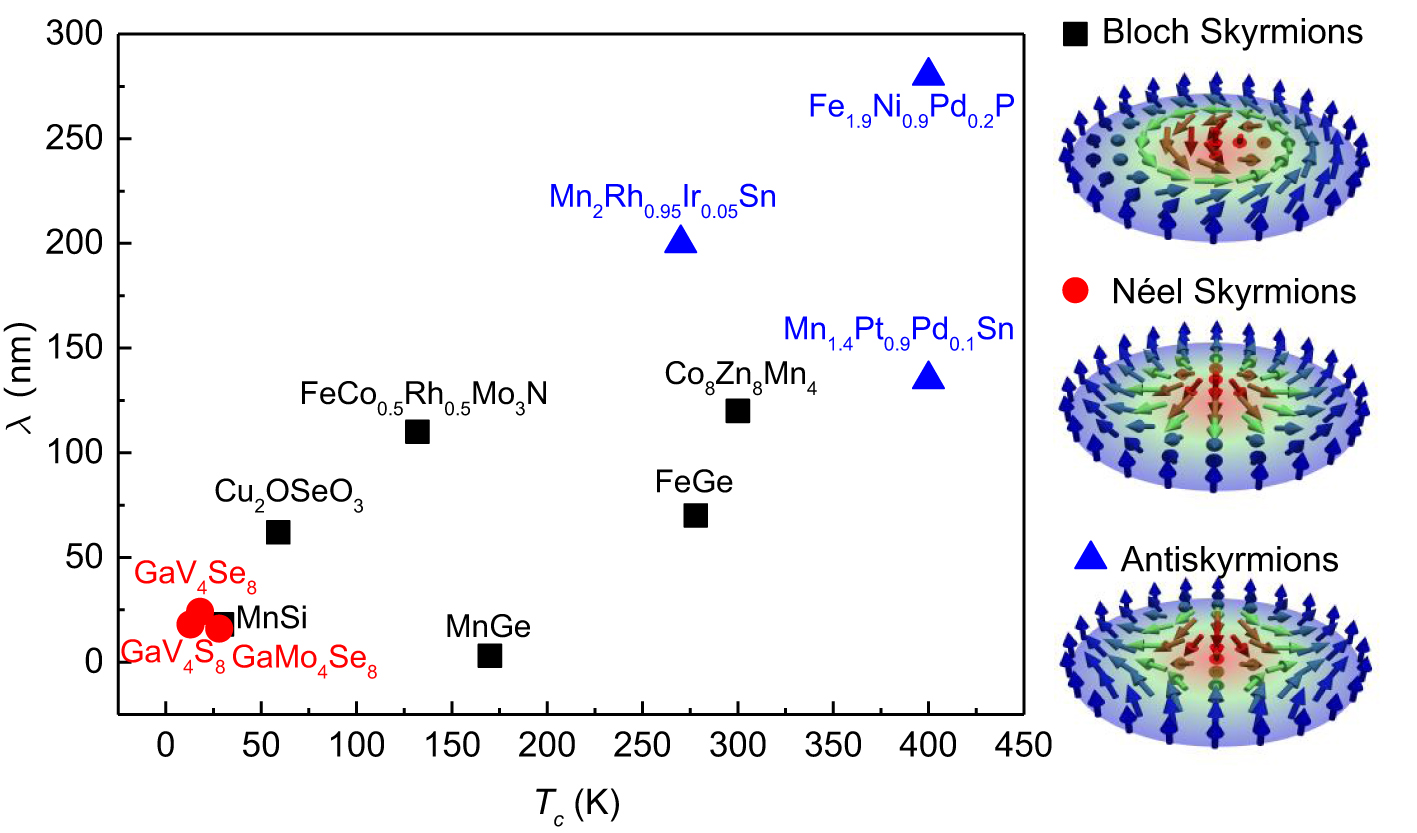
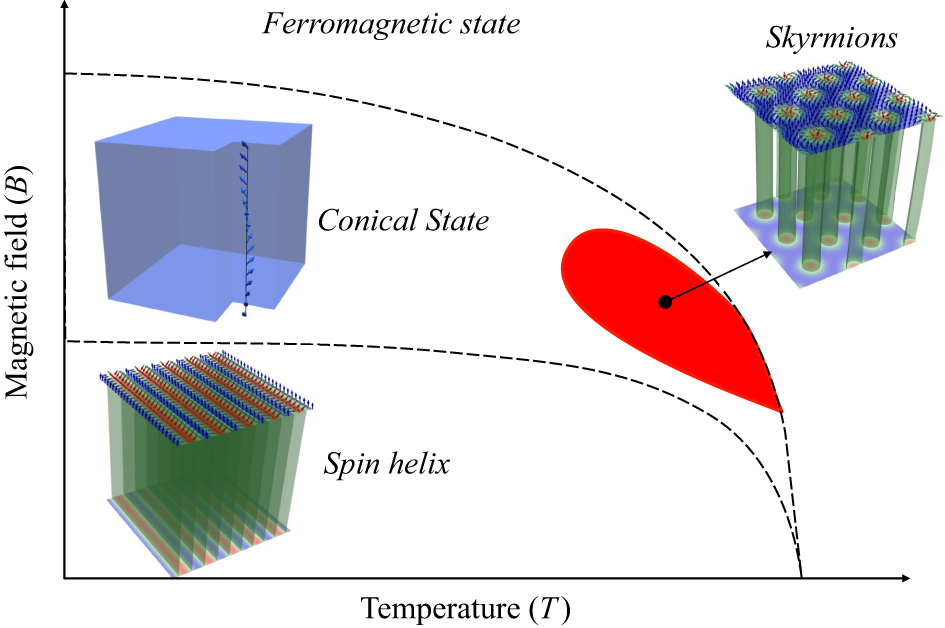
</mo></mrow><mi>η</mi><msub><mi>δ</mi><mrow><mi>i</mi><mi>j</mi></mrow></msub></mrow></math><inline-graphic xmlns:xlink="http://www.w3.org/1999/xlink" xlink:href="cpb_31_8_087507_ieqn7.gif"></inline-graphic></inline-formula></span> and <i>η</i> is close to unity. The pinning force <i><strong>F</strong></i> originates from the impurity of the material and is given by <i>F<sub>i</sub></i> = ∫ <i>γ <strong>m</strong></i> ⋅ [<i>∂<sub>i</sub><strong>m</strong></i> × (<i><strong>m</strong></i> × <i><strong>H</strong></i><sub>pin</sub>)] d <i>x</i> d <i>y</i>. For the current applied in the <i>x</i>-direction, i.e., <i><strong>u</strong></i> = (<i>u</i>,0), the skyrmion velocity can be obtained as<disp-formula id="cpb_31_8_087507eqn3"><label>3</label><tex-math></tex-math><math xmlns:mml="http://www.w3.org/1998/Math/MathML"><mrow><msub><mi>v</mi><mi>x</mi></msub><mo>=</mo><mo>−</mo><mstyle displaystyle="true"><mfrac><mrow><msup><mi>G</mi><mn>2</mn></msup><mo>+</mo><msup><mi>D</mi><mn>2</mn></msup><mi>α</mi><mi>β</mi></mrow><mrow><msup><mi>G</mi><mn>2</mn></msup><mo>+</mo><msup><mi>α</mi><mn>2</mn></msup><msup><mi>D</mi><mn>2</mn></msup></mrow></mfrac></mstyle><mi>u</mi><mo>,</mo><mspace width="1em)