Synthesis and superconductivity in yttrium superhydrides under high pressure
Wang Yingying1, 2, Wang Kui1, 2, Sun Yao1, 2, Ma Liang1, 2, 3, Wang Yanchao1, 2, Zou Bo1, Liu Guangtao2, †, Zhou Mi2, ‡, Wang Hongbo1, 2, §
ManuID:
ac872e
Received:2022-05-15
Copyright:
2022
More
Abstract
Flourishing rare earth superhydrides are a class of recently discovered materials that exhibit near-room-temperature superconductivity at high pressures, ushering in a new era of superconductivity research at high pressures. Yttrium superhydrides drew the most attention among these superhydrides due to their abundance of stoichiometries and excellent superconductivities. Here, we carried out a comprehensive study of yttrium superhydrides in a wide pressure range of 140 GPa–300 GPa. We successfully synthesized a series of superhydrides with the compositions of YH4, YH6, YH7, and YH9, and reported superconducting transition temperatures of 82 K at 167 GPa, 218 K at 165 GPa, 29 K at 162 GPa, and 230 K at 300 GPa, respectively, as evidenced by sharp drops in resistance. The structure and superconductivity of YH4 were taken as a representative example and were also examined using x-ray diffraction measurements and the superconductivity suppression under external magnetic fields, respectively. Clathrate YH10, a candidate for room-temperature superconductor, was not synthesized within the study pressure and temperature ranges of up to 300 GPa and 2000 K. The current study established a detailed foundation for future research into room-temperature superconductors in polynary yttrium-based superhydrides.
WangYingying, WangKui, SunYao, MaLiang, WangYanchao, ZouBo, LiuGuangtao, ZhouMi, WangHongbo. Synthesis and superconductivity in yttrium superhydrides under high pressure[J]. Chinese Physics B, 2022, 31(10): https://doi.org/10.1088/1674-1056/ac872e
Introduction
The search for high-temperature superconductors (HTS) with superconducting transition temperature (Tc) above liquid-nitrogen temperature has long been recognized as an intriguing topic since the discovery of Hg with Tc = 4.2 K.[1] According to the Bardeen–Cooper–Schrieffer theory,[2] metallic hydrogen (MH) is one of the best candidates for achieving HTS; however, the quest for MH has proven extremely challenging due to the requirements of ultrahigh pressure conditions. Satterthwaite et al. discovered ∼ 8 K superconductivity in thorium hydride in 1970, implying that hydrogen-rich metal hydrides would be HTS.[3] Then, Gilman[4] and Ashcroft[5] further proposed that MH could be achieved in hydrogen-rich compounds at lower pressures because the heavier atoms played a chemical precompression role in hydrogen, ushering in a new era of HTS research in hydrogen-rich compounds at high pressures. However, despite significant efforts, there were no experimental breakthroughs for a long time until the observation of 203 K superconductivity at 155 GPa in covalent H3S,[6] which further inspired the search for HTS in conventional phonon-mediated hydride superconductors.
In contrast to covalent superhydrides such as H3S, ionic metal hydrides offer more options for finding HTS. Wang et al. (2012) predicted the first CaH6 clathrate hydride with a very high Tc of 235 K at 150 GPa.[7] Following this study, a long list of clathrate REH6, REH9, and REH10 superhydrides (RE: rare earth metal) were predicted to have high Tc values close to or even above room temperature.[8–10] Stimulated by these predictions, a series of clathrate superhydrides, such as CaH6,[11] LaH10,[12,13] CeH9, CeH10,[14] ThH9, ThH10,[15] (La, Y)H10,[16] were successfully synthesized with Tc ranging from 57 K–260 K. Among ionic superhydrides, yttrium superhydrides piqued the interest of researchers due to their abundant stoichiometries, they are predicted to have high Tc, e.g., 84 K–95 K at 120 GPa in YH4,[10,17] 251 K–264 K at 120 GPa in YH6,[10] 21.5 K–43 K at 165 GPa in YH7,[18] 253 K–276 K at 150 GPa in YH9,[8] and 305 K–326 K at 250 GPa in YH10.[9] Recently, Kong et al.[19] successfully synthesized YH4 and clathrate structured YH6 and YH9 with observed Tcs of 220 K at 183 GPa and 243 K at 201 GPa for the last two yttrium superhydrides, respectively. Meanwhile, Troyan et al. also independently synthesized a clathrate YH6,[18] with an observed Tc of 224 K at 166 GPa. Following that, Snider et al. synthesized YH9 with a Tc of up to 262 K using catalytic hydrogenation at about 182 GPa.[20] Furthermore, recent research has successfully observed 88 K superconductivity of YH4 at 155 GPa.[21]
Besides binary yttrium superhydrides, yttrium-bearing ternary hydrides, where the introduction of a third element other than hydrogen considerably expands the phase space, have attracted extensive attention. Liang et al.[22] and Xie et al.[23] predicted a clathrate CaYH12 with an estimated Tc of 258 K at 200 GPa and 230 K at 180 GPa, respectively. Then, Liang et al. predicted a ternary YSH6 with a Tc of 91 K at 210 GPa.[24] (La, Y)H6 and (La, Y)H10[16] were synthesized experimentally at high pressures with Tcs of 237 K and 253 K, respectively.
Previous research has primarily concentrated on HTS (Tc > 200 K), even though more superhydrides have been synthesized. Thus far, there has been a dearth of efforts to systematically investigate the superconductivity of all experimentally reported unconventional superhydrides. In this work, we first conducted detailed structure and superconductivity studies of YH4, which was chosen as an example due to its rare previous investigation. X-ray diffraction measurements revealed the successful synthesis of predicted I4/mmm-YH4 at about 167 GPa and 1600 K, and its measured Tc of 82 K was evidenced by a sharp drop in resistance and a characteristic decrease in superconducting transition under a magnetic field up to 8.5 T. Further electrical transport measurements revealed a series of additional superconducting transitions at 29 K (162 GPa), 218 K (165 GPa), and 230 K (300 GPa), which arise from YH7 and clathrate structured YH6, and YH9, respectively, inferred from Tcs consistency with previous studies.
Experimental methods
According to the different target pressures, symmetric diamond anvil cells (DACs) outfitted diamond anvils with a culet size of ∼ 30 μm–60 μm beveled at 8.5° to a diameter of ∼ 250 μm. The composite gasket was composed of rhenium outer annulus and a mixture of epoxy resin and Al2O3 powder. The insulating gasket was pre-indented to a thickness of 10 μm, and the corresponding sample chamber with a diameter of 20 μm–30 μm was drilled using a laser drilling system. Commercially available yttrium ingot (Alfa Aesar, 99.9% purity) and NH3BH3 (AB) powder (Sigma-Aldrich, 97%) were loaded into the sample chamber inside a glovebox filled with Ar atmosphere with O2 and H2O contents of < 0.01 ppm. The Y foil and Au electrodes with thicknesses of 2 μm and 1 μm, respectively, were sandwiched between the AB layers. The application of Au electrodes can effectively avoid the chemical reaction[25] between the electrodes and hydrogen, which can result in the formation of undesirable superconductors, as well as help to maintain a hydrogen-rich environment. AB serves as a hydrogen source while also acting as thermal insulation layers. Subsequently, the samples were compressed to the required synthesis pressure. The pressure in the sample chamber was calibrated using the high-frequency edge of the diamond Raman line.[26] The laser heating of the sample was performed using a pulsed YAG infrared laser, and the temperature was determined using the black-body radiation fit within the Planck function. In situ high-pressure angle-dispersive x-ray diffraction (ADXRD) experiments were performed at the Shanghai Synchrotron Radiation Facility’s BL15U1 beamline (5 μm × 12 μm) with a monochromatic beam wavelength of 0.6199 Å and an average acquisition time of 120 s. Before the experiment, the relevant geometric parameters were calibrated using a CeO2 standard. Diffraction patterns were collected using a Mar165 CCD detector and analyzed using DIOPTAS software, yielding one-dimension profiles.[27] The Le Bail profile matching refinements were performed using the GSAS + EXPGUI programs.[28] Based on the four-probe van der Pauw method,[29] the resistance measurements were performed with currents of 10−6–10−4 A (Keithley 2182A nanovoltmeter and 6221 AC and DC source) and the selected data were warming cycles with a controlled rate of approximately 1 K ⋅ min−1. Furthermore, non-magnetic DACs made of Be–Cu alloy were used for resistance measurements in an external magnetic field of up to 8.5 T.
Results and discussion
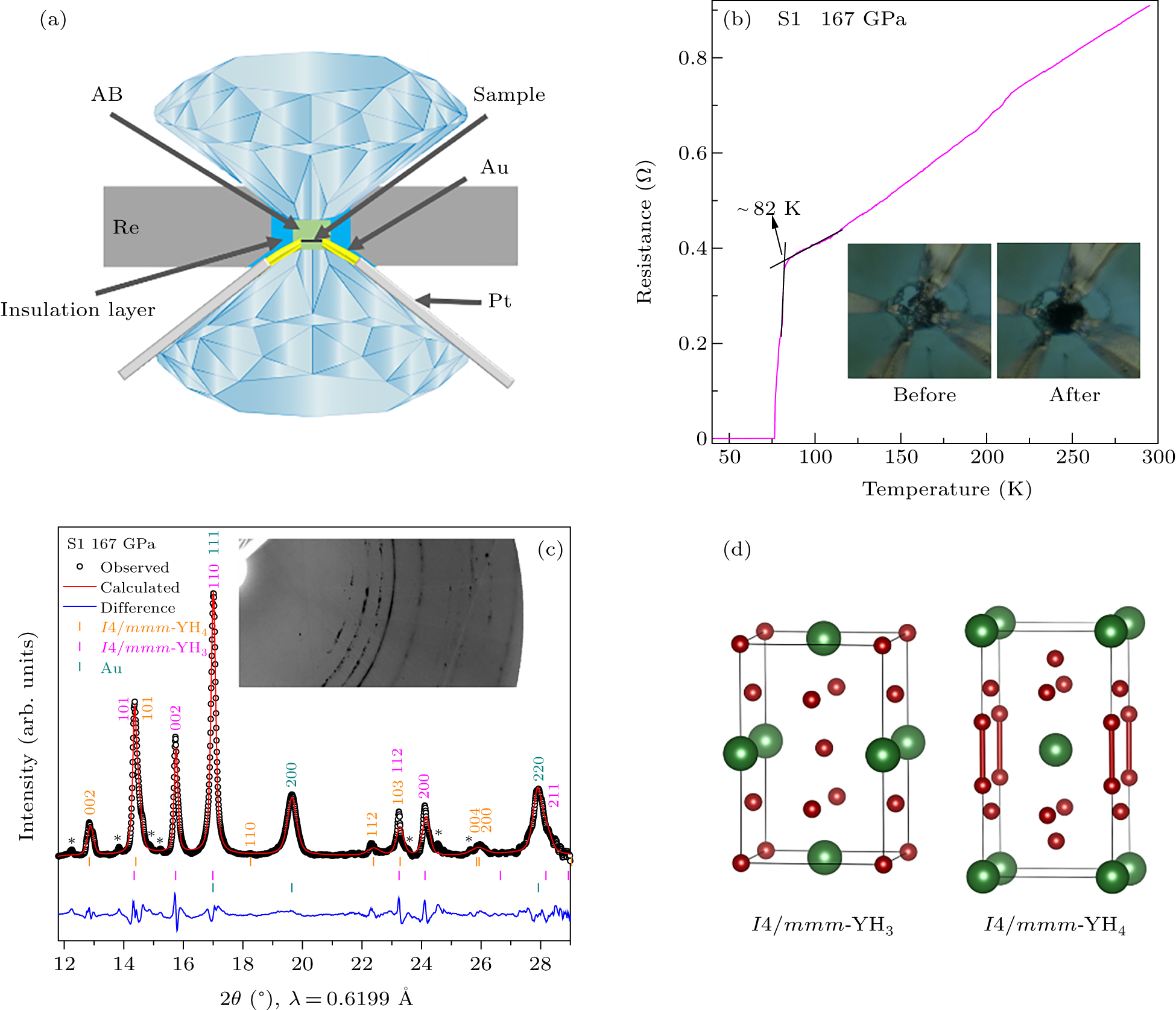
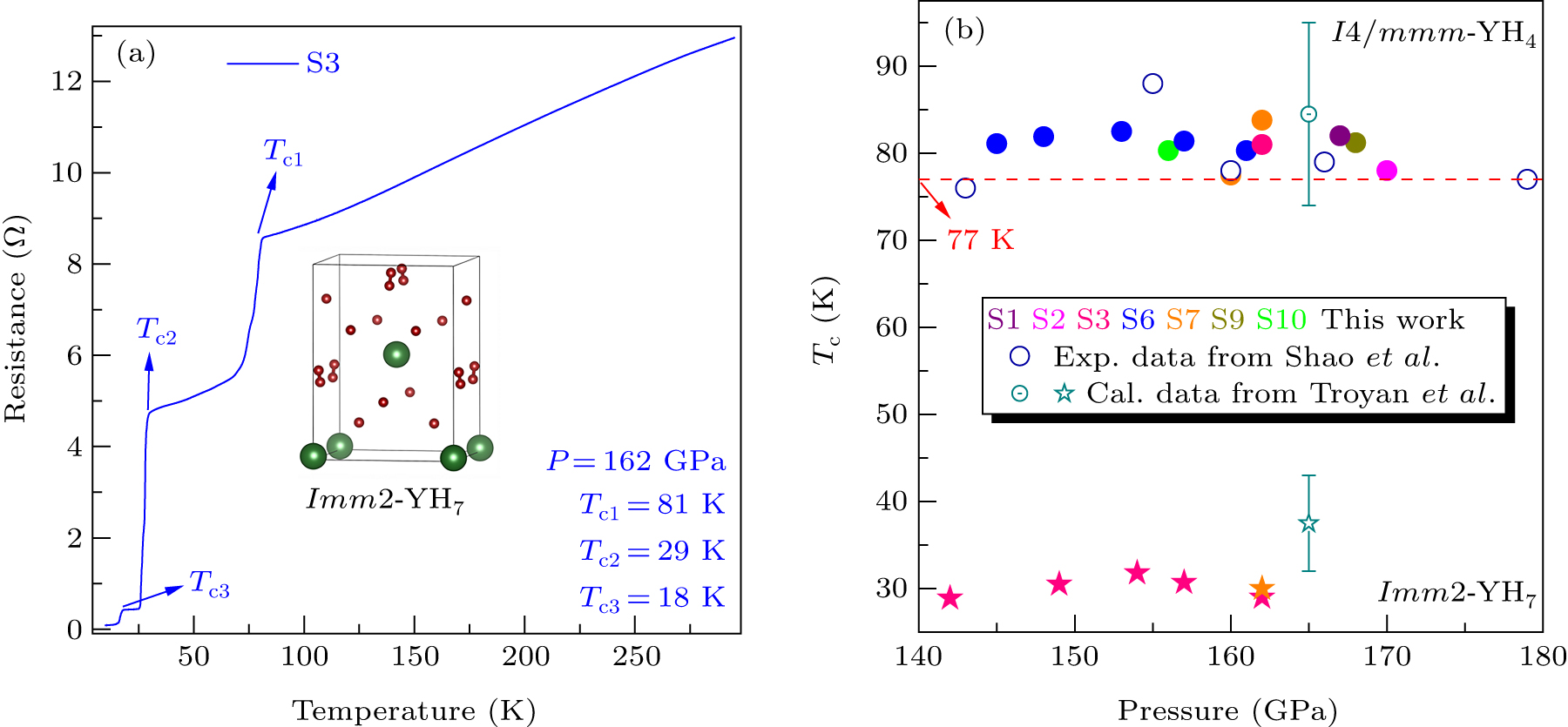
In this work, we prepared 11 samples, labeled as samples 1 through sample 11, to synthesize yttrium superhydrides from a mixture of Y and AB, and explore their superconductivity. Previous excellent results have shown AB to be a reliable H2 source.[11,13,18,19,21] At high temperatures, AB would decompose into H2 plus c-BN, the latter avoiding the problem of poor contact between the synthesized product and electrodes. The diagram of the assembly used for synthesis and four-probe electrical resistance measurements is shown in Fig. 1(a). In sample 1, the reactants were compressed to 167 GPa [Fig. S1(a)] before being heated to about 1600 K. The clear H–H vibration from H2 molecular [Fig. S1(b)] demonstrates a hydrogen-rich environment. The sample turned black after laser heating, indicating that a chemical reaction occurred [inset in Fig. 1(b)]. Representative electrical resistance measurements as a function of temperature reveal a superconducting transition at 82 K, as evidenced by the sharp drop in the resistance, as shown in Fig. 1(b). This superconducting transition can be perfectly reproduced in several independent experiments (Fig. 2 and Fig. S2), further confirming the reliability of our results. To determine the highest value of Tc, we evaluated the pressure dependence of Tc, as shown in Fig. 2(b). Tc fluctuates in the pressure range of 145 GPa–170 GPa in different experiments and the highest Tc of 84 K at 162 GPa is consistent with the previous theoretical estimate of 84 K–95 K for YH4. Furthermore, as pressure decreases, the superconducting transition disappears at about 143 GPa [Figs. S2(a) and S2(b)], indicating a possible superconducting phase decomposition.
Fig. 1. (a) Schematic of the experimental setup for synthesis and four-probe superconducting electrical resistance measurements. (b) Temperature dependence of resistance in sample 1 (S1) at 167 GPa. The insets show an optical micrograph of the sample before and after laser heating. The value of the Tc is defined as the crossing point of the resistance slopes before and after the resistance drop. (c) Synchrotron XRD pattern of S1 at 167 GPa. The inset displays a two-dimensional XRD pattern. Unidentified weak reflections are marked by asterisks. (d) Crystal structures of I4/mmm-YH3 and I4/mmm-YH4. Big and small balls represent Y and H atoms, respectively.
Fig. 2. (a) Temperature dependence of resistance in sample 3 (S3) at 162 GPa. Inset: crystal structures of Imm2-YH7. Big and small balls represent Y and H atoms, respectively. (b) Pressure dependence of Tc for I4/mmm YH4 (circle) and Imm2-YH7 (star). Different colors represent different samples. The cited experimental data for YH4 are represented by open circles.[21] Dark cyan symbols depict the calculated data from Troyan et al.[18]
To further determine the structure of the high-temperature superconducting phase, we performed in situ high-pressure ADXRD measurements of sample 1, which revealed that the products were dominated by I4/mmm-YH3 and I4/mmm-YH4 as shown in Fig. 1(c) and the refined structural information is listed in Table S1. The tetragonal YH3, which possessed a new high-pressure phase in addition to the conventional fcc phase, was synthesized for the first time after prediction.[17] Moreover, no superconductivity was predicted in I4/mmm-YH3 up to 200 GPa. Consequently, the observed-superconducting transition in sample 1 should be attributed to YH4.
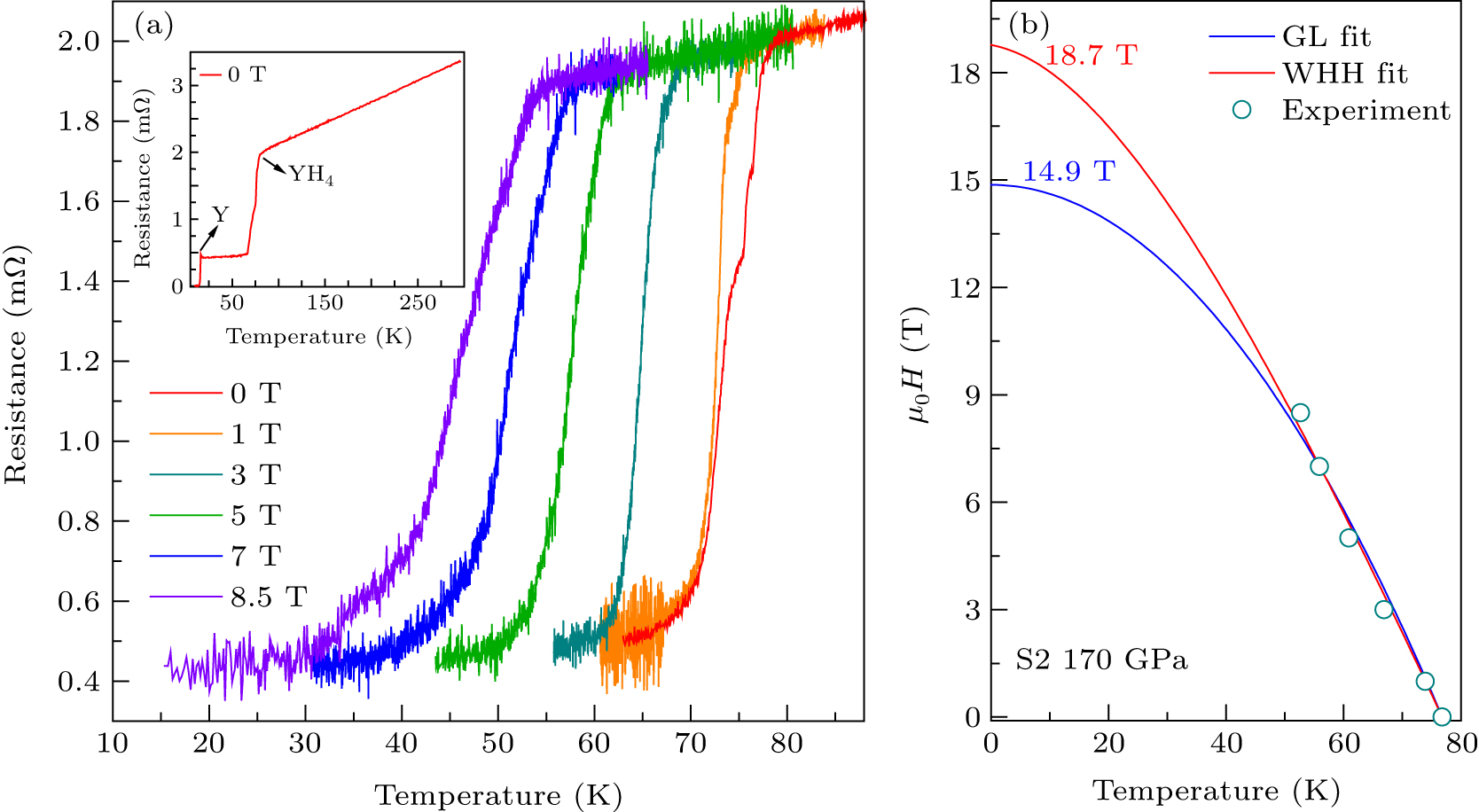
Due to the small sample size, measuring the Meissner effect in ultra-high-pressure experiments remains a significant challenge to this day. An applied external magnetic field can break the Cooper pairs, reducing the value of Tc; thus, the suppression of superconducting transitions by an applied magnetic field can be used to investigate the nature of the superconducting states. Figure 3(a) shows the measured resistance of sample 2 under different magnetic fields at 170 GPa. The Tc decreased from 77 K to 53 K as the magnetic field increased to 8.5 T, indicating the superconducting nature of the transition. The extrapolated upper critical field μ0Hc2(T) and coherence length toward T = 0 K are 14.9 T and 47 Å, as well as 18.7 T and 42 Å, respectively, as shown in Fig. 3(b), and were fitted by the Ginzburg–Landau (GL)[30] and Werthamer–Helfand–Hohenberg (WHH)[31] models. Furthermore, besides the superconductivity of YH4, we observed another low-temperature superconductivity of 17 K [inset in Fig. 3(a)] in this experiment, which can be attributed to the element yttrium based on the agreement with the Tc of the unheated sample (Fig. S3). Similar results for YH4 were independently reported by another group.[21]
Fig. 3. (a) The temperature dependence of the resistance for I4/mmm-YH4 under external magnetic fields of μ0H = 0 T, 1 T, 3 T, 5 T, 7 T, and 8.5 T at 170 GPa in sample 2 (S2). Inset: the temperature-resistance curve without external magnetic fields. (b) Upper critical field versus temperature, μ0H(0) was fitted with the GL and WHH models.
Furthermore, after laser heating sample 3 to approximately 1750 K at 162 GPa, we observed step-down behavior in electrical resistance measurements at 81 K, 29 K, and 18 K (Fig. 2(a)). As aforementioned, the first and third resistance drops, result from superconducting transitions of YH4 and element Y, respectively. Based on previous theoretical work,[18] we hypothesized that the second resistance drop at 29 K may originate from the superconducting transition of Imm2-YH7, which was also reproduced in sample 7 [Fig. S2(c)]. Figure 2(b) summarizes the pressure dependency of Tc for YH7 and YH4. Similar to the variation trend of YH4, the Tc of YH7 was relatively stable in the pressure range of 142 GPa–170 GPa. Although both I4/mmm-YH4 and Imm2-YH7 have a molecular “H2” unit [Fig. 1(d) and Fig. 2(a)], the Tc of YH4 with a high-symmetry structure is higher than that of YH7 due to stronger electron-phonon coupling.[18]
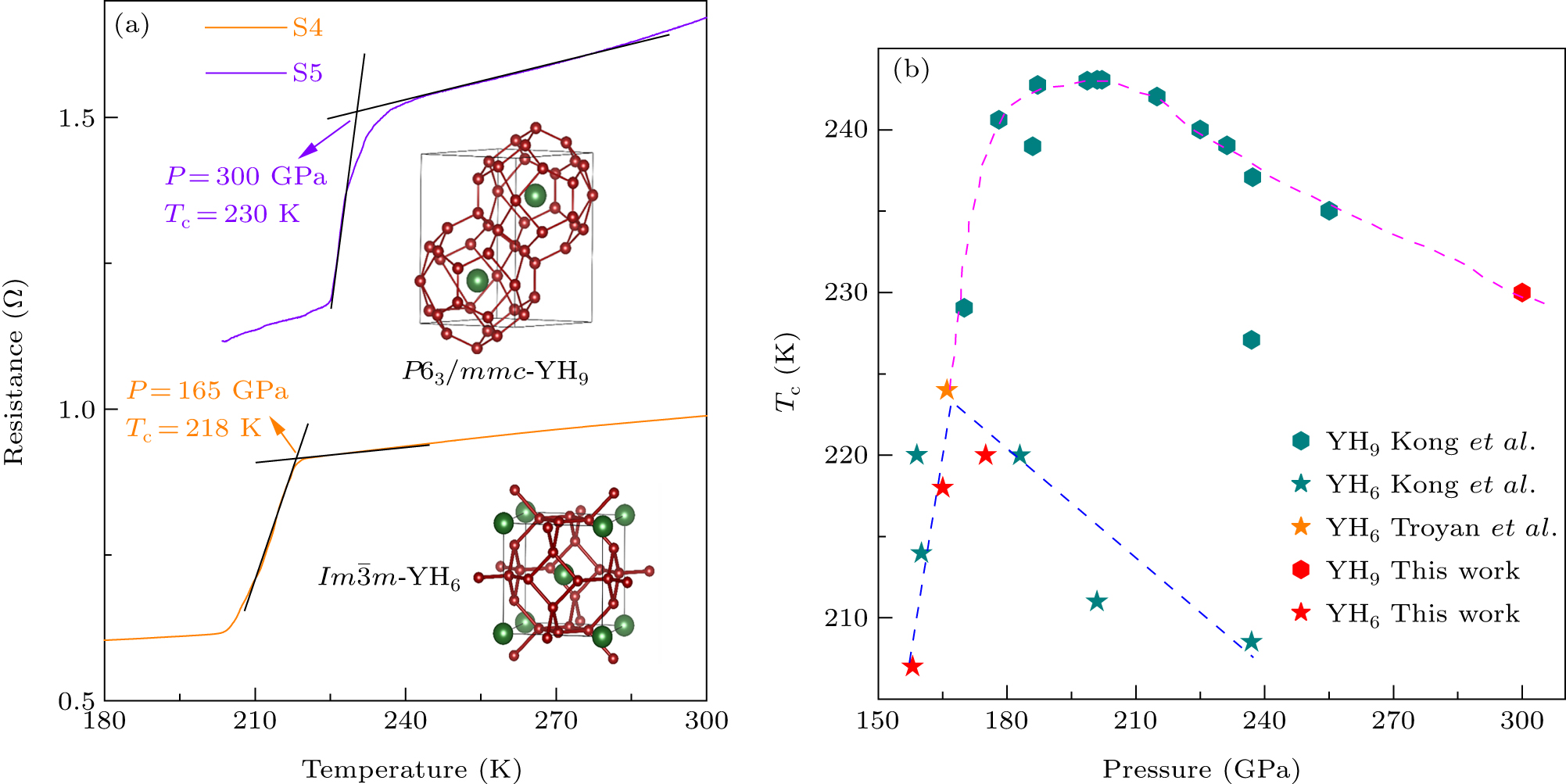
In the following work, we tuned the heating temperature and pressure, to synthesize the high-temperature superconducting clathrate YH6, YH9, or even YH10. When we increased the heating temperature to 2200 K at 165 GPa for sample 4, a Tc of 218 K was observed, as shown in Fig. 4(a). Subsequently, sample 5 was compressed to a superhigh pressure of 300 GPa [Fig. S1(a)] and heated to about 2000 K, and the electrical resistance measurement curve revealed superconductivity at 230 K (Fig. 4(a)). As shown in Fig. 4(b) the Tcs of samples 4 and samples 5 perfectly match the reported experimental results for clathrate structured YH6 and YH9,[18,19] respectively. The high Tc of -YH6 and P63/mmc-YH9 was attributed to their hydrogen cage structure, and particularly the significant contribution of the H-derived electronic density of states at the Fermi level.[8,10] Unfortunately, we found no evidence of clathrate YH10, which may be synthesized at higher pressures.
Fig. 4. (a) Temperature dependence of resistance in sample 4 (S4) at 165 GPa and sample 5 (S5) at 300 GPa. The large residual resistance in S4 and S5 is mainly from the coexistence of multiple phases. Furthermore, the pseudo-four-electrode method was used in the electrical measurement for S5, thus introducing additional resistance from the electrodes. Inset: crystal structures of -YH6 and P63/mmc-YH9. Big and small balls represent Y and H atoms, respectively. (b) Pressure dependence of Tc for -YH6 (star) and P63/mmc-YH9 (hexagon). The symbols of dark cyan, orange, and red correspond to the data of Kong et al.,[19] Troyan et al.,[18] and this work, respectively.
A series of superhydrides with high Tc have been synthesized under high pressures; however, the absence of resistive transition broadening with increasing magnetic field in some works[12,16,32] has led to a debate about their superconductivity.[33] Using YH4 as an example, we observed a clear broadening of the resistive transition under applied magnetic fields (Fig. S4), which follows a similar trend to that of typical standard superconductors such as MgB2[34] and NbN,[35] further demonstrating the veracity of our results. As a member of superhydride, the results of electrical transport measurements under external magnetic fields in YH4 will help clarify the debate on the superconductivity in superhydrides.
Conclusion and perspectives
In summary, we have successfully synthesized YH4, YH6, YH7, and YH9, which exhibited Tcs of 82 K at 167 GPa, 218 K at 165 GPa, 29 K at 162 GPa, and 230 K at 300 GPa, respectively. Furthermore, a tetragonal phase as a new high-pressure structure of conventional YH3 was synthesized for the first time at 167 GPa. These findings confirm the original theoretical prediction and provide a foundation for future research into HTS on the doped Y-based polynary superhydrides.
Acknowledgments
XRD measurements were performed at BL15U1 station in Shanghai Synchrotron Radiation Facility (SSRF) and 4W2 station in Beijing Synchrotron Radiation Facility (BSRF). The measurements of superconducting transition under external magnetic fields were supported by the Synergic Extreme Condition User Facility (SECUF) and China’s Steady High Magnetic Field Facility (SHMFF).
Project supported by the National Key Research and Development Program of China (Grant Nos. 2021YFA1400203 and 2018YFA0305900), the National Natural Science Foundation of China (Grant Nos. 52090024, 11874175, 12074139, 12074138, 11874176, and 12034009), the Strategic Priority Research Program of Chinese Academy of Sciences (Grant No. XDB33000000), and Program for JLU Science and Technology Innovative Research Team (JLUSTIRT).
... The search for high-temperature superconductors (HTS) with superconducting transition temperature (Tc) above liquid-nitrogen temperature has long been recognized as an intriguing topic since the discovery of Hg with Tc = 4.2 K.[1] According to the Bardeen–Cooper–Schrieffer theory,[2] metallic hydrogen (MH) is one of the best candidates for achieving HTS; however, the quest for MH has proven extremely challenging due to the requirements of ultrahigh pressure conditions. Satterthwaite et al. discovered ∼ 8 K superconductivity in thorium hydride in 1970, implying that hydrogen-rich metal hydrides would be HTS.[3] Then, Gilman[4] and Ashcroft[5] further proposed that MH could be achieved in hydrogen-rich compounds at lower pressures because the heavier atoms played a chemical precompression role in hydrogen, ushering in a new era of HTS research in hydrogen-rich compounds at high pressures. However, despite significant efforts, there were no experimental breakthroughs for a long time until the observation of 203 K superconductivity at 155 GPa in covalent H3S,[6] which further inspired the search for HTS in conventional phonon-mediated hydride superconductors. ...
1
1957
... The search for high-temperature superconductors (HTS) with superconducting transition temperature (Tc) above liquid-nitrogen temperature has long been recognized as an intriguing topic since the discovery of Hg with Tc = 4.2 K.[1] According to the Bardeen–Cooper–Schrieffer theory,[2] metallic hydrogen (MH) is one of the best candidates for achieving HTS; however, the quest for MH has proven extremely challenging due to the requirements of ultrahigh pressure conditions. Satterthwaite et al. discovered ∼ 8 K superconductivity in thorium hydride in 1970, implying that hydrogen-rich metal hydrides would be HTS.[3] Then, Gilman[4] and Ashcroft[5] further proposed that MH could be achieved in hydrogen-rich compounds at lower pressures because the heavier atoms played a chemical precompression role in hydrogen, ushering in a new era of HTS research in hydrogen-rich compounds at high pressures. However, despite significant efforts, there were no experimental breakthroughs for a long time until the observation of 203 K superconductivity at 155 GPa in covalent H3S,[6] which further inspired the search for HTS in conventional phonon-mediated hydride superconductors. ...
1
1970
... The search for high-temperature superconductors (HTS) with superconducting transition temperature (Tc) above liquid-nitrogen temperature has long been recognized as an intriguing topic since the discovery of Hg with Tc = 4.2 K.[1] According to the Bardeen–Cooper–Schrieffer theory,[2] metallic hydrogen (MH) is one of the best candidates for achieving HTS; however, the quest for MH has proven extremely challenging due to the requirements of ultrahigh pressure conditions. Satterthwaite et al. discovered ∼ 8 K superconductivity in thorium hydride in 1970, implying that hydrogen-rich metal hydrides would be HTS.[3] Then, Gilman[4] and Ashcroft[5] further proposed that MH could be achieved in hydrogen-rich compounds at lower pressures because the heavier atoms played a chemical precompression role in hydrogen, ushering in a new era of HTS research in hydrogen-rich compounds at high pressures. However, despite significant efforts, there were no experimental breakthroughs for a long time until the observation of 203 K superconductivity at 155 GPa in covalent H3S,[6] which further inspired the search for HTS in conventional phonon-mediated hydride superconductors. ...
1
1971
... The search for high-temperature superconductors (HTS) with superconducting transition temperature (Tc) above liquid-nitrogen temperature has long been recognized as an intriguing topic since the discovery of Hg with Tc = 4.2 K.[1] According to the Bardeen–Cooper–Schrieffer theory,[2] metallic hydrogen (MH) is one of the best candidates for achieving HTS; however, the quest for MH has proven extremely challenging due to the requirements of ultrahigh pressure conditions. Satterthwaite et al. discovered ∼ 8 K superconductivity in thorium hydride in 1970, implying that hydrogen-rich metal hydrides would be HTS.[3] Then, Gilman[4] and Ashcroft[5] further proposed that MH could be achieved in hydrogen-rich compounds at lower pressures because the heavier atoms played a chemical precompression role in hydrogen, ushering in a new era of HTS research in hydrogen-rich compounds at high pressures. However, despite significant efforts, there were no experimental breakthroughs for a long time until the observation of 203 K superconductivity at 155 GPa in covalent H3S,[6] which further inspired the search for HTS in conventional phonon-mediated hydride superconductors. ...
1
2004
... The search for high-temperature superconductors (HTS) with superconducting transition temperature (Tc) above liquid-nitrogen temperature has long been recognized as an intriguing topic since the discovery of Hg with Tc = 4.2 K.[1] According to the Bardeen–Cooper–Schrieffer theory,[2] metallic hydrogen (MH) is one of the best candidates for achieving HTS; however, the quest for MH has proven extremely challenging due to the requirements of ultrahigh pressure conditions. Satterthwaite et al. discovered ∼ 8 K superconductivity in thorium hydride in 1970, implying that hydrogen-rich metal hydrides would be HTS.[3] Then, Gilman[4] and Ashcroft[5] further proposed that MH could be achieved in hydrogen-rich compounds at lower pressures because the heavier atoms played a chemical precompression role in hydrogen, ushering in a new era of HTS research in hydrogen-rich compounds at high pressures. However, despite significant efforts, there were no experimental breakthroughs for a long time until the observation of 203 K superconductivity at 155 GPa in covalent H3S,[6] which further inspired the search for HTS in conventional phonon-mediated hydride superconductors. ...
1
2015
... The search for high-temperature superconductors (HTS) with superconducting transition temperature (Tc) above liquid-nitrogen temperature has long been recognized as an intriguing topic since the discovery of Hg with Tc = 4.2 K.[1] According to the Bardeen–Cooper–Schrieffer theory,[2] metallic hydrogen (MH) is one of the best candidates for achieving HTS; however, the quest for MH has proven extremely challenging due to the requirements of ultrahigh pressure conditions. Satterthwaite et al. discovered ∼ 8 K superconductivity in thorium hydride in 1970, implying that hydrogen-rich metal hydrides would be HTS.[3] Then, Gilman[4] and Ashcroft[5] further proposed that MH could be achieved in hydrogen-rich compounds at lower pressures because the heavier atoms played a chemical precompression role in hydrogen, ushering in a new era of HTS research in hydrogen-rich compounds at high pressures. However, despite significant efforts, there were no experimental breakthroughs for a long time until the observation of 203 K superconductivity at 155 GPa in covalent H3S,[6] which further inspired the search for HTS in conventional phonon-mediated hydride superconductors. ...
1
2012
... In contrast to covalent superhydrides such as H3S, ionic metal hydrides offer more options for finding HTS. Wang et al. (2012) predicted the first CaH6 clathrate hydride with a very high Tc of 235 K at 150 GPa.[7] Following this study, a long list of clathrate REH6, REH9, and REH10 superhydrides (RE: rare earth metal) were predicted to have high Tc values close to or even above room temperature.[8–10] Stimulated by these predictions, a series of clathrate superhydrides, such as CaH6,[11] LaH10,[12,13] CeH9, CeH10,[14] ThH9, ThH10,[15] (La, Y)H10,[16] were successfully synthesized with Tc ranging from 57 K–260 K. Among ionic superhydrides, yttrium superhydrides piqued the interest of researchers due to their abundant stoichiometries, they are predicted to have high Tc, e.g., 84 K–95 K at 120 GPa in YH4,[10,17] 251 K–264 K at 120 GPa in YH6,[10] 21.5 K–43 K at 165 GPa in YH7,[18] 253 K–276 K at 150 GPa in YH9,[8] and 305 K–326 K at 250 GPa in YH10.[9] Recently, Kong et al.[19] successfully synthesized YH4 and clathrate structured YH6 and YH9 with observed Tcs of 220 K at 183 GPa and 243 K at 201 GPa for the last two yttrium superhydrides, respectively. Meanwhile, Troyan et al. also independently synthesized a clathrate YH6,[18] with an observed Tc of 224 K at 166 GPa. Following that, Snider et al. synthesized YH9 with a Tc of up to 262 K using catalytic hydrogenation at about 182 GPa.[20] Furthermore, recent research has successfully observed 88 K superconductivity of YH4 at 155 GPa.[21] ...
3
2017
... In contrast to covalent superhydrides such as H3S, ionic metal hydrides offer more options for finding HTS. Wang et al. (2012) predicted the first CaH6 clathrate hydride with a very high Tc of 235 K at 150 GPa.[7] Following this study, a long list of clathrate REH6, REH9, and REH10 superhydrides (RE: rare earth metal) were predicted to have high Tc values close to or even above room temperature.[8–10] Stimulated by these predictions, a series of clathrate superhydrides, such as CaH6,[11] LaH10,[12,13] CeH9, CeH10,[14] ThH9, ThH10,[15] (La, Y)H10,[16] were successfully synthesized with Tc ranging from 57 K–260 K. Among ionic superhydrides, yttrium superhydrides piqued the interest of researchers due to their abundant stoichiometries, they are predicted to have high Tc, e.g., 84 K–95 K at 120 GPa in YH4,[10,17] 251 K–264 K at 120 GPa in YH6,[10] 21.5 K–43 K at 165 GPa in YH7,[18] 253 K–276 K at 150 GPa in YH9,[8] and 305 K–326 K at 250 GPa in YH10.[9] Recently, Kong et al.[19] successfully synthesized YH4 and clathrate structured YH6 and YH9 with observed Tcs of 220 K at 183 GPa and 243 K at 201 GPa for the last two yttrium superhydrides, respectively. Meanwhile, Troyan et al. also independently synthesized a clathrate YH6,[18] with an observed Tc of 224 K at 166 GPa. Following that, Snider et al. synthesized YH9 with a Tc of up to 262 K using catalytic hydrogenation at about 182 GPa.[20] Furthermore, recent research has successfully observed 88 K superconductivity of YH4 at 155 GPa.[21] ...
... [8] and 305 K–326 K at 250 GPa in YH10.[9] Recently, Kong et al.[19] successfully synthesized YH4 and clathrate structured YH6 and YH9 with observed Tcs of 220 K at 183 GPa and 243 K at 201 GPa for the last two yttrium superhydrides, respectively. Meanwhile, Troyan et al. also independently synthesized a clathrate YH6,[18] with an observed Tc of 224 K at 166 GPa. Following that, Snider et al. synthesized YH9 with a Tc of up to 262 K using catalytic hydrogenation at about 182 GPa.[20] Furthermore, recent research has successfully observed 88 K superconductivity of YH4 at 155 GPa.[21] ...
... In the following work, we tuned the heating temperature and pressure, to synthesize the high-temperature superconducting clathrate YH6, YH9, or even YH10. When we increased the heating temperature to 2200 K at 165 GPa for sample 4, a Tc of 218 K was observed, as shown in Fig. 4(a). Subsequently, sample 5 was compressed to a superhigh pressure of 300 GPa [Fig. S1(a)] and heated to about 2000 K, and the electrical resistance measurement curve revealed superconductivity at 230 K (Fig. 4(a)). As shown in Fig. 4(b) the Tcs of samples 4 and samples 5 perfectly match the reported experimental results for clathrate structured YH6 and YH9,[18,19] respectively. The high Tc of -YH6 and P63/mmc-YH9 was attributed to their hydrogen cage structure, and particularly the significant contribution of the H-derived electronic density of states at the Fermi level.[8,10] Unfortunately, we found no evidence of clathrate YH10, which may be synthesized at higher pressures. ...
1
2017
... In contrast to covalent superhydrides such as H3S, ionic metal hydrides offer more options for finding HTS. Wang et al. (2012) predicted the first CaH6 clathrate hydride with a very high Tc of 235 K at 150 GPa.[7] Following this study, a long list of clathrate REH6, REH9, and REH10 superhydrides (RE: rare earth metal) were predicted to have high Tc values close to or even above room temperature.[8–10] Stimulated by these predictions, a series of clathrate superhydrides, such as CaH6,[11] LaH10,[12,13] CeH9, CeH10,[14] ThH9, ThH10,[15] (La, Y)H10,[16] were successfully synthesized with Tc ranging from 57 K–260 K. Among ionic superhydrides, yttrium superhydrides piqued the interest of researchers due to their abundant stoichiometries, they are predicted to have high Tc, e.g., 84 K–95 K at 120 GPa in YH4,[10,17] 251 K–264 K at 120 GPa in YH6,[10] 21.5 K–43 K at 165 GPa in YH7,[18] 253 K–276 K at 150 GPa in YH9,[8] and 305 K–326 K at 250 GPa in YH10.[9] Recently, Kong et al.[19] successfully synthesized YH4 and clathrate structured YH6 and YH9 with observed Tcs of 220 K at 183 GPa and 243 K at 201 GPa for the last two yttrium superhydrides, respectively. Meanwhile, Troyan et al. also independently synthesized a clathrate YH6,[18] with an observed Tc of 224 K at 166 GPa. Following that, Snider et al. synthesized YH9 with a Tc of up to 262 K using catalytic hydrogenation at about 182 GPa.[20] Furthermore, recent research has successfully observed 88 K superconductivity of YH4 at 155 GPa.[21] ...
4
2015
... In contrast to covalent superhydrides such as H3S, ionic metal hydrides offer more options for finding HTS. Wang et al. (2012) predicted the first CaH6 clathrate hydride with a very high Tc of 235 K at 150 GPa.[7] Following this study, a long list of clathrate REH6, REH9, and REH10 superhydrides (RE: rare earth metal) were predicted to have high Tc values close to or even above room temperature.[8–10] Stimulated by these predictions, a series of clathrate superhydrides, such as CaH6,[11] LaH10,[12,13] CeH9, CeH10,[14] ThH9, ThH10,[15] (La, Y)H10,[16] were successfully synthesized with Tc ranging from 57 K–260 K. Among ionic superhydrides, yttrium superhydrides piqued the interest of researchers due to their abundant stoichiometries, they are predicted to have high Tc, e.g., 84 K–95 K at 120 GPa in YH4,[10,17] 251 K–264 K at 120 GPa in YH6,[10] 21.5 K–43 K at 165 GPa in YH7,[18] 253 K–276 K at 150 GPa in YH9,[8] and 305 K–326 K at 250 GPa in YH10.[9] Recently, Kong et al.[19] successfully synthesized YH4 and clathrate structured YH6 and YH9 with observed Tcs of 220 K at 183 GPa and 243 K at 201 GPa for the last two yttrium superhydrides, respectively. Meanwhile, Troyan et al. also independently synthesized a clathrate YH6,[18] with an observed Tc of 224 K at 166 GPa. Following that, Snider et al. synthesized YH9 with a Tc of up to 262 K using catalytic hydrogenation at about 182 GPa.[20] Furthermore, recent research has successfully observed 88 K superconductivity of YH4 at 155 GPa.[21] ...
... [10,17] 251 K–264 K at 120 GPa in YH6,[10] 21.5 K–43 K at 165 GPa in YH7,[18] 253 K–276 K at 150 GPa in YH9,[8] and 305 K–326 K at 250 GPa in YH10.[9] Recently, Kong et al.[19] successfully synthesized YH4 and clathrate structured YH6 and YH9 with observed Tcs of 220 K at 183 GPa and 243 K at 201 GPa for the last two yttrium superhydrides, respectively. Meanwhile, Troyan et al. also independently synthesized a clathrate YH6,[18] with an observed Tc of 224 K at 166 GPa. Following that, Snider et al. synthesized YH9 with a Tc of up to 262 K using catalytic hydrogenation at about 182 GPa.[20] Furthermore, recent research has successfully observed 88 K superconductivity of YH4 at 155 GPa.[21] ...
... [10] 21.5 K–43 K at 165 GPa in YH7,[18] 253 K–276 K at 150 GPa in YH9,[8] and 305 K–326 K at 250 GPa in YH10.[9] Recently, Kong et al.[19] successfully synthesized YH4 and clathrate structured YH6 and YH9 with observed Tcs of 220 K at 183 GPa and 243 K at 201 GPa for the last two yttrium superhydrides, respectively. Meanwhile, Troyan et al. also independently synthesized a clathrate YH6,[18] with an observed Tc of 224 K at 166 GPa. Following that, Snider et al. synthesized YH9 with a Tc of up to 262 K using catalytic hydrogenation at about 182 GPa.[20] Furthermore, recent research has successfully observed 88 K superconductivity of YH4 at 155 GPa.[21] ...
... In the following work, we tuned the heating temperature and pressure, to synthesize the high-temperature superconducting clathrate YH6, YH9, or even YH10. When we increased the heating temperature to 2200 K at 165 GPa for sample 4, a Tc of 218 K was observed, as shown in Fig. 4(a). Subsequently, sample 5 was compressed to a superhigh pressure of 300 GPa [Fig. S1(a)] and heated to about 2000 K, and the electrical resistance measurement curve revealed superconductivity at 230 K (Fig. 4(a)). As shown in Fig. 4(b) the Tcs of samples 4 and samples 5 perfectly match the reported experimental results for clathrate structured YH6 and YH9,[18,19] respectively. The high Tc of -YH6 and P63/mmc-YH9 was attributed to their hydrogen cage structure, and particularly the significant contribution of the H-derived electronic density of states at the Fermi level.[8,10] Unfortunately, we found no evidence of clathrate YH10, which may be synthesized at higher pressures. ...
2
2022
... In contrast to covalent superhydrides such as H3S, ionic metal hydrides offer more options for finding HTS. Wang et al. (2012) predicted the first CaH6 clathrate hydride with a very high Tc of 235 K at 150 GPa.[7] Following this study, a long list of clathrate REH6, REH9, and REH10 superhydrides (RE: rare earth metal) were predicted to have high Tc values close to or even above room temperature.[8–10] Stimulated by these predictions, a series of clathrate superhydrides, such as CaH6,[11] LaH10,[12,13] CeH9, CeH10,[14] ThH9, ThH10,[15] (La, Y)H10,[16] were successfully synthesized with Tc ranging from 57 K–260 K. Among ionic superhydrides, yttrium superhydrides piqued the interest of researchers due to their abundant stoichiometries, they are predicted to have high Tc, e.g., 84 K–95 K at 120 GPa in YH4,[10,17] 251 K–264 K at 120 GPa in YH6,[10] 21.5 K–43 K at 165 GPa in YH7,[18] 253 K–276 K at 150 GPa in YH9,[8] and 305 K–326 K at 250 GPa in YH10.[9] Recently, Kong et al.[19] successfully synthesized YH4 and clathrate structured YH6 and YH9 with observed Tcs of 220 K at 183 GPa and 243 K at 201 GPa for the last two yttrium superhydrides, respectively. Meanwhile, Troyan et al. also independently synthesized a clathrate YH6,[18] with an observed Tc of 224 K at 166 GPa. Following that, Snider et al. synthesized YH9 with a Tc of up to 262 K using catalytic hydrogenation at about 182 GPa.[20] Furthermore, recent research has successfully observed 88 K superconductivity of YH4 at 155 GPa.[21] ...
... In this work, we prepared 11 samples, labeled as samples 1 through sample 11, to synthesize yttrium superhydrides from a mixture of Y and AB, and explore their superconductivity. Previous excellent results have shown AB to be a reliable H2 source.[11,13,18,19,21] At high temperatures, AB would decompose into H2 plus c-BN, the latter avoiding the problem of poor contact between the synthesized product and electrodes. The diagram of the assembly used for synthesis and four-probe electrical resistance measurements is shown in Fig. 1(a). In sample 1, the reactants were compressed to 167 GPa [Fig. S1(a)] before being heated to about 1600 K. The clear H–H vibration from H2 molecular [Fig. S1(b)] demonstrates a hydrogen-rich environment. The sample turned black after laser heating, indicating that a chemical reaction occurred [inset in Fig. 1(b)]. Representative electrical resistance measurements as a function of temperature reveal a superconducting transition at 82 K, as evidenced by the sharp drop in the resistance, as shown in Fig. 1(b). This superconducting transition can be perfectly reproduced in several independent experiments (Fig. 2 and Fig. S2), further confirming the reliability of our results. To determine the highest value of Tc, we evaluated the pressure dependence of Tc, as shown in Fig. 2(b). Tc fluctuates in the pressure range of 145 GPa–170 GPa in different experiments and the highest Tc of 84 K at 162 GPa is consistent with the previous theoretical estimate of 84 K–95 K for YH4. Furthermore, as pressure decreases, the superconducting transition disappears at about 143 GPa [Figs. S2(a) and S2(b)], indicating a possible superconducting phase decomposition. ...
2
2019
... In contrast to covalent superhydrides such as H3S, ionic metal hydrides offer more options for finding HTS. Wang et al. (2012) predicted the first CaH6 clathrate hydride with a very high Tc of 235 K at 150 GPa.[7] Following this study, a long list of clathrate REH6, REH9, and REH10 superhydrides (RE: rare earth metal) were predicted to have high Tc values close to or even above room temperature.[8–10] Stimulated by these predictions, a series of clathrate superhydrides, such as CaH6,[11] LaH10,[12,13] CeH9, CeH10,[14] ThH9, ThH10,[15] (La, Y)H10,[16] were successfully synthesized with Tc ranging from 57 K–260 K. Among ionic superhydrides, yttrium superhydrides piqued the interest of researchers due to their abundant stoichiometries, they are predicted to have high Tc, e.g., 84 K–95 K at 120 GPa in YH4,[10,17] 251 K–264 K at 120 GPa in YH6,[10] 21.5 K–43 K at 165 GPa in YH7,[18] 253 K–276 K at 150 GPa in YH9,[8] and 305 K–326 K at 250 GPa in YH10.[9] Recently, Kong et al.[19] successfully synthesized YH4 and clathrate structured YH6 and YH9 with observed Tcs of 220 K at 183 GPa and 243 K at 201 GPa for the last two yttrium superhydrides, respectively. Meanwhile, Troyan et al. also independently synthesized a clathrate YH6,[18] with an observed Tc of 224 K at 166 GPa. Following that, Snider et al. synthesized YH9 with a Tc of up to 262 K using catalytic hydrogenation at about 182 GPa.[20] Furthermore, recent research has successfully observed 88 K superconductivity of YH4 at 155 GPa.[21] ...
... A series of superhydrides with high Tc have been synthesized under high pressures; however, the absence of resistive transition broadening with increasing magnetic field in some works[12,16,32] has led to a debate about their superconductivity.[33] Using YH4 as an example, we observed a clear broadening of the resistive transition under applied magnetic fields (Fig. S4), which follows a similar trend to that of typical standard superconductors such as MgB2[34] and NbN,[35] further demonstrating the veracity of our results. As a member of superhydride, the results of electrical transport measurements under external magnetic fields in YH4 will help clarify the debate on the superconductivity in superhydrides. ...
2
2019
... In contrast to covalent superhydrides such as H3S, ionic metal hydrides offer more options for finding HTS. Wang et al. (2012) predicted the first CaH6 clathrate hydride with a very high Tc of 235 K at 150 GPa.[7] Following this study, a long list of clathrate REH6, REH9, and REH10 superhydrides (RE: rare earth metal) were predicted to have high Tc values close to or even above room temperature.[8–10] Stimulated by these predictions, a series of clathrate superhydrides, such as CaH6,[11] LaH10,[12,13] CeH9, CeH10,[14] ThH9, ThH10,[15] (La, Y)H10,[16] were successfully synthesized with Tc ranging from 57 K–260 K. Among ionic superhydrides, yttrium superhydrides piqued the interest of researchers due to their abundant stoichiometries, they are predicted to have high Tc, e.g., 84 K–95 K at 120 GPa in YH4,[10,17] 251 K–264 K at 120 GPa in YH6,[10] 21.5 K–43 K at 165 GPa in YH7,[18] 253 K–276 K at 150 GPa in YH9,[8] and 305 K–326 K at 250 GPa in YH10.[9] Recently, Kong et al.[19] successfully synthesized YH4 and clathrate structured YH6 and YH9 with observed Tcs of 220 K at 183 GPa and 243 K at 201 GPa for the last two yttrium superhydrides, respectively. Meanwhile, Troyan et al. also independently synthesized a clathrate YH6,[18] with an observed Tc of 224 K at 166 GPa. Following that, Snider et al. synthesized YH9 with a Tc of up to 262 K using catalytic hydrogenation at about 182 GPa.[20] Furthermore, recent research has successfully observed 88 K superconductivity of YH4 at 155 GPa.[21] ...
... In this work, we prepared 11 samples, labeled as samples 1 through sample 11, to synthesize yttrium superhydrides from a mixture of Y and AB, and explore their superconductivity. Previous excellent results have shown AB to be a reliable H2 source.[11,13,18,19,21] At high temperatures, AB would decompose into H2 plus c-BN, the latter avoiding the problem of poor contact between the synthesized product and electrodes. The diagram of the assembly used for synthesis and four-probe electrical resistance measurements is shown in Fig. 1(a). In sample 1, the reactants were compressed to 167 GPa [Fig. S1(a)] before being heated to about 1600 K. The clear H–H vibration from H2 molecular [Fig. S1(b)] demonstrates a hydrogen-rich environment. The sample turned black after laser heating, indicating that a chemical reaction occurred [inset in Fig. 1(b)]. Representative electrical resistance measurements as a function of temperature reveal a superconducting transition at 82 K, as evidenced by the sharp drop in the resistance, as shown in Fig. 1(b). This superconducting transition can be perfectly reproduced in several independent experiments (Fig. 2 and Fig. S2), further confirming the reliability of our results. To determine the highest value of Tc, we evaluated the pressure dependence of Tc, as shown in Fig. 2(b). Tc fluctuates in the pressure range of 145 GPa–170 GPa in different experiments and the highest Tc of 84 K at 162 GPa is consistent with the previous theoretical estimate of 84 K–95 K for YH4. Furthermore, as pressure decreases, the superconducting transition disappears at about 143 GPa [Figs. S2(a) and S2(b)], indicating a possible superconducting phase decomposition. ...
1
2021
... In contrast to covalent superhydrides such as H3S, ionic metal hydrides offer more options for finding HTS. Wang et al. (2012) predicted the first CaH6 clathrate hydride with a very high Tc of 235 K at 150 GPa.[7] Following this study, a long list of clathrate REH6, REH9, and REH10 superhydrides (RE: rare earth metal) were predicted to have high Tc values close to or even above room temperature.[8–10] Stimulated by these predictions, a series of clathrate superhydrides, such as CaH6,[11] LaH10,[12,13] CeH9, CeH10,[14] ThH9, ThH10,[15] (La, Y)H10,[16] were successfully synthesized with Tc ranging from 57 K–260 K. Among ionic superhydrides, yttrium superhydrides piqued the interest of researchers due to their abundant stoichiometries, they are predicted to have high Tc, e.g., 84 K–95 K at 120 GPa in YH4,[10,17] 251 K–264 K at 120 GPa in YH6,[10] 21.5 K–43 K at 165 GPa in YH7,[18] 253 K–276 K at 150 GPa in YH9,[8] and 305 K–326 K at 250 GPa in YH10.[9] Recently, Kong et al.[19] successfully synthesized YH4 and clathrate structured YH6 and YH9 with observed Tcs of 220 K at 183 GPa and 243 K at 201 GPa for the last two yttrium superhydrides, respectively. Meanwhile, Troyan et al. also independently synthesized a clathrate YH6,[18] with an observed Tc of 224 K at 166 GPa. Following that, Snider et al. synthesized YH9 with a Tc of up to 262 K using catalytic hydrogenation at about 182 GPa.[20] Furthermore, recent research has successfully observed 88 K superconductivity of YH4 at 155 GPa.[21] ...
1
2020
... In contrast to covalent superhydrides such as H3S, ionic metal hydrides offer more options for finding HTS. Wang et al. (2012) predicted the first CaH6 clathrate hydride with a very high Tc of 235 K at 150 GPa.[7] Following this study, a long list of clathrate REH6, REH9, and REH10 superhydrides (RE: rare earth metal) were predicted to have high Tc values close to or even above room temperature.[8–10] Stimulated by these predictions, a series of clathrate superhydrides, such as CaH6,[11] LaH10,[12,13] CeH9, CeH10,[14] ThH9, ThH10,[15] (La, Y)H10,[16] were successfully synthesized with Tc ranging from 57 K–260 K. Among ionic superhydrides, yttrium superhydrides piqued the interest of researchers due to their abundant stoichiometries, they are predicted to have high Tc, e.g., 84 K–95 K at 120 GPa in YH4,[10,17] 251 K–264 K at 120 GPa in YH6,[10] 21.5 K–43 K at 165 GPa in YH7,[18] 253 K–276 K at 150 GPa in YH9,[8] and 305 K–326 K at 250 GPa in YH10.[9] Recently, Kong et al.[19] successfully synthesized YH4 and clathrate structured YH6 and YH9 with observed Tcs of 220 K at 183 GPa and 243 K at 201 GPa for the last two yttrium superhydrides, respectively. Meanwhile, Troyan et al. also independently synthesized a clathrate YH6,[18] with an observed Tc of 224 K at 166 GPa. Following that, Snider et al. synthesized YH9 with a Tc of up to 262 K using catalytic hydrogenation at about 182 GPa.[20] Furthermore, recent research has successfully observed 88 K superconductivity of YH4 at 155 GPa.[21] ...
3
2021
... In contrast to covalent superhydrides such as H3S, ionic metal hydrides offer more options for finding HTS. Wang et al. (2012) predicted the first CaH6 clathrate hydride with a very high Tc of 235 K at 150 GPa.[7] Following this study, a long list of clathrate REH6, REH9, and REH10 superhydrides (RE: rare earth metal) were predicted to have high Tc values close to or even above room temperature.[8–10] Stimulated by these predictions, a series of clathrate superhydrides, such as CaH6,[11] LaH10,[12,13] CeH9, CeH10,[14] ThH9, ThH10,[15] (La, Y)H10,[16] were successfully synthesized with Tc ranging from 57 K–260 K. Among ionic superhydrides, yttrium superhydrides piqued the interest of researchers due to their abundant stoichiometries, they are predicted to have high Tc, e.g., 84 K–95 K at 120 GPa in YH4,[10,17] 251 K–264 K at 120 GPa in YH6,[10] 21.5 K–43 K at 165 GPa in YH7,[18] 253 K–276 K at 150 GPa in YH9,[8] and 305 K–326 K at 250 GPa in YH10.[9] Recently, Kong et al.[19] successfully synthesized YH4 and clathrate structured YH6 and YH9 with observed Tcs of 220 K at 183 GPa and 243 K at 201 GPa for the last two yttrium superhydrides, respectively. Meanwhile, Troyan et al. also independently synthesized a clathrate YH6,[18] with an observed Tc of 224 K at 166 GPa. Following that, Snider et al. synthesized YH9 with a Tc of up to 262 K using catalytic hydrogenation at about 182 GPa.[20] Furthermore, recent research has successfully observed 88 K superconductivity of YH4 at 155 GPa.[21] ...
... Besides binary yttrium superhydrides, yttrium-bearing ternary hydrides, where the introduction of a third element other than hydrogen considerably expands the phase space, have attracted extensive attention. Liang et al.[22] and Xie et al.[23] predicted a clathrate CaYH12 with an estimated Tc of 258 K at 200 GPa and 230 K at 180 GPa, respectively. Then, Liang et al. predicted a ternary YSH6 with a Tc of 91 K at 210 GPa.[24] (La, Y)H6 and (La, Y)H10[16] were synthesized experimentally at high pressures with Tcs of 237 K and 253 K, respectively. ...
... A series of superhydrides with high Tc have been synthesized under high pressures; however, the absence of resistive transition broadening with increasing magnetic field in some works[12,16,32] has led to a debate about their superconductivity.[33] Using YH4 as an example, we observed a clear broadening of the resistive transition under applied magnetic fields (Fig. S4), which follows a similar trend to that of typical standard superconductors such as MgB2[34] and NbN,[35] further demonstrating the veracity of our results. As a member of superhydride, the results of electrical transport measurements under external magnetic fields in YH4 will help clarify the debate on the superconductivity in superhydrides. ...
2
2017
... In contrast to covalent superhydrides such as H3S, ionic metal hydrides offer more options for finding HTS. Wang et al. (2012) predicted the first CaH6 clathrate hydride with a very high Tc of 235 K at 150 GPa.[7] Following this study, a long list of clathrate REH6, REH9, and REH10 superhydrides (RE: rare earth metal) were predicted to have high Tc values close to or even above room temperature.[8–10] Stimulated by these predictions, a series of clathrate superhydrides, such as CaH6,[11] LaH10,[12,13] CeH9, CeH10,[14] ThH9, ThH10,[15] (La, Y)H10,[16] were successfully synthesized with Tc ranging from 57 K–260 K. Among ionic superhydrides, yttrium superhydrides piqued the interest of researchers due to their abundant stoichiometries, they are predicted to have high Tc, e.g., 84 K–95 K at 120 GPa in YH4,[10,17] 251 K–264 K at 120 GPa in YH6,[10] 21.5 K–43 K at 165 GPa in YH7,[18] 253 K–276 K at 150 GPa in YH9,[8] and 305 K–326 K at 250 GPa in YH10.[9] Recently, Kong et al.[19] successfully synthesized YH4 and clathrate structured YH6 and YH9 with observed Tcs of 220 K at 183 GPa and 243 K at 201 GPa for the last two yttrium superhydrides, respectively. Meanwhile, Troyan et al. also independently synthesized a clathrate YH6,[18] with an observed Tc of 224 K at 166 GPa. Following that, Snider et al. synthesized YH9 with a Tc of up to 262 K using catalytic hydrogenation at about 182 GPa.[20] Furthermore, recent research has successfully observed 88 K superconductivity of YH4 at 155 GPa.[21] ...
... To further determine the structure of the high-temperature superconducting phase, we performed in situ high-pressure ADXRD measurements of sample 1, which revealed that the products were dominated by I4/mmm-YH3 and I4/mmm-YH4 as shown in Fig. 1(c) and the refined structural information is listed in Table S1. The tetragonal YH3, which possessed a new high-pressure phase in addition to the conventional fcc phase, was synthesized for the first time after prediction.[17] Moreover, no superconductivity was predicted in I4/mmm-YH3 up to 200 GPa. Consequently, the observed-superconducting transition in sample 1 should be attributed to YH4. ...
8
2021
... In contrast to covalent superhydrides such as H3S, ionic metal hydrides offer more options for finding HTS. Wang et al. (2012) predicted the first CaH6 clathrate hydride with a very high Tc of 235 K at 150 GPa.[7] Following this study, a long list of clathrate REH6, REH9, and REH10 superhydrides (RE: rare earth metal) were predicted to have high Tc values close to or even above room temperature.[8–10] Stimulated by these predictions, a series of clathrate superhydrides, such as CaH6,[11] LaH10,[12,13] CeH9, CeH10,[14] ThH9, ThH10,[15] (La, Y)H10,[16] were successfully synthesized with Tc ranging from 57 K–260 K. Among ionic superhydrides, yttrium superhydrides piqued the interest of researchers due to their abundant stoichiometries, they are predicted to have high Tc, e.g., 84 K–95 K at 120 GPa in YH4,[10,17] 251 K–264 K at 120 GPa in YH6,[10] 21.5 K–43 K at 165 GPa in YH7,[18] 253 K–276 K at 150 GPa in YH9,[8] and 305 K–326 K at 250 GPa in YH10.[9] Recently, Kong et al.[19] successfully synthesized YH4 and clathrate structured YH6 and YH9 with observed Tcs of 220 K at 183 GPa and 243 K at 201 GPa for the last two yttrium superhydrides, respectively. Meanwhile, Troyan et al. also independently synthesized a clathrate YH6,[18] with an observed Tc of 224 K at 166 GPa. Following that, Snider et al. synthesized YH9 with a Tc of up to 262 K using catalytic hydrogenation at about 182 GPa.[20] Furthermore, recent research has successfully observed 88 K superconductivity of YH4 at 155 GPa.[21] ...
... [18] with an observed Tc of 224 K at 166 GPa. Following that, Snider et al. synthesized YH9 with a Tc of up to 262 K using catalytic hydrogenation at about 182 GPa.[20] Furthermore, recent research has successfully observed 88 K superconductivity of YH4 at 155 GPa.[21] ...
... In this work, we prepared 11 samples, labeled as samples 1 through sample 11, to synthesize yttrium superhydrides from a mixture of Y and AB, and explore their superconductivity. Previous excellent results have shown AB to be a reliable H2 source.[11,13,18,19,21] At high temperatures, AB would decompose into H2 plus c-BN, the latter avoiding the problem of poor contact between the synthesized product and electrodes. The diagram of the assembly used for synthesis and four-probe electrical resistance measurements is shown in Fig. 1(a). In sample 1, the reactants were compressed to 167 GPa [Fig. S1(a)] before being heated to about 1600 K. The clear H–H vibration from H2 molecular [Fig. S1(b)] demonstrates a hydrogen-rich environment. The sample turned black after laser heating, indicating that a chemical reaction occurred [inset in Fig. 1(b)]. Representative electrical resistance measurements as a function of temperature reveal a superconducting transition at 82 K, as evidenced by the sharp drop in the resistance, as shown in Fig. 1(b). This superconducting transition can be perfectly reproduced in several independent experiments (Fig. 2 and Fig. S2), further confirming the reliability of our results. To determine the highest value of Tc, we evaluated the pressure dependence of Tc, as shown in Fig. 2(b). Tc fluctuates in the pressure range of 145 GPa–170 GPa in different experiments and the highest Tc of 84 K at 162 GPa is consistent with the previous theoretical estimate of 84 K–95 K for YH4. Furthermore, as pressure decreases, the superconducting transition disappears at about 143 GPa [Figs. S2(a) and S2(b)], indicating a possible superconducting phase decomposition. ...
... (a) Temperature dependence of resistance in sample 3 (S3) at 162 GPa. Inset: crystal structures of Imm2-YH7. Big and small balls represent Y and H atoms, respectively. (b) Pressure dependence of Tc for I4/mmm YH4 (circle) and Imm2-YH7 (star). Different colors represent different samples. The cited experimental data for YH4 are represented by open circles.[21] Dark cyan symbols depict the calculated data from Troyan et al.[18] ...
... Furthermore, after laser heating sample 3 to approximately 1750 K at 162 GPa, we observed step-down behavior in electrical resistance measurements at 81 K, 29 K, and 18 K (Fig. 2(a)). As aforementioned, the first and third resistance drops, result from superconducting transitions of YH4 and element Y, respectively. Based on previous theoretical work,[18] we hypothesized that the second resistance drop at 29 K may originate from the superconducting transition of Imm2-YH7, which was also reproduced in sample 7 [Fig. S2(c)]. Figure 2(b) summarizes the pressure dependency of Tc for YH7 and YH4. Similar to the variation trend of YH4, the Tc of YH7 was relatively stable in the pressure range of 142 GPa–170 GPa. Although both I4/mmm-YH4 and Imm2-YH7 have a molecular “H2” unit [Fig. 1(d) and Fig. 2(a)], the Tc of YH4 with a high-symmetry structure is higher than that of YH7 due to stronger electron-phonon coupling.[18] ...
... [18] ...
... In the following work, we tuned the heating temperature and pressure, to synthesize the high-temperature superconducting clathrate YH6, YH9, or even YH10. When we increased the heating temperature to 2200 K at 165 GPa for sample 4, a Tc of 218 K was observed, as shown in Fig. 4(a). Subsequently, sample 5 was compressed to a superhigh pressure of 300 GPa [Fig. S1(a)] and heated to about 2000 K, and the electrical resistance measurement curve revealed superconductivity at 230 K (Fig. 4(a)). As shown in Fig. 4(b) the Tcs of samples 4 and samples 5 perfectly match the reported experimental results for clathrate structured YH6 and YH9,[18,19] respectively. The high Tc of -YH6 and P63/mmc-YH9 was attributed to their hydrogen cage structure, and particularly the significant contribution of the H-derived electronic density of states at the Fermi level.[8,10] Unfortunately, we found no evidence of clathrate YH10, which may be synthesized at higher pressures. ...
... (a) Temperature dependence of resistance in sample 4 (S4) at 165 GPa and sample 5 (S5) at 300 GPa. The large residual resistance in S4 and S5 is mainly from the coexistence of multiple phases. Furthermore, the pseudo-four-electrode method was used in the electrical measurement for S5, thus introducing additional resistance from the electrodes. Inset: crystal structures of -YH6 and P63/mmc-YH9. Big and small balls represent Y and H atoms, respectively. (b) Pressure dependence of Tc for -YH6 (star) and P63/mmc-YH9 (hexagon). The symbols of dark cyan, orange, and red correspond to the data of Kong et al.,[19] Troyan et al.,[18] and this work, respectively. ...
4
2021
... In contrast to covalent superhydrides such as H3S, ionic metal hydrides offer more options for finding HTS. Wang et al. (2012) predicted the first CaH6 clathrate hydride with a very high Tc of 235 K at 150 GPa.[7] Following this study, a long list of clathrate REH6, REH9, and REH10 superhydrides (RE: rare earth metal) were predicted to have high Tc values close to or even above room temperature.[8–10] Stimulated by these predictions, a series of clathrate superhydrides, such as CaH6,[11] LaH10,[12,13] CeH9, CeH10,[14] ThH9, ThH10,[15] (La, Y)H10,[16] were successfully synthesized with Tc ranging from 57 K–260 K. Among ionic superhydrides, yttrium superhydrides piqued the interest of researchers due to their abundant stoichiometries, they are predicted to have high Tc, e.g., 84 K–95 K at 120 GPa in YH4,[10,17] 251 K–264 K at 120 GPa in YH6,[10] 21.5 K–43 K at 165 GPa in YH7,[18] 253 K–276 K at 150 GPa in YH9,[8] and 305 K–326 K at 250 GPa in YH10.[9] Recently, Kong et al.[19] successfully synthesized YH4 and clathrate structured YH6 and YH9 with observed Tcs of 220 K at 183 GPa and 243 K at 201 GPa for the last two yttrium superhydrides, respectively. Meanwhile, Troyan et al. also independently synthesized a clathrate YH6,[18] with an observed Tc of 224 K at 166 GPa. Following that, Snider et al. synthesized YH9 with a Tc of up to 262 K using catalytic hydrogenation at about 182 GPa.[20] Furthermore, recent research has successfully observed 88 K superconductivity of YH4 at 155 GPa.[21] ...
... In this work, we prepared 11 samples, labeled as samples 1 through sample 11, to synthesize yttrium superhydrides from a mixture of Y and AB, and explore their superconductivity. Previous excellent results have shown AB to be a reliable H2 source.[11,13,18,19,21] At high temperatures, AB would decompose into H2 plus c-BN, the latter avoiding the problem of poor contact between the synthesized product and electrodes. The diagram of the assembly used for synthesis and four-probe electrical resistance measurements is shown in Fig. 1(a). In sample 1, the reactants were compressed to 167 GPa [Fig. S1(a)] before being heated to about 1600 K. The clear H–H vibration from H2 molecular [Fig. S1(b)] demonstrates a hydrogen-rich environment. The sample turned black after laser heating, indicating that a chemical reaction occurred [inset in Fig. 1(b)]. Representative electrical resistance measurements as a function of temperature reveal a superconducting transition at 82 K, as evidenced by the sharp drop in the resistance, as shown in Fig. 1(b). This superconducting transition can be perfectly reproduced in several independent experiments (Fig. 2 and Fig. S2), further confirming the reliability of our results. To determine the highest value of Tc, we evaluated the pressure dependence of Tc, as shown in Fig. 2(b). Tc fluctuates in the pressure range of 145 GPa–170 GPa in different experiments and the highest Tc of 84 K at 162 GPa is consistent with the previous theoretical estimate of 84 K–95 K for YH4. Furthermore, as pressure decreases, the superconducting transition disappears at about 143 GPa [Figs. S2(a) and S2(b)], indicating a possible superconducting phase decomposition. ...
... In the following work, we tuned the heating temperature and pressure, to synthesize the high-temperature superconducting clathrate YH6, YH9, or even YH10. When we increased the heating temperature to 2200 K at 165 GPa for sample 4, a Tc of 218 K was observed, as shown in Fig. 4(a). Subsequently, sample 5 was compressed to a superhigh pressure of 300 GPa [Fig. S1(a)] and heated to about 2000 K, and the electrical resistance measurement curve revealed superconductivity at 230 K (Fig. 4(a)). As shown in Fig. 4(b) the Tcs of samples 4 and samples 5 perfectly match the reported experimental results for clathrate structured YH6 and YH9,[18,19] respectively. The high Tc of -YH6 and P63/mmc-YH9 was attributed to their hydrogen cage structure, and particularly the significant contribution of the H-derived electronic density of states at the Fermi level.[8,10] Unfortunately, we found no evidence of clathrate YH10, which may be synthesized at higher pressures. ...
... (a) Temperature dependence of resistance in sample 4 (S4) at 165 GPa and sample 5 (S5) at 300 GPa. The large residual resistance in S4 and S5 is mainly from the coexistence of multiple phases. Furthermore, the pseudo-four-electrode method was used in the electrical measurement for S5, thus introducing additional resistance from the electrodes. Inset: crystal structures of -YH6 and P63/mmc-YH9. Big and small balls represent Y and H atoms, respectively. (b) Pressure dependence of Tc for -YH6 (star) and P63/mmc-YH9 (hexagon). The symbols of dark cyan, orange, and red correspond to the data of Kong et al.,[19] Troyan et al.,[18] and this work, respectively. ...
1
2021
... In contrast to covalent superhydrides such as H3S, ionic metal hydrides offer more options for finding HTS. Wang et al. (2012) predicted the first CaH6 clathrate hydride with a very high Tc of 235 K at 150 GPa.[7] Following this study, a long list of clathrate REH6, REH9, and REH10 superhydrides (RE: rare earth metal) were predicted to have high Tc values close to or even above room temperature.[8–10] Stimulated by these predictions, a series of clathrate superhydrides, such as CaH6,[11] LaH10,[12,13] CeH9, CeH10,[14] ThH9, ThH10,[15] (La, Y)H10,[16] were successfully synthesized with Tc ranging from 57 K–260 K. Among ionic superhydrides, yttrium superhydrides piqued the interest of researchers due to their abundant stoichiometries, they are predicted to have high Tc, e.g., 84 K–95 K at 120 GPa in YH4,[10,17] 251 K–264 K at 120 GPa in YH6,[10] 21.5 K–43 K at 165 GPa in YH7,[18] 253 K–276 K at 150 GPa in YH9,[8] and 305 K–326 K at 250 GPa in YH10.[9] Recently, Kong et al.[19] successfully synthesized YH4 and clathrate structured YH6 and YH9 with observed Tcs of 220 K at 183 GPa and 243 K at 201 GPa for the last two yttrium superhydrides, respectively. Meanwhile, Troyan et al. also independently synthesized a clathrate YH6,[18] with an observed Tc of 224 K at 166 GPa. Following that, Snider et al. synthesized YH9 with a Tc of up to 262 K using catalytic hydrogenation at about 182 GPa.[20] Furthermore, recent research has successfully observed 88 K superconductivity of YH4 at 155 GPa.[21] ...
4
2021
... In contrast to covalent superhydrides such as H3S, ionic metal hydrides offer more options for finding HTS. Wang et al. (2012) predicted the first CaH6 clathrate hydride with a very high Tc of 235 K at 150 GPa.[7] Following this study, a long list of clathrate REH6, REH9, and REH10 superhydrides (RE: rare earth metal) were predicted to have high Tc values close to or even above room temperature.[8–10] Stimulated by these predictions, a series of clathrate superhydrides, such as CaH6,[11] LaH10,[12,13] CeH9, CeH10,[14] ThH9, ThH10,[15] (La, Y)H10,[16] were successfully synthesized with Tc ranging from 57 K–260 K. Among ionic superhydrides, yttrium superhydrides piqued the interest of researchers due to their abundant stoichiometries, they are predicted to have high Tc, e.g., 84 K–95 K at 120 GPa in YH4,[10,17] 251 K–264 K at 120 GPa in YH6,[10] 21.5 K–43 K at 165 GPa in YH7,[18] 253 K–276 K at 150 GPa in YH9,[8] and 305 K–326 K at 250 GPa in YH10.[9] Recently, Kong et al.[19] successfully synthesized YH4 and clathrate structured YH6 and YH9 with observed Tcs of 220 K at 183 GPa and 243 K at 201 GPa for the last two yttrium superhydrides, respectively. Meanwhile, Troyan et al. also independently synthesized a clathrate YH6,[18] with an observed Tc of 224 K at 166 GPa. Following that, Snider et al. synthesized YH9 with a Tc of up to 262 K using catalytic hydrogenation at about 182 GPa.[20] Furthermore, recent research has successfully observed 88 K superconductivity of YH4 at 155 GPa.[21] ...
... In this work, we prepared 11 samples, labeled as samples 1 through sample 11, to synthesize yttrium superhydrides from a mixture of Y and AB, and explore their superconductivity. Previous excellent results have shown AB to be a reliable H2 source.[11,13,18,19,21] At high temperatures, AB would decompose into H2 plus c-BN, the latter avoiding the problem of poor contact between the synthesized product and electrodes. The diagram of the assembly used for synthesis and four-probe electrical resistance measurements is shown in Fig. 1(a). In sample 1, the reactants were compressed to 167 GPa [Fig. S1(a)] before being heated to about 1600 K. The clear H–H vibration from H2 molecular [Fig. S1(b)] demonstrates a hydrogen-rich environment. The sample turned black after laser heating, indicating that a chemical reaction occurred [inset in Fig. 1(b)]. Representative electrical resistance measurements as a function of temperature reveal a superconducting transition at 82 K, as evidenced by the sharp drop in the resistance, as shown in Fig. 1(b). This superconducting transition can be perfectly reproduced in several independent experiments (Fig. 2 and Fig. S2), further confirming the reliability of our results. To determine the highest value of Tc, we evaluated the pressure dependence of Tc, as shown in Fig. 2(b). Tc fluctuates in the pressure range of 145 GPa–170 GPa in different experiments and the highest Tc of 84 K at 162 GPa is consistent with the previous theoretical estimate of 84 K–95 K for YH4. Furthermore, as pressure decreases, the superconducting transition disappears at about 143 GPa [Figs. S2(a) and S2(b)], indicating a possible superconducting phase decomposition. ...
... (a) Temperature dependence of resistance in sample 3 (S3) at 162 GPa. Inset: crystal structures of Imm2-YH7. Big and small balls represent Y and H atoms, respectively. (b) Pressure dependence of Tc for I4/mmm YH4 (circle) and Imm2-YH7 (star). Different colors represent different samples. The cited experimental data for YH4 are represented by open circles.[21] Dark cyan symbols depict the calculated data from Troyan et al.[18] ...
... Due to the small sample size, measuring the Meissner effect in ultra-high-pressure experiments remains a significant challenge to this day. An applied external magnetic field can break the Cooper pairs, reducing the value of Tc; thus, the suppression of superconducting transitions by an applied magnetic field can be used to investigate the nature of the superconducting states. Figure 3(a) shows the measured resistance of sample 2 under different magnetic fields at 170 GPa. The Tc decreased from 77 K to 53 K as the magnetic field increased to 8.5 T, indicating the superconducting nature of the transition. The extrapolated upper critical field μ0Hc2(T) and coherence length toward T = 0 K are 14.9 T and 47 Å, as well as 18.7 T and 42 Å, respectively, as shown in Fig. 3(b), and were fitted by the Ginzburg–Landau (GL)[30] and Werthamer–Helfand–Hohenberg (WHH)[31] models. Furthermore, besides the superconductivity of YH4, we observed another low-temperature superconductivity of 17 K [inset in Fig. 3(a)] in this experiment, which can be attributed to the element yttrium based on the agreement with the Tc of the unheated sample (Fig. S3). Similar results for YH4 were independently reported by another group.[21] ...
1
2019
... Besides binary yttrium superhydrides, yttrium-bearing ternary hydrides, where the introduction of a third element other than hydrogen considerably expands the phase space, have attracted extensive attention. Liang et al.[22] and Xie et al.[23] predicted a clathrate CaYH12 with an estimated Tc of 258 K at 200 GPa and 230 K at 180 GPa, respectively. Then, Liang et al. predicted a ternary YSH6 with a Tc of 91 K at 210 GPa.[24] (La, Y)H6 and (La, Y)H10[16] were synthesized experimentally at high pressures with Tcs of 237 K and 253 K, respectively. ...
1
2017
... According to the different target pressures, symmetric diamond anvil cells (DACs) outfitted diamond anvils with a culet size of ∼ 30 μm–60 μm beveled at 8.5° to a diameter of ∼ 250 μm. The composite gasket was composed of rhenium outer annulus and a mixture of epoxy resin and Al2O3 powder. The insulating gasket was pre-indented to a thickness of 10 μm, and the corresponding sample chamber with a diameter of 20 μm–30 μm was drilled using a laser drilling system. Commercially available yttrium ingot (Alfa Aesar, 99.9% purity) and NH3BH3 (AB) powder (Sigma-Aldrich, 97%) were loaded into the sample chamber inside a glovebox filled with Ar atmosphere with O2 and H2O contents of < 0.01 ppm. The Y foil and Au electrodes with thicknesses of 2 μm and 1 μm, respectively, were sandwiched between the AB layers. The application of Au electrodes can effectively avoid the chemical reaction[25] between the electrodes and hydrogen, which can result in the formation of undesirable superconductors, as well as help to maintain a hydrogen-rich environment. AB serves as a hydrogen source while also acting as thermal insulation layers. Subsequently, the samples were compressed to the required synthesis pressure. The pressure in the sample chamber was calibrated using the high-frequency edge of the diamond Raman line.[26] The laser heating of the sample was performed using a pulsed YAG infrared laser, and the temperature was determined using the black-body radiation fit within the Planck function. In situ high-pressure angle-dispersive x-ray diffraction (ADXRD) experiments were performed at the Shanghai Synchrotron Radiation Facility’s BL15U1 beamline (5 μm × 12 μm) with a monochromatic beam wavelength of 0.6199 Å and an average acquisition time of 120 s. Before the experiment, the relevant geometric parameters were calibrated using a CeO2 standard. Diffraction patterns were collected using a Mar165 CCD detector and analyzed using DIOPTAS software, yielding one-dimension profiles.[27] The Le Bail profile matching refinements were performed using the GSAS + EXPGUI programs.[28] Based on the four-probe van der Pauw method,[29] the resistance measurements were performed with currents of 10−6–10−4 A (Keithley 2182A nanovoltmeter and 6221 AC and DC source) and the selected data were warming cycles with a controlled rate of approximately 1 K ⋅ min−1. Furthermore, non-magnetic DACs made of Be–Cu alloy were used for resistance measurements in an external magnetic field of up to 8.5 T. ...
1
2010
... According to the different target pressures, symmetric diamond anvil cells (DACs) outfitted diamond anvils with a culet size of ∼ 30 μm–60 μm beveled at 8.5° to a diameter of ∼ 250 μm. The composite gasket was composed of rhenium outer annulus and a mixture of epoxy resin and Al2O3 powder. The insulating gasket was pre-indented to a thickness of 10 μm, and the corresponding sample chamber with a diameter of 20 μm–30 μm was drilled using a laser drilling system. Commercially available yttrium ingot (Alfa Aesar, 99.9% purity) and NH3BH3 (AB) powder (Sigma-Aldrich, 97%) were loaded into the sample chamber inside a glovebox filled with Ar atmosphere with O2 and H2O contents of < 0.01 ppm. The Y foil and Au electrodes with thicknesses of 2 μm and 1 μm, respectively, were sandwiched between the AB layers. The application of Au electrodes can effectively avoid the chemical reaction[25] between the electrodes and hydrogen, which can result in the formation of undesirable superconductors, as well as help to maintain a hydrogen-rich environment. AB serves as a hydrogen source while also acting as thermal insulation layers. Subsequently, the samples were compressed to the required synthesis pressure. The pressure in the sample chamber was calibrated using the high-frequency edge of the diamond Raman line.[26] The laser heating of the sample was performed using a pulsed YAG infrared laser, and the temperature was determined using the black-body radiation fit within the Planck function. In situ high-pressure angle-dispersive x-ray diffraction (ADXRD) experiments were performed at the Shanghai Synchrotron Radiation Facility’s BL15U1 beamline (5 μm × 12 μm) with a monochromatic beam wavelength of 0.6199 Å and an average acquisition time of 120 s. Before the experiment, the relevant geometric parameters were calibrated using a CeO2 standard. Diffraction patterns were collected using a Mar165 CCD detector and analyzed using DIOPTAS software, yielding one-dimension profiles.[27] The Le Bail profile matching refinements were performed using the GSAS + EXPGUI programs.[28] Based on the four-probe van der Pauw method,[29] the resistance measurements were performed with currents of 10−6–10−4 A (Keithley 2182A nanovoltmeter and 6221 AC and DC source) and the selected data were warming cycles with a controlled rate of approximately 1 K ⋅ min−1. Furthermore, non-magnetic DACs made of Be–Cu alloy were used for resistance measurements in an external magnetic field of up to 8.5 T. ...
1
2015
... According to the different target pressures, symmetric diamond anvil cells (DACs) outfitted diamond anvils with a culet size of ∼ 30 μm–60 μm beveled at 8.5° to a diameter of ∼ 250 μm. The composite gasket was composed of rhenium outer annulus and a mixture of epoxy resin and Al2O3 powder. The insulating gasket was pre-indented to a thickness of 10 μm, and the corresponding sample chamber with a diameter of 20 μm–30 μm was drilled using a laser drilling system. Commercially available yttrium ingot (Alfa Aesar, 99.9% purity) and NH3BH3 (AB) powder (Sigma-Aldrich, 97%) were loaded into the sample chamber inside a glovebox filled with Ar atmosphere with O2 and H2O contents of < 0.01 ppm. The Y foil and Au electrodes with thicknesses of 2 μm and 1 μm, respectively, were sandwiched between the AB layers. The application of Au electrodes can effectively avoid the chemical reaction[25] between the electrodes and hydrogen, which can result in the formation of undesirable superconductors, as well as help to maintain a hydrogen-rich environment. AB serves as a hydrogen source while also acting as thermal insulation layers. Subsequently, the samples were compressed to the required synthesis pressure. The pressure in the sample chamber was calibrated using the high-frequency edge of the diamond Raman line.[26] The laser heating of the sample was performed using a pulsed YAG infrared laser, and the temperature was determined using the black-body radiation fit within the Planck function. In situ high-pressure angle-dispersive x-ray diffraction (ADXRD) experiments were performed at the Shanghai Synchrotron Radiation Facility’s BL15U1 beamline (5 μm × 12 μm) with a monochromatic beam wavelength of 0.6199 Å and an average acquisition time of 120 s. Before the experiment, the relevant geometric parameters were calibrated using a CeO2 standard. Diffraction patterns were collected using a Mar165 CCD detector and analyzed using DIOPTAS software, yielding one-dimension profiles.[27] The Le Bail profile matching refinements were performed using the GSAS + EXPGUI programs.[28] Based on the four-probe van der Pauw method,[29] the resistance measurements were performed with currents of 10−6–10−4 A (Keithley 2182A nanovoltmeter and 6221 AC and DC source) and the selected data were warming cycles with a controlled rate of approximately 1 K ⋅ min−1. Furthermore, non-magnetic DACs made of Be–Cu alloy were used for resistance measurements in an external magnetic field of up to 8.5 T. ...
1
2001
... According to the different target pressures, symmetric diamond anvil cells (DACs) outfitted diamond anvils with a culet size of ∼ 30 μm–60 μm beveled at 8.5° to a diameter of ∼ 250 μm. The composite gasket was composed of rhenium outer annulus and a mixture of epoxy resin and Al2O3 powder. The insulating gasket was pre-indented to a thickness of 10 μm, and the corresponding sample chamber with a diameter of 20 μm–30 μm was drilled using a laser drilling system. Commercially available yttrium ingot (Alfa Aesar, 99.9% purity) and NH3BH3 (AB) powder (Sigma-Aldrich, 97%) were loaded into the sample chamber inside a glovebox filled with Ar atmosphere with O2 and H2O contents of < 0.01 ppm. The Y foil and Au electrodes with thicknesses of 2 μm and 1 μm, respectively, were sandwiched between the AB layers. The application of Au electrodes can effectively avoid the chemical reaction[25] between the electrodes and hydrogen, which can result in the formation of undesirable superconductors, as well as help to maintain a hydrogen-rich environment. AB serves as a hydrogen source while also acting as thermal insulation layers. Subsequently, the samples were compressed to the required synthesis pressure. The pressure in the sample chamber was calibrated using the high-frequency edge of the diamond Raman line.[26] The laser heating of the sample was performed using a pulsed YAG infrared laser, and the temperature was determined using the black-body radiation fit within the Planck function. In situ high-pressure angle-dispersive x-ray diffraction (ADXRD) experiments were performed at the Shanghai Synchrotron Radiation Facility’s BL15U1 beamline (5 μm × 12 μm) with a monochromatic beam wavelength of 0.6199 Å and an average acquisition time of 120 s. Before the experiment, the relevant geometric parameters were calibrated using a CeO2 standard. Diffraction patterns were collected using a Mar165 CCD detector and analyzed using DIOPTAS software, yielding one-dimension profiles.[27] The Le Bail profile matching refinements were performed using the GSAS + EXPGUI programs.[28] Based on the four-probe van der Pauw method,[29] the resistance measurements were performed with currents of 10−6–10−4 A (Keithley 2182A nanovoltmeter and 6221 AC and DC source) and the selected data were warming cycles with a controlled rate of approximately 1 K ⋅ min−1. Furthermore, non-magnetic DACs made of Be–Cu alloy were used for resistance measurements in an external magnetic field of up to 8.5 T. ...
1
1958
... According to the different target pressures, symmetric diamond anvil cells (DACs) outfitted diamond anvils with a culet size of ∼ 30 μm–60 μm beveled at 8.5° to a diameter of ∼ 250 μm. The composite gasket was composed of rhenium outer annulus and a mixture of epoxy resin and Al2O3 powder. The insulating gasket was pre-indented to a thickness of 10 μm, and the corresponding sample chamber with a diameter of 20 μm–30 μm was drilled using a laser drilling system. Commercially available yttrium ingot (Alfa Aesar, 99.9% purity) and NH3BH3 (AB) powder (Sigma-Aldrich, 97%) were loaded into the sample chamber inside a glovebox filled with Ar atmosphere with O2 and H2O contents of < 0.01 ppm. The Y foil and Au electrodes with thicknesses of 2 μm and 1 μm, respectively, were sandwiched between the AB layers. The application of Au electrodes can effectively avoid the chemical reaction[25] between the electrodes and hydrogen, which can result in the formation of undesirable superconductors, as well as help to maintain a hydrogen-rich environment. AB serves as a hydrogen source while also acting as thermal insulation layers. Subsequently, the samples were compressed to the required synthesis pressure. The pressure in the sample chamber was calibrated using the high-frequency edge of the diamond Raman line.[26] The laser heating of the sample was performed using a pulsed YAG infrared laser, and the temperature was determined using the black-body radiation fit within the Planck function. In situ high-pressure angle-dispersive x-ray diffraction (ADXRD) experiments were performed at the Shanghai Synchrotron Radiation Facility’s BL15U1 beamline (5 μm × 12 μm) with a monochromatic beam wavelength of 0.6199 Å and an average acquisition time of 120 s. Before the experiment, the relevant geometric parameters were calibrated using a CeO2 standard. Diffraction patterns were collected using a Mar165 CCD detector and analyzed using DIOPTAS software, yielding one-dimension profiles.[27] The Le Bail profile matching refinements were performed using the GSAS + EXPGUI programs.[28] Based on the four-probe van der Pauw method,[29] the resistance measurements were performed with currents of 10−6–10−4 A (Keithley 2182A nanovoltmeter and 6221 AC and DC source) and the selected data were warming cycles with a controlled rate of approximately 1 K ⋅ min−1. Furthermore, non-magnetic DACs made of Be–Cu alloy were used for resistance measurements in an external magnetic field of up to 8.5 T. ...
1
1950
... Due to the small sample size, measuring the Meissner effect in ultra-high-pressure experiments remains a significant challenge to this day. An applied external magnetic field can break the Cooper pairs, reducing the value of Tc; thus, the suppression of superconducting transitions by an applied magnetic field can be used to investigate the nature of the superconducting states. Figure 3(a) shows the measured resistance of sample 2 under different magnetic fields at 170 GPa. The Tc decreased from 77 K to 53 K as the magnetic field increased to 8.5 T, indicating the superconducting nature of the transition. The extrapolated upper critical field μ0Hc2(T) and coherence length toward T = 0 K are 14.9 T and 47 Å, as well as 18.7 T and 42 Å, respectively, as shown in Fig. 3(b), and were fitted by the Ginzburg–Landau (GL)[30] and Werthamer–Helfand–Hohenberg (WHH)[31] models. Furthermore, besides the superconductivity of YH4, we observed another low-temperature superconductivity of 17 K [inset in Fig. 3(a)] in this experiment, which can be attributed to the element yttrium based on the agreement with the Tc of the unheated sample (Fig. S3). Similar results for YH4 were independently reported by another group.[21] ...
1
1966
... Due to the small sample size, measuring the Meissner effect in ultra-high-pressure experiments remains a significant challenge to this day. An applied external magnetic field can break the Cooper pairs, reducing the value of Tc; thus, the suppression of superconducting transitions by an applied magnetic field can be used to investigate the nature of the superconducting states. Figure 3(a) shows the measured resistance of sample 2 under different magnetic fields at 170 GPa. The Tc decreased from 77 K to 53 K as the magnetic field increased to 8.5 T, indicating the superconducting nature of the transition. The extrapolated upper critical field μ0Hc2(T) and coherence length toward T = 0 K are 14.9 T and 47 Å, as well as 18.7 T and 42 Å, respectively, as shown in Fig. 3(b), and were fitted by the Ginzburg–Landau (GL)[30] and Werthamer–Helfand–Hohenberg (WHH)[31] models. Furthermore, besides the superconductivity of YH4, we observed another low-temperature superconductivity of 17 K [inset in Fig. 3(a)] in this experiment, which can be attributed to the element yttrium based on the agreement with the Tc of the unheated sample (Fig. S3). Similar results for YH4 were independently reported by another group.[21] ...
1
2020
... A series of superhydrides with high Tc have been synthesized under high pressures; however, the absence of resistive transition broadening with increasing magnetic field in some works[12,16,32] has led to a debate about their superconductivity.[33] Using YH4 as an example, we observed a clear broadening of the resistive transition under applied magnetic fields (Fig. S4), which follows a similar trend to that of typical standard superconductors such as MgB2[34] and NbN,[35] further demonstrating the veracity of our results. As a member of superhydride, the results of electrical transport measurements under external magnetic fields in YH4 will help clarify the debate on the superconductivity in superhydrides. ...
1
2021
... A series of superhydrides with high Tc have been synthesized under high pressures; however, the absence of resistive transition broadening with increasing magnetic field in some works[12,16,32] has led to a debate about their superconductivity.[33] Using YH4 as an example, we observed a clear broadening of the resistive transition under applied magnetic fields (Fig. S4), which follows a similar trend to that of typical standard superconductors such as MgB2[34] and NbN,[35] further demonstrating the veracity of our results. As a member of superhydride, the results of electrical transport measurements under external magnetic fields in YH4 will help clarify the debate on the superconductivity in superhydrides. ...
1
2003
... A series of superhydrides with high Tc have been synthesized under high pressures; however, the absence of resistive transition broadening with increasing magnetic field in some works[12,16,32] has led to a debate about their superconductivity.[33] Using YH4 as an example, we observed a clear broadening of the resistive transition under applied magnetic fields (Fig. S4), which follows a similar trend to that of typical standard superconductors such as MgB2[34] and NbN,[35] further demonstrating the veracity of our results. As a member of superhydride, the results of electrical transport measurements under external magnetic fields in YH4 will help clarify the debate on the superconductivity in superhydrides. ...
1
2016
... A series of superhydrides with high Tc have been synthesized under high pressures; however, the absence of resistive transition broadening with increasing magnetic field in some works[12,16,32] has led to a debate about their superconductivity.[33] Using YH4 as an example, we observed a clear broadening of the resistive transition under applied magnetic fields (Fig. S4), which follows a similar trend to that of typical standard superconductors such as MgB2[34] and NbN,[35] further demonstrating the veracity of our results. As a member of superhydride, the results of electrical transport measurements under external magnetic fields in YH4 will help clarify the debate on the superconductivity in superhydrides. ...