Highly sensitive detection of Rydberg atoms with fluorescence loss spectrum in cold atoms
Project supported by the National Key Research and Development Program of China (Grant Nos. 2017YFA0304203 and 2016YFF0200104), the National Natural Science Foundation of China (Grant Nos. 61505099, 61827824, 91536110, and 61975104), and the Fund for Shanxi ‘1331 Project’ Key Subjects Construction, Bairen Project of Shanxi Province, China.
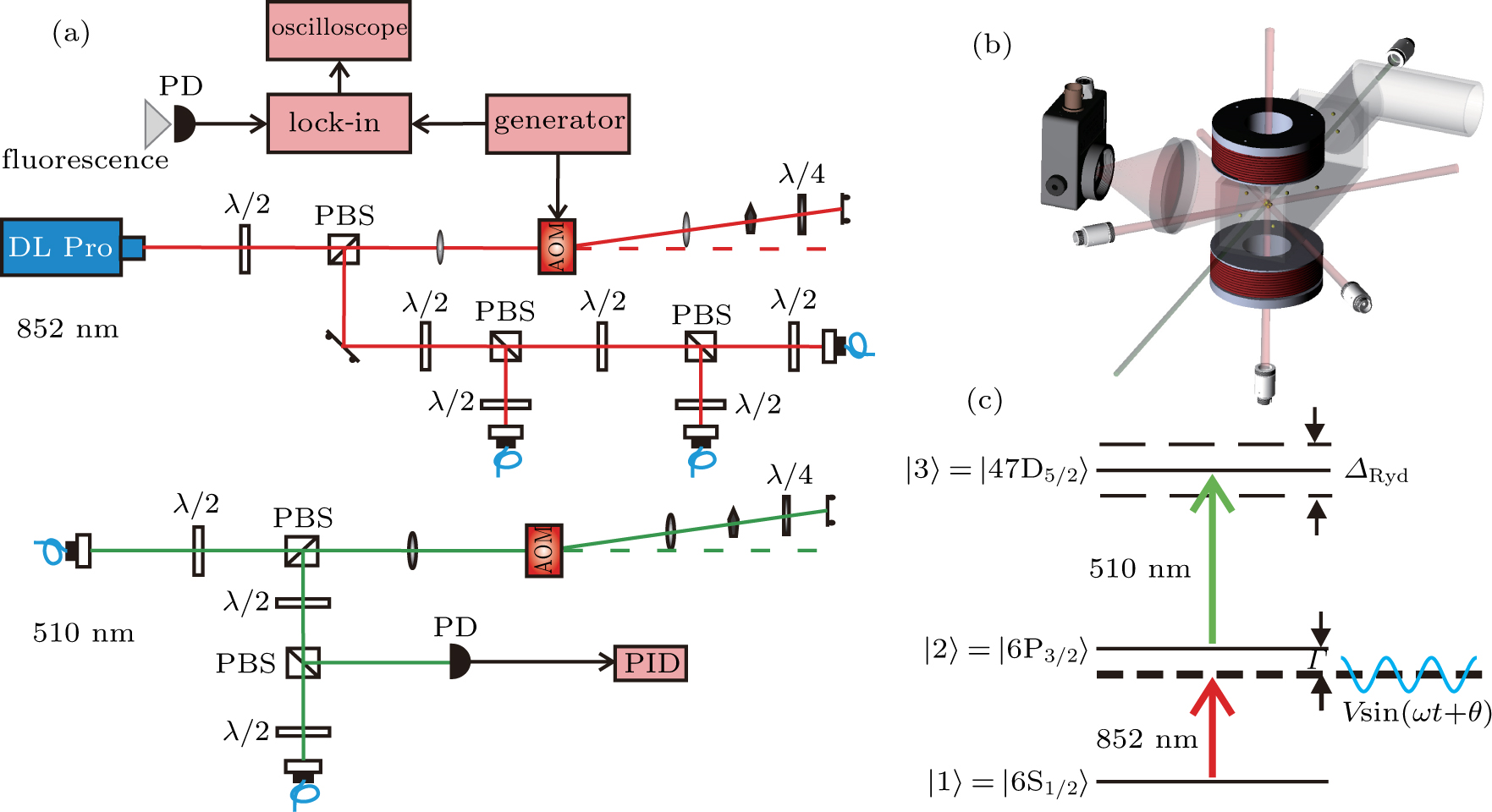
Experiment setup and levels diagram. (a) Lasers setup, where the 852 nm laser (upper left) is coupled into three PM fibers respectively as the cooling beams. The 510 nm coupling beam (left lower) is split into two parts, one of which is used for power stabilization via PID, and the other one is coupled into a PM fiber for Rydberg excitation. (b) Zoom in of the trapping area, including cooling and excitation lasers, MOT coils, and photodiode for fluorescence collection. (c) Cascade three levels of Rydberg excitation. Cesium atoms are excited from 6S1/2 ground state to 6P3/2 excited state with 852 nm cooling lasers and then from the excited state to 47D5/2 Rydberg state by 510 nm coupling laser. The detuning of the first excitation laser is periodically varied due to the modulation of the 852 nm cooling lasers.