

Direct spin–phonon coupling of spin-flip relaxation in quantum dots
Cite this Article
Yin Ji-Wen, Li Wei-Ping, Li Hong-Juan, Yu Yi-Fu. Direct spin–phonon coupling of spin-flip relaxation in quantum dots. Chinese Physics B, 2017, 26(1): 017201 
Permissions
Direct spin–phonon coupling of spin-flip relaxation in quantum dots
† Corresponding author. E-mail:
Abstract
Within the frame of the Pavlov–Firsov spin–phonon coupling model, we study the spin-flip assisted by the acoustical phonon scattering between the first-excited state and the ground state in quantum dots. We analyze the behaviors of the spin relaxation rates as a function of an external magnetic field and lateral radius of quantum dot. The different trends of the relaxation rates depending on the magnetic field and lateral radius are obtained, which may serve as a channel to distinguish the relaxation processes and thus control the spin state effectively.
1. Introduction
The electron spin relaxation in quantum dots (QDs) is of central importance for the applications on the spin polarization and quantum computation devices.[1,2] In the semiconductor QD, extensive theoretical works have researched the main phonon mediated spin-flip relaxation mechanism, such as the admixture processes due to spin–orbit coupling,[2–5] phonon coupling due to interface motion (ripple mechanism),[6] the direct spin–phonon coupling mechanism,[10] the fluctuating magnetic field due to the fluctuating electron density or the modulation of the hyperfine coupling with nuclei by lattice vibration,[2] and so on. Among them, what remains in discussion is which mechanism is the dominant one and needs more endeavor in detail. The direct spin–phonon coupling mechanism is an intrinsic one that cannot be eliminated in principle, so it can provide the most fundamental upper bound on the lifetime of the electron spin state in QDs when the spin–orbit coupling does not produce a significant admixture between spin states. This situation can be reached in symmetrical samples in the absence of an electric field and in materials with negligible Dresselhaus contribution. In particular, recent experiments[7–9,11,12] suggest that the spin–phonon coupling dominates the spin relaxation in GaAs QDs in the strong magnetic field and some nonpolar or monolayer materials, such as silicene and graphene.[13,14]
In the present paper, we study the spin relaxation between the first-excited and ground states based on the spin–phonon interaction model proposed by Pavlov and Firsov,[15,16] which describes the transitions with spin reversal of the conduction band electrons due to the scattering by the longitudinal lattice vibrations, and has the advantage of being adaptable to the study of the other scattering mechanism by various phonon modes. Romano et al.[17] have used this Hamiltonian to investigate the spin-flip process of a single electron between the Zeeman sublevels in the same orbital state by considering the deformation potential mechanism as the dominant electron–phonon coupling. They give the regions in which the spin relaxation rates can be practically suppressed by choosing the suitable magnetic field and lateral QD size. We investigate the spin relaxation rates for the 

2. Theoretical model
in which

with

stands for the electron momentum operator,

is the electron effective mass, and

is the Zeeman energy with σ representing the Pauli matrices.
one can determine the eigenenergy and the eigenfunction of the Hamiltonian H
0 as follows:
where

and

are quantum numbers,

and

,

is scaled radius with

,

is the Zeeman splitting energy,

refers to the spin polarization along the vertical direction, and

is the generalized Laguerre polynomial.
where

is the annihilation (creation) operator of the acoustic phonon with wave vector


, where

and

are unitary vectors along the x and y axes;

is the unit vector in the direction of the phonon polarization; ρ is the mass density; and V is the system volume. We assume the linear dispersion

, ν being the average sound velocity. The form factor[19,20]

equals unity for

. The electron phonon scattering due to the deformation potential coupling described by the parameter

is defined as
where

denotes the deformation potential constant,

is the semiconductor band gap,

is the spin–orbit splitting, and

.[17,18]
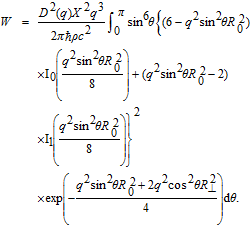
We mainly consider the spin-flip processes between the first-excited and ground states. After complexly calculations, the expression of the spin relaxation rate can be written as
The parameter

and

for the

and

processes, respectively. Here,

(

) is the zero (first) order Bessel function,

is the lateral radius,

denotes the height of QD in the vertical direction. We assume that the radius is much longer than the height, that is

. The dynamics along the vertical direction is restricted to the lowest subband, corresponding to the ground-state wave function

.[18–20] Throughout the paper, the ratio

is fixed.
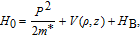
We consider a single electron quantum dot with different parabolic confinement potentials in lateral and vertical directions 


 | (1) |
By solving
 | (2) |
 | (3) |
 | (4) |
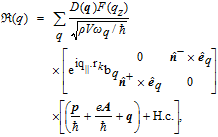
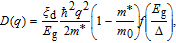
The spin–orbit interaction mediates a coupling between the spin and the electron orbital bath. Based on the effective mass theory, the spin–phonon interaction Hamitonian in the presence of an external magnetic field, which describes the transitions with spin reversal of the conduction band electrons due to scattering with lattice vibrations, can be expressed as[17,18]
 | (5) |
 | (6) |
Based on the Fermi golden rule, the spin-flip relaxation rate assisted by one phonon scattering between an initial electron state 

 | (7) |
 | (8) |
3. Numerical results
We only consider the contribution of the electron-longitudinal acoustic (LA) phonon coupling via the deformation potential mechanism to the relaxation rates, which plays the predominant role when the energy separation between the orbital states is in a several meV regime. The calculation of the relaxation rates is performed at temperature 


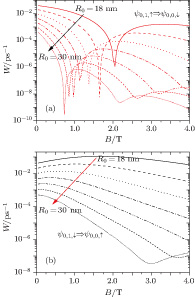
Figure 

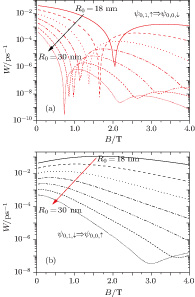 | Fig. 1. (color online) The spin relaxation rate as a function of the magnetic field for different radii of QD, (a) for the process 

|
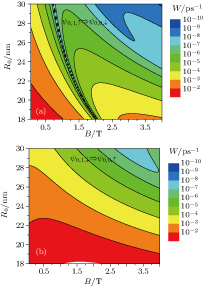
The spin-flip relaxation rates as functions of the magnetic field and radius are contour plotted in Figs. 

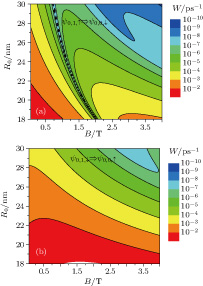 | Fig. 2. (color online) Contour plot of the spin relaxation rates as a function of magnetic field and radius for processes (a) 

|
4. Summary
In conclusion, we study the spin relaxation rates for the transitions between Zeeman sublevels of the first-excited and ground state in quantum dots based on the Pavlov–Firsov spin–phonon coupling mechanism. We find that the magnetic field and radius dependence of the relaxation rates for the two cases are very different, which may serve as an effective channel to distinguish the relaxation processes in experiment, and thus control the spin coherent state for the application of spin qubit.
Reference
| 1 | |
| 2 | |
| 3 | |
| 4 | |
| 5 | |
| 6 | |
| 7 | |
| 8 | |
| 9 | |
| 10 | |
| 11 | |
| 12 | |
| 13 | |
| 14 | |
| 15 | |
| 16 | |
| 17 | |
| 18 | |
| 19 | |
| 20 | |
| 21 | |
| 22 |