Home
|
About CPB
|
Announcement
|
CPS journals
Article lookup
导航切换
Chinese Physics B
Highlights
Special topics
In press
Authors
Submit an article
Manuscript tracking
Call for papers
Scope
Instruction for authors
Copyright agreement
Templates
PACS
Flow chart
Author FAQs
Referees
Review policy
Referee login
Referee FAQs
Editor in chief login
Editor login
Office login
Content of TOPICAL REVIEW — Exciton physics: Fundamentals, materials and devices in our journal
Published in last 1 year
|
In last 2 years
|
In last 3 years
|
All
Please wait a minute...
For selected:
Download citations
EndNote
Ris
BibTeX
Toggle thumbnails
Select
First-principles design of excitonic insulators: A review
Hongwei Qu(曲宏伟), Haitao Liu(刘海涛), and Yuanchang Li(李元昌)
Chin. Phys. B, 2025, 34 (
9
): 097101. DOI:
10.1088/1674-1056/ade073
Abstract
(
116
)
HTML
(
2
)
PDF
(1397KB)(
111
)
Knowledge map
The excitonic insulator (EI) is a more than 60-year-old theoretical proposal that is still elusive. It is a purely quantum phenomenon involving the spontaneous generation of excitons in quantum mechanics and the spontaneous condensation of excitons in quantum statistics. At this point, the excitons represent the ground state rather than the conventional excited state. Thus, the scarcity of candidate materials is a key factor contributing to the lack of recognized EI to date. In this review, we begin with the birth of EI, presenting the current state of the field and the main challenges it faces. We then focus on recent advances in the discovery and design of EIs based on the first-principles Bethe-Salpeter scheme, in particular the dark-exciton rule guided screening of materials. It not only opens up new avenues for realizing excitonic instability in direct-gap and wide-gap semiconductors, but also leads to the discovery of novel quantum states of matter such as half-EIs and spin-triplet EIs. Finally, we will look ahead to possible research pathways leading to the first recognized EI, both theoretically and computationally.
Select
Unique high-energy excitons in two-dimensional transition metal dichalcogenides
Yongsheng Gao(高永盛), Yuanzheng Li(李远征), Weizhen Liu(刘为振), Chuxin Yan(闫楚欣), Qingbin Wang(王庆彬), Wei Xin(辛巍), Haiyang Xu(徐海阳), and Yichun Liu(刘益春)
Chin. Phys. B, 2025, 34 (
9
): 097102. DOI:
10.1088/1674-1056/ade074
Abstract
(
98
)
HTML
(
0
)
PDF
(5665KB)(
49
)
Knowledge map
Two-dimensional (2D) transition metal dichalcogenides (TMDs), endowed with exceptional light-matter interaction strength, have become a pivotal platform in advanced optoelectronics, enabling atomically precise control of excitonic phenomena and offering transformative potential for engineering next-generation optoelectronic devices. In contrast to the narrowband absorption characteristics of conventional band-edge excitons, which are limited by the bandgap energy, high-energy excitons not only demonstrate broad momentum matching capability in the ultraviolet regime due to band nesting effects, but also exhibit distinct absorption peak signatures owing to robust excitonic stabilization under 2D confinement. These unique photophysical properties have established such systems as a prominent research frontier in contemporary exciton physics. This review primarily outlines the distinctive physical characteristics of high-energy excitons in TMDs from the perspectives of band structure, excitonic characteristics, and optical properties. Subsequently, we systematically delineate cutting-edge developments in TMD-based photonic devices exploiting high-energy excitonic band-nesting phenomena, with dedicated emphasis on the strategic engineering of nanoscale heterostructures for tailored optoelectronic functionality. Finally, the discussion concludes with an examination of the challenges associated with the design of high-energy exciton devices and their potential future applications.
Select
Exciton insulators in two-dimensional systems
Huaiyuan Yang(杨怀远), Xi Dai(戴希), and Xin-Zheng Li(李新征)
Chin. Phys. B, 2025, 34 (
9
): 097301. DOI:
10.1088/1674-1056/ade3ae
Abstract
(
106
)
HTML
(
0
)
PDF
(1788KB)(
59
)
Knowledge map
Electron-hole interactions play a crucial role in determining the optoelectronic properties of materials, and in low-dimensional systems this is especially true due to the decrease of screening. In this review, we focus on one unique quantum phase induced by the electron-hole interaction in two-dimensional systems, known as "exciton insulators" (EIs). Although this phase of matter has been studied for more than half a century, suitable platforms for its stable realization remain scarce. We provide an overview of the strategies to realize EIs in accessible materials and structures, along with a discussion on some unique properties of EIs stemming from the band structures of these materials. Additionally, signatures in experiments to distinguish EIs are discussed.
Select
Regulation strategies of hot carrier cooling process in perovskite nanocrystals
Zhenyao Tan(谭振耀), Kexin Xu(徐可欣), Yi Chen(陈逸), Can Ren(任璨), and Tingchao He(贺廷超)
Chin. Phys. B, 2025, 34 (
9
): 097302. DOI:
10.1088/1674-1056/ade24d
Abstract
(
82
)
HTML
(
0
)
PDF
(2530KB)(
76
)
Knowledge map
Recent breakthroughs in hot carrier (HC) cooling dynamics within halide perovskite nanocrystals (NCs) have positioned them as promising candidates for next-generation optoelectronic applications. Therefore, it is of great importance to systematically summarize advances in understanding and controlling HC relaxation mechanisms. Here, we offer an overview of advances in the understanding of the HC cooling process in perovskite NCs, with a focus on influences of excitation energy, excitation intensity, composition, size, dimensionality, doping, and core-shell structure on the HC cooling times. Finally, we propose suggestions for future investigations into the HC cooling process in perovskite NCs.
ISSN 1674-1056 CN 11-5639/O4
Table of contents
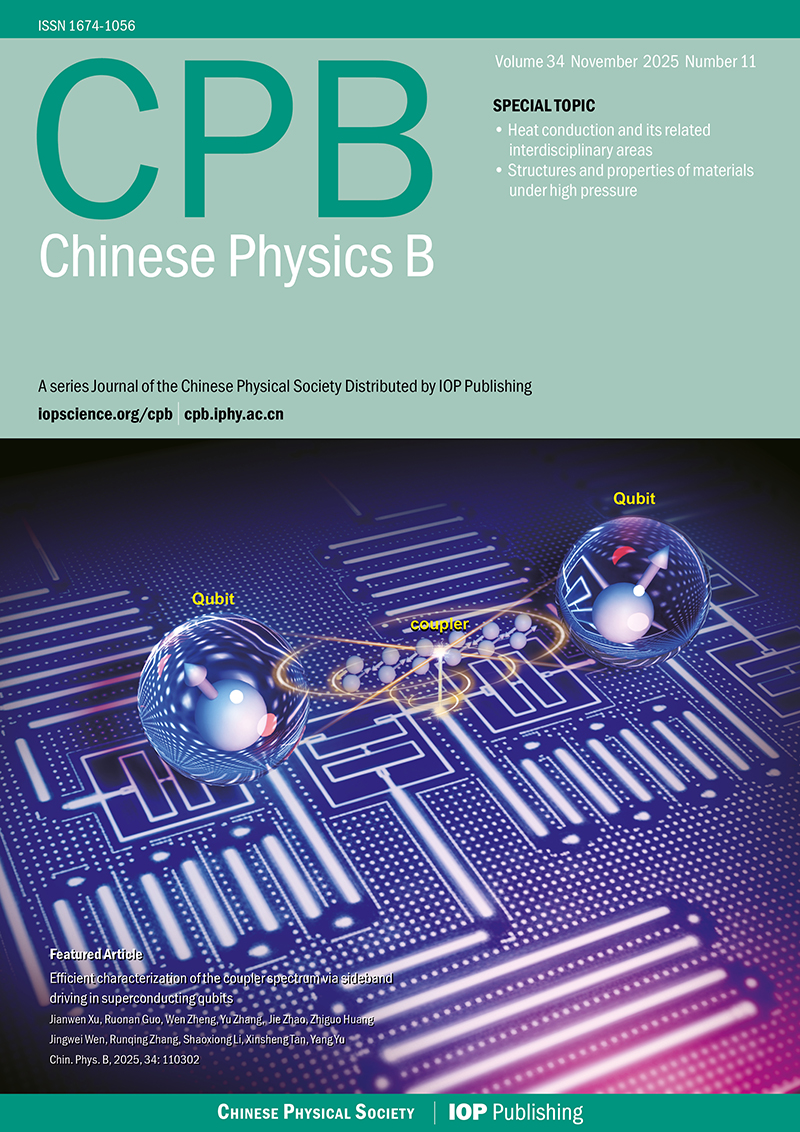
Cover illustration
×
Cover illustration
Download cover
Download table of contents
Current issue
, Vol. 34, No. 11
Previous issues
1992 - present
Featured Columns
Highlights
Awards
SCI top cited
Top downloaded
E-mail alert
RSS