Home
|
About CPB
|
Announcement
|
CPS journals
Article lookup
导航切换
Chinese Physics B
Highlights
Special topics
In press
Authors
Submit an article
Manuscript tracking
Call for papers
Scope
Instruction for authors
Copyright agreement
Templates
PACS
Flow chart
Author FAQs
Referees
Review policy
Referee login
Referee FAQs
Editor in chief login
Editor login
Office login
Content of SPECIAL TOPIC — Heat conduction and its related interdisciplinary areas in our journal
Published in last 1 year
|
In last 2 years
|
In last 3 years
|
All
Please wait a minute...
For selected:
Download citations
EndNote
Ris
BibTeX
Toggle thumbnails
Select
Strain modulated phonon transport in one-dimensional nonlinear lattice with on-site potential
Hongbin Chen(陈宏斌), Nianbei Li(李念北), and Jie Chen(陈杰)
Chin. Phys. B, 2025, 34 (
11
): 114401. DOI:
10.1088/1674-1056/adf1ea
Abstract
(
22
)
PDF
(598KB)(
7
)
Knowledge map
The one-dimensional (1D) nonlinear lattices with on-site potentials exhibit normal heat conduction and energy diffusion behaviors. The strain-modulated energy diffusion constants are studied for the 1D Frenkel-Kontorova (FK) lattices, which are typical lattices with on-site potentials. The 1D FK lattices show strain-modulated symmetric behaviors of local extrema in energy diffusion constants, similar to those previously observed in 1D Fermi-Pasta-Ulam (FPU) lattices that contain only interparticle potentials. However, the 1D FK lattices exhibit local minima in energy diffusion constants, which is in contrast to the behavior of the 1D FPU lattices. Although strain always enhances the phonon group velocity and suppresses the phonon relaxation time for both the 1D FK and FPU lattices, the suppression of the phonon relaxation time is much weaker for the 1D FK lattices compared to the 1D FPU lattices.
Select
Thermal diode with switchable cloaking effect enabled by asymmetric temperature-dependent thermal conductivity
Mengzhen Xue(薛梦贞), Jun Wang(王军), and Guodong Xia(夏国栋)
Chin. Phys. B, 2025, 34 (
11
): 114403. DOI:
10.1088/1674-1056/ae118b
Abstract
(
23
)
PDF
(1188KB)(
5
)
Knowledge map
Thermal rectification refers to the asymmetry in heat transfer capability when subjected to forward and reverse temperature gradients. A thermal cloak can render objects invisible in thermal fields by redirecting heat flux pathways. In this paper, we present a thermal diode model based on a bi-layer thermal cloak system that incorporates a composite heat-flux-attracting layer with asymmetric, temperature-dependent thermal conductivity. In the forward case, the heat flux bypasses the cloaking region while maintaining undistorted background isotherm contours, whereas in the reverse case, the thermal cloak fails to function and the device effectively insulates heat. Consequently, thermal rectification occurs in the bi-layer thermal cloak system. A significant increase in the thermal rectification ratio is observed as the temperature gradient increases. By optimizing the system dimensions, a peak rectification ratio of 11.06 is achieved. This study provides physical insight and a design framework for developing novel thermal diodes with dual-functional thermal management capabilities.
Select
A molecular dynamics study of bubble nucleation on grooved surfaces: Effects of wettability and heat flux
Mian Yu(余绵), Bingheng Li(李丙衡), Lianfeng Wu(吴连锋), Lianxiang Ma(马连湘), Xiangwen Meng(孟祥文), and Yuanzheng Tang(唐元政)
Chin. Phys. B, 2025, 34 (
11
): 114703. DOI:
10.1088/1674-1056/ae0896
Abstract
(
38
)
PDF
(2302KB)(
1
)
Knowledge map
Bubble nucleation plays a crucial role in boiling heat transfer and other applications. Traditional experiments struggle to capture its microscopic mechanisms, making molecular dynamics simulations a powerful tool for such studies. This work uses molecular dynamics simulations to investigate bubble nucleation of water on copper surfaces with sinusoidal groove roughness under varying heat flux and surface wettability. Results show that at the same wettability, higher heat flux leads to higher surface temperatures after the same heating time, promoting bubble nucleation, growth, and departure. Moreover, under constant heat flux, stronger surface hydrophilicity enhances heat transfer from the solid to the liquid, further accelerating the nucleation. This study provides valuable insights into the mechanism of bubble nucleation and offers theoretical guidance for enhancing heat transfer.
Select
Molecular dynamics study incorporating regression analysis: Quantitative effects of sinusoidal protrusions and wettability on water phase transition containing insoluble gases
Bingheng Li(李丙衡), Yujian Gao(高雨键), Mian Yu(余绵), Lianfeng Wu(吴连锋), Lianxiang Ma(马连湘), and Yuanzheng Tang(唐元政)
Chin. Phys. B, 2025, 34 (
11
): 114704. DOI:
10.1088/1674-1056/ae0894
Abstract
(
19
)
PDF
(2249KB)(
2
)
Knowledge map
Molecular dynamics simulations were employed to establish a more realistic model of nanoscale boiling phase transitions. We examined the effects of different configurations of nanoscale sinusoidal protrusions and surface wettability on the phase transition behavior of systems containing insoluble gases under continuous heat flux input. To enhance the clarity and comparability of the results, a quantitative evaluation method was introduced. The findings reveal that, under identical wettability conditions, increasing the number of sinusoidal protrusions accelerates the onset of phase transition. In contrast, for a fixed number of protrusions, higher surface wettability delays the initiation of the phase change. By incorporating regression analysis to quantify the phase transition process and compare influencing factors, it was observed that although high wettability generally inhibits phase transition, the synergistic interaction between surface structure and wettability ultimately facilitates the phase transition process.
Select
Efficient thermal rectification in nitrogen-doped carbon nanotube heterostructures
Zhibo Xing(邢志博), Yingguang Liu(刘英光), Haochen Liu(刘浩宸), Yahao Wang(王雅浩), Cheng Zhang(张成), and Ning Wu(吴宁)
Chin. Phys. B, 2025, 34 (
11
): 116101. DOI:
10.1088/1674-1056/adfdc4
Abstract
(
14
)
PDF
(3070KB)(
4
)
Knowledge map
Carbon nanotubes (CNTs) are widely used in various fields owing to their unique properties. In this study, three different types of nitrogen-doped CNT heterojunctions were constructed: parallel-doped (PCNT), vertically doped (VCNT), and mesh-doped (MCNT). Non-equilibrium molecular dynamics (NEMD) simulations were conducted to investigate their heat flux and thermal rectification (TR) effects. The results show that heat flux preferentially flows from nitrogen-doped regions to undoped regions, exhibiting distinct thermal rectification behavior, with PCNT showing the most pronounced effect. Interestingly, the TR ratio of the zigzag PCNT is significantly higher than that of the armchair PCNT. Subsequently, we examined the effects of system length and diameter on the TR ratio of the PCNT and found that the TR ratio increases and then decreases with increasing model length. In addition, the effect of defect density on the heat flux of the PCNT is peculiar. The phonon density of states, phonon dispersion, participation ratio, and phonon spectral heat flux were analyzed to elucidate the thermal transport behavior of phonons in the nanotubes. This study provides insights into the development and design of nitrogen-doped CNT thermal rectifiers.
Select
Finite-size effects on phonon-mediated thermal transport across Si-Ge interfaces: Spectral analysis and parameter optimization for molecular dynamics simulations
Zhicong Wei(魏志聪), Haoqiang Li(李浩强), Jianlian Huang(黄建廉), Weikuang Li(李唯宽), Yijuan Li(李艺娟), Yajuan Cheng(程亚娟), and Shiyun Xiong(熊世云)
Chin. Phys. B, 2025, 34 (
11
): 116301. DOI:
10.1088/1674-1056/ae0432
Abstract
(
21
)
PDF
(2194KB)(
10
)
Knowledge map
The interfacial thermal resistance (ITR) at material interfaces has emerged as a critical factor in the thermal management of micro/nanoelectronic devices and composite materials. Using non-equilibrium molecular dynamics simulations, we systematically investigate how simulation parameters affect the calculated ITR in Si/Ge heterojunctions. Our results demonstrate that the ITR decreases with increasing system length $L_{\rm sys}$ and thermal bath length $L_{\rm bath}$. We identify linear relationships between ITR and the inverse of both $L_{\rm sys}$ and $L_{\rm bath}$, enabling reliable extrapolation to infinite-system values. While the thermostat coupling constant $\tau$ shows a negligible influence on ITR, excessively large values ($\tau > 5$ ps) compromise temperature control accuracy. Spectral analysis reveals that these size effects primarily originate from mid-to-low-frequency phonons (< 6 THz), whose long mean free paths make their transport particularly sensitive to system dimensions. This work establishes fundamental guidelines for parameter selection in interfacial thermal transport simulations, while providing new insights into phonon-interface interactions. The findings offer valuable implications for thermal design in high-power devices and composite materials, where accurate ITR prediction is crucial for performance optimization.
Select
Local time reversal symmetry breaking induced attenuation and localization of phonon transmission
Yu-Jia Zeng(曾育佳), Qi-Zhuang Qu(曲其壮), Zhong-Ke Ding(丁中科), and Wu-Xing Zhou(周五星)
Chin. Phys. B, 2025, 34 (
11
): 116302. DOI:
10.1088/1674-1056/adf61b
Abstract
(
26
)
PDF
(7774KB)(
2
)
Knowledge map
Time-reversal symmetry (TRS) breaking induced dissipationless topological phonon edge modes provide an unprecedented way to manipulate phonon transport. However, the effect of TRS breaking on the transport properties of bulk phonon modes is still unclear. In this work, we assess the effect of local TRS-breaking domains on the transport properties of bulk phonon modes in a two-dimensional (2D) hexagonal phononic lattice model. The results show that bulk phonon modes can be strongly scattered by local TRS breaking owing to the shift of the local phonon band gap, which results in significant suppression of phonon transmission. Moreover, we show that the aperiodic distribution of local TRS-breaking domains can induce phonon Anderson localization, and the localization length can be effectively tuned by the strength of TRS breaking. Our study suggests that TRS breaking can not only be used to construct dissipationless topological phonon edge states, but also be used to block the transmission of bulk phonon modes by carefully controlling the size and distribution of TRS-breaking domains. Such results provide a highly alternative way for manipulating energy flux at the nanoscale.
Select
Normal energy and stretch diffusion in a one-dimensional momentum conserving lattice with nonlinear bounded kinetic energy
Hongbin Chen(陈宏斌), Qin-Yi Zhang(张钦奕), Jiahui Wang(王佳惠), Nianbei Li(李念北), and Jie Chen(陈杰)
Chin. Phys. B, 2025, 34 (
9
): 094401. DOI:
10.1088/1674-1056/addce5
Abstract
(
70
)
HTML
(
0
)
PDF
(647KB)(
61
)
Knowledge map
One-dimensional (1D) nonlinear lattices that conserve momentum exhibit anomalous heat conduction, except for the specific case of the 1D coupled rotator lattice. Unlike classical interacting 1D nonlinear lattices such as the Fermi-Pasta-Ulam $\beta$ (FPU-$\beta$) lattice, the 1D coupled rotator lattice has a bounded interaction potential energy. Recently, the 1D coupled rotator lattice with additional bounded kinetic energy has also been found to exhibit normal heat conduction. Here, we study energy diffusion in the 1D momentum-conserving lattice with bounded kinetic energy only. We find that this lattice exhibits normal energy diffusion as well as normal stretch diffusion. This work indicates that bounded energy, whether kinetic or potential, is crucial for normal energy diffusion and heat conduction in 1D momentum-conserving nonlinear lattices.
Select
Giant thermal rectification beyond structural asymmetry via current-induced nonreciprocity effects
Jiayao Zhang(张佳瑶), Yu Hao(郝雨), Bowen Xiong(熊博文), Shanhe Su(苏山河), and Zhimin Yang(杨智敏)
Chin. Phys. B, 2025, 34 (
9
): 094402. DOI:
10.1088/1674-1056/add906
Abstract
(
58
)
HTML
(
0
)
PDF
(625KB)(
21
)
Knowledge map
Pursuing significant thermal rectification effect with minimal temperature differences is critical for thermal rectifiers. While asymmetric structures enable spectral matching, they inherently limit thermal rectification performance. To address this issue, we developed a thermal rectification structure comprising a current-biased graphene-coated silicon carbide (SiC) substrate paired with another graphene-coated SiC substrate separated by a nanoscale vacuum gap. A current-biased graphene sheet generates nonreciprocal effect that actively modulates radiative energy transfer. Our theoretical framework demonstrates that the current-biased graphene achieves a high thermal diode efficiency even under a modest temperature difference. Remarkably, the thermal diode efficiency exceeds 0.8 at a temperature difference of just 100 K (between 300 K and 400 K). These findings highlight the synergistic enhancement from graphene coatings and current biasing, providing a viable strategy for nanoscale thermal management applications.
Select
Dual-band switchable mid-infrared emitter based on In
3
SbTe
2
for gas detection application
Biyuan Wu(吴必园), Xiqiao Huang(黄希桥), and Xiaohu Wu(吴小虎)
Chin. Phys. B, 2025, 34 (
9
): 094403. DOI:
10.1088/1674-1056/ade59e
Abstract
(
73
)
HTML
(
0
)
PDF
(660KB)(
42
)
Knowledge map
As a highly energy-efficient and sensitive radiation source, narrowband thermal emitters provide an ideal solution for non-contact gas detection, enabling the widespread application of mid-infrared "molecular fingerprint" technology. However, most narrowband thermal emitters lack reconfigurability, limiting their adaptability in practical applications. In this study, we propose a novel dual-band switchable narrowband thermal emitter in the mid-infrared region. The emitter consists of an aperiodic Ge/SiO$_{2}$/Ge/SiO$_{2}$ (GSGS) structure and a phase change material In$_{3}$SbTe$_{2}$ (IST). When IST is in the crystalline state, the emitter achieves narrowband emission peaks at wavelengths of 3.79 μm and 6.12 μm, corresponding to the "on" state. However, when IST transitions to the amorphous state, the dual-band high emission disappears and it features angle- and polarization-independent behavior, representing the "off" state. Furthermore, we verify the physical mechanism behind the high emission through phase and amplitude calculations as well as electric field distribution analysis. Notably, the introduction of the IST provides an additional degree of freedom for tunability. Furthermore, by adjusting the thickness of the spacer layer, the emitter can be precisely tuned to match the characteristic absorption peaks of various mid-infrared gases, such as CH$_{4}$, CO$_{2}$, CO, and NO, enabling multi-gas detection in mixed gas environments. The proposed thermal emitter serves as an effective and low-cost alternative for dual-band narrowband mid-infrared light sources, contributing to the advancement of multi-gas detection strategies.
Select
Cattaneo-Christov heat transfer model for tangent hyperbolic fluid with Thompson-Torian slip and melting effects
Anwar Saeed and Afrah Al-Bossly
Chin. Phys. B, 2025, 34 (
9
): 094404. DOI:
10.1088/1674-1056/add90a
Abstract
(
64
)
HTML
(
0
)
PDF
(934KB)(
29
)
Knowledge map
This work investigates thermal enhancement in fluid flow over a nonlinear stretching sheet. The thickness of the sheet is variable and the flow of the fluid is affected by solar radiation energy with Thompson and Troian slip effects. The flow is magnetized by applying a magnetic field in the normal direction to the flow system. Moreover, thermal transport is controlled by incorporating the Cattaneo-Christov heat fluid model into the flow problem. The governing equations, initially framed in their dimensional form, are meticulously transformed into a dimensionless framework to simplify the analysis. These dimensionless equations are then solved using the homotopy analysis method (HAM). It is observed in this study that upsurges in the stagnation parameter, critical shear rate and velocity slip factor augment the velocity distribution while reducing the thermal profiles. The velocity distribution deteriorates while the thermal profiles are amplified with expansions in the magnetic factor and power law index. The thermal distribution also increases with rising Prandtl number and radiation factor. Augmentation of the power-law index, velocity slip parameter, critical shear rate, magnetic factor and stagnation parameter leads to an increased Nusselt number. The modeled problem is validated by comparing the current results with established work for different values of nonlinear stretching factor $n$ in terms of the drag force and thermal flow rate at $\eta =0$, and a good agreement is observed between the current and established results.
Select
Thermal transport properties of 2D narrow bandgap semiconductor Ca
3
N
2
, Ba
3
P
2
, and Ba
3
As
2
: Machine learning potential study
Wenlong Li(李文龙), Yu Liu(刘余), Zhendong Li(李振东), Pei Zhang(张培), Xinghua Li(李兴华), and Tao Ouyang(欧阳滔)
Chin. Phys. B, 2025, 34 (
9
): 096302. DOI:
10.1088/1674-1056/ade5a0
Abstract
(
72
)
HTML
(
0
)
PDF
(3286KB)(
44
)
Knowledge map
By combining neuroevolution potential (NEP) with phonon Boltzmann transport theory, we systematically investigate the thermal transport properties of three two-dimensional (2D) narrow bandgap semiconductors: Ca$_3$N$_2$, Ba$_3$P$_2$, and Ba$_3$As$_2$. The room-temperature lattice thermal conductivities ($\kappa_{\rm L}$) of Ca$_3$N$_2$, Ba$_3$P$_2$, and Ba$_3$As$_2$ considering only three-phonon scattering are 6.60 W/mK, 11.90 W/mK, and 8.88 W/mK, respectively. When taking into account the higher-order phonon (four-phonon) scattering processes, the $\kappa_{\rm L}$ of these three materials decrease to 6.12 W/mK, 9.73 W/mK and 6.77 W/mK, respectively. Among these systems, Ba$_3$As$_2$ undergoes the most pronounced suppression with a reduction of 23.8%. This is mainly due to the greater scattering phase space which enhances the four-phonon scattering. Meanwhile, it is revealed that unlike the traditional evaluation using the $P_{4}/P_{3}$ ratio as an indicator of the strength of four-phonon interactions, the thermal conductivity of Ba$_3$P$_2$ exhibits weaker four-phonon suppression behavior compared to Ba$_3$As$_2$, despite hosting a higher $P_{4}/P_{3}$ ratio. That is to say, the strength of four-phonon scattering cannot be evaluated solely by the ratio of $P_{4}/P_{3}$. These results presented in this work shed light on the thermal transport properties of such new 2D semiconductors with narrow bandgaps.
Select
Tunable thermal conductivity and mechanical properties of metastable silicon by phase engineering
Guoshuai Du(杜国帅), Yubing Du(杜玉冰), Jiaxin Ming(明嘉欣), Zhixi Zhu(朱芷希), Jiaohui Yan(闫皎辉), Jiayin Li(李嘉荫), Tiansong Zhang(张天颂), Lina Yang(杨哩娜), Ke Jin(靳柯), and Yabin Chen(陈亚彬)
Chin. Phys. B, 2025, 34 (
9
): 096401. DOI:
10.1088/1674-1056/adcf8a
Abstract
(
76
)
HTML
(
0
)
PDF
(855KB)(
26
)
Knowledge map
The extensive applications of cubic silicon in flexible transistors and infrared detectors are greatly hindered by its intrinsic properties. Metastable silicon phases, such as Si-III, IV, and XII, prepared using extreme pressure methods, provide a unique "genetic bank" with diverse structures and exotic characteristics. However, exploration of their inherent physical properties remains underdeveloped. Herein, we demonstrate the phase engineering strategy to modulate the thermal conductivity and mechanical properties of metastable silicon. The thermal conductivity, obtained via the Raman optothermal approach, exhibits broad tunability across various Si-I, III, XII, and IV phases. The hardness and Young's modulus of Si-IV are significantly greater than those of the Si-III/XII mixture, as confirmed by the nanoindentation technique. Moreover, it was found that pressure-induced structural defects can substantially degrade the thermal and mechanical properties of silicon. This systematic investigation offers a feasible route for designing novel semiconductors and further advancing their desirable applications in advanced nanodevices and mechanical transducers.
Select
Charge doping induced thermal switches with a high switching ratio in monolayer MoS
2
Chen Gui(桂琛), Zhi-Fu Duan(段志福), Chang-Hao Ding(丁长浩), Hao Chen(陈浩), Yuan Yao(姚远), Nan-Nan Luo(罗南南), Jiang Zeng(曾犟), Li-Ming Tang(唐黎明), and Ke-Qiu Chen(陈克求)
Chin. Phys. B, 2025, 34 (
9
): 097401. DOI:
10.1088/1674-1056/add907
Abstract
(
50
)
HTML
(
0
)
PDF
(3522KB)(
30
)
Knowledge map
The thermal switch plays a crucial role in regulating system temperature, protecting devices from overheating, and improving energy efficiency. Achieving a high thermal switching ratio is essential for its practical application. In this study, by utilizing first-principles calculations and semi-classical Boltzmann transport theory, it is found that hole doping with an experimentally achievable concentration of $1.83 \times 10^{14}$ cm$^{-2}$ can reduce the lattice thermal conductivity of monolayer MoS$_2$ from 151.79 W$\cdot$m$^{-1}\cdot$K$^{-1}$ to 12.19 W$\cdot$m$^{-1}\cdot$K$^{-1}$, achieving a high thermal switching ratio of 12.5. The achieved switching ratio significantly surpasses previously reported values, including those achieved by extreme strain methods. This phenomenon mainly arises from the enhanced lattice anharmonicity, which is primarily contributed by the S atoms. These results indicate that hole doping is an effective method for tuning the lattice thermal conductivity of materials, and demonstrate that monolayer MoS$_2$ is a potential candidate material for thermal switches.
ISSN 1674-1056 CN 11-5639/O4
Table of contents
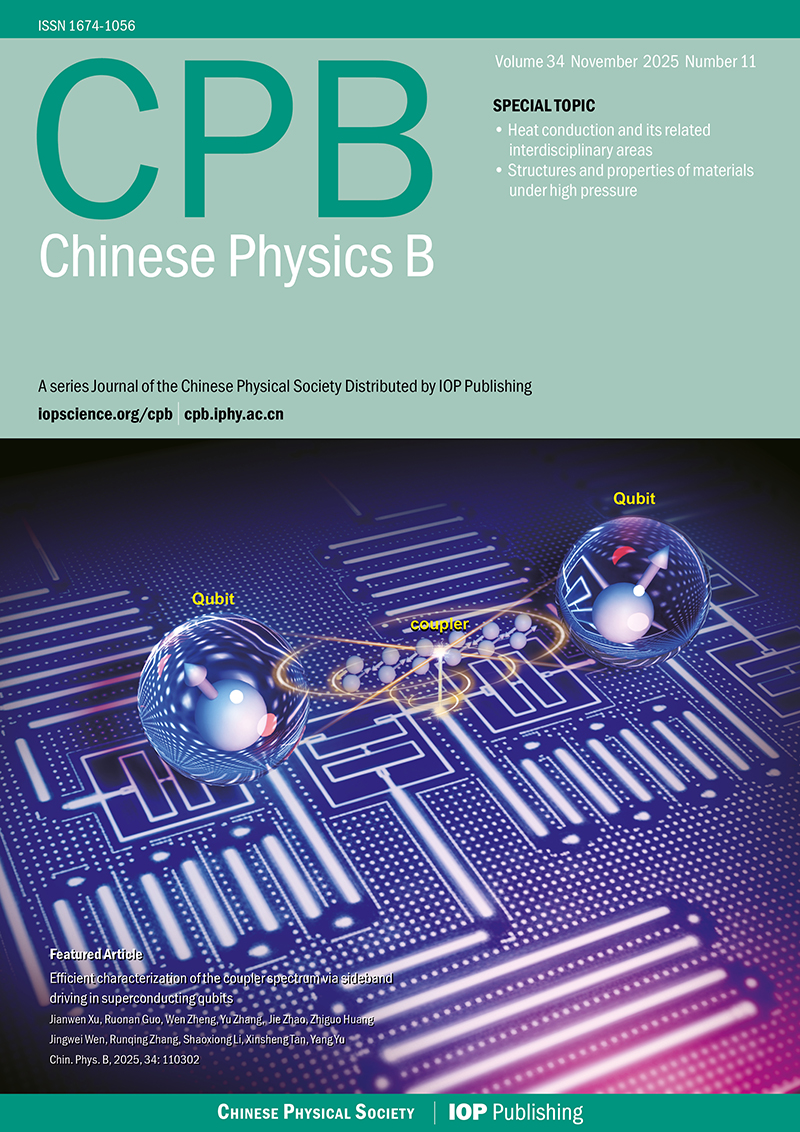
Cover illustration
×
Cover illustration
Download cover
Download table of contents
Current issue
, Vol. 34, No. 11
Previous issues
1992 - present
Featured Columns
Highlights
Awards
SCI top cited
Top downloaded
E-mail alert
RSS